
The risk of a church being audited by the Internal Revenue Service is minimal, but careful attention to IRS guidelines is always prudent.
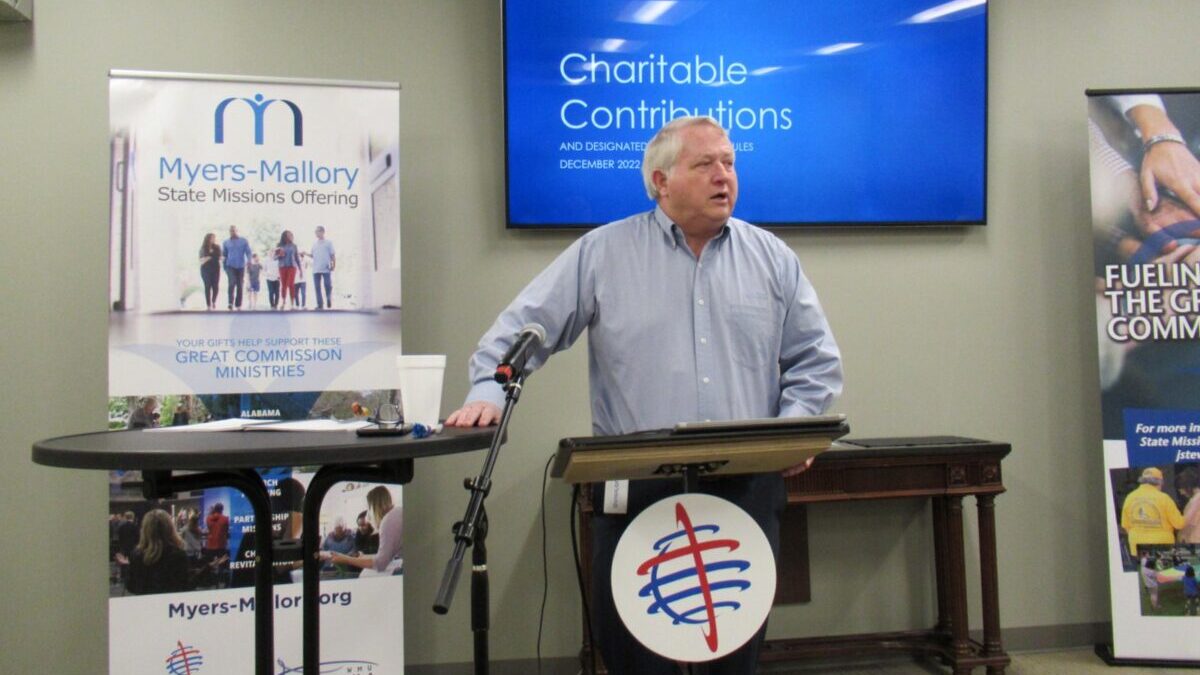
Of the 350,000 churches in the USA, only a few hundred will be audited in a given year, and the IRS will follow a definite procedure, said Lee Wright, coordinator of church compensation services for the Alabama Baptist State Board of Missions.
“The IRS won’t telephone to ask for money, nor will they threaten to send law enforcement,” Wright said. “This is a scam. The IRS will send a letter if one of their computers picks up a problem. The letter will contain the correction and perhaps a penalty. An actual audit won’t happen to the average congregation since they really chase the ‘big abusers.’”
However, Wright encouraged church leaders to follow IRS guidelines carefully.
Wright directs several church tax conferences each year and spoke at the SBOM facility in Prattville on Jan. 5.
Gifts
He said the IRS has six rules for charitable giving.
“Gifts to churches must be cash or property, not gifts of time or labor,” he said. “And these gifts must be given by Dec. 31 to be recorded as a contribution for the current year. Additionally, gifts must be given without tangible benefit to the donor, and a statement to this effect should be printed on the contribution records churches provide for their members.”
Wright said gifts must be used for qualified charities and must not be in excess of legal amounts. The limit on contributions for tax deductions is currently 60 percent of the donor’s adjusted gross income.
Gifts also must be substantiated. He suggested contribution records be kept for seven years and contribution envelopes be kept for at least three.
“A good way to support God’s work is through gifts of stock,” he said. “This means that the investor won’t pay tax on gain but can count the full sales price as a deduction.”
A special concern, according to Wright, is designated gifts.
“The key is church authorization and control,” he said. “The church oversees the designation, and it cannot be for the personal benefit of the donor or for a particular individual.”
Wright noted that the standard deduction under current tax law is $25,900 for 2022 and $27,700 for 2023.
“Accordingly, 95% of taxpayers don’t itemize anymore for their federal taxes,” he said. “The state of Alabama still allows itemization, but church contributions aren’t as important for federal income tax purposes for most of our members in recent years.”
Trump-era tax laws removed traditional business deductions for employees, so Wright said unless the church has a reimbursable expense plan, the minister cannot deduct typical expenses such as mileage, books and supplies and cellphones.
Confusion
Wright said there remains much confusion over a minister’s dual tax status — an employee for federal income tax purposes and self-employed for FICA (Social Security) taxes.
One benefit of the self-employed nature of ministry as an ordained minister is the housing allowance that is not taxable for federal purposes but is taxable for self-employment tax purposes, he said. The housing allowance should be requested by the minister and approved by the church.
“The average bivocational pastor in Alabama makes about $23,000 according to our study,” Wright said. “It’s conceivable that these pastors could request their entire church salary be designated as housing. The housing allowance should not exceed the fair rental value of the house, furnished, plus utilities. And with a church-sponsored retirement program, such as GuideStone, retired ministers can designate part or all of their retirement benefits as housing for further tax savings.”
Wright said most Americans fall short in retirement savings, and ministers are no exception.
“The average retirement savings in GuideStone is around $160,000,” he said. “This sounds like a large amount, but it would generate about $1,000 each month in retirement. That’s why we recommend the default position for the church to be both church contributions and employee tax-sheltered contributions for retirement. This will help employees for many years to come.”
Wright offers a number of materials concerning taxes and other financial issues at alsbom.org/ccs. He can be reached at 800-264-1225, extension 2241. His email is lwright@alsbom.org.
Click below to read how a North Carolina church was scammed out of hundreds of thousands of dollars.



Share with others: