
It’s highly unlikely that Tchaikovsky will ever make the top 10 music charts or that MTV will feature Mozart medleys, but there’s still a following for classical music.
That music also has an important niche in Baptist churches in Alabama, according to several music educators and church music directors. They say that classical works, prepared and performed well, provide an inspiring worship experience.
“I think of classical music as music that has stood the test of time, written by composers like Mozart, Hayden and Beethoven,” said Dale Peterson, music minister at First Baptist Church, Auburn. “But great words and great hymns are timeless and might be called classics, (such as) ‘A Mighty Fortress Is Our God’ and ‘O God, Our Help in Ages Past.’”
Michael Adler, music minister at Shades Mountain Baptist Church, Birmingham, identifies classical more with the seriousness of the music itself and the level of performance difficulty. “This year we performed a new oratorio, ‘Man of Sorrows,’ by Greg Nelson,” he said. “I consider that a contemporary classic.”
Classical music is also an important aspect of the music curriculum in Alabama’s Baptist schools, where many future music ministers and directors receive training.
“At the University of Mobile, we embrace all aspects of music,” said Roger Breland, director of the Center for Performing Arts. “Foundationally, we begin with the classics. We can’t provide a total educational experience without them.”
Milburn Price, dean of the division of music at Samford University, has been a church music director as well as college professor. He said classical training is essential. “It’s basic to a whole language of music that we call music theory — understanding scale patterns, chord structures and learning to think musically.”
Depending on the music director and church musicians, classical training is used in a variety of ways in churches.
“Churches have different concentrations of people with musical background and experience, particularly in the broad classical tradition,” Price said. “But I believe that one of the roles of the church musician is to be a music educator — to be able to help choir members sing a wide variety of repertoires or to develop the skills of instrumentalists.”
Classical music can be complex and require a high level of performance skill, Price said. “On the other hand, a piece doesn’t have to be complex and difficult in order to be artful and in the classical tradition,” he added, saying that choir directors can accommodate musical choices to the talents of available musicians.
But because classical works do often require long rehearsals, above-average technical skill or unusual instrumentation, they are frequently reserved for special occasions. First, Auburn, has a special program of “Choral Classics by Candlelight” every October, and Shades Mountain Baptist usually presents classical music at Christmas, Easter or other holidays.
Keith Hibbs, associate in the office of worship leadership/music ministry of the Alabama Baptist State Convention, acknowledges there is often a skill level to surmount in performing classical works. “I see another difficulty,” he said. “We often don’t put the same amount of energy and enthusiasm into classical music that we would in a more modern idiom. … We may approach the classics from a technical standpoint rather than a Spirit-led standpoint.”
However, one group enjoys the challenges of classical music. The Alabama Singing Men, composed largely of music ministers and directors, performs at various events and locations throughout the year. “Many selections are by Bach or other great composers,” said Gordon Welch, the group’s president and music minister at First Baptist Church, Selma. “We find this stretches and challenges all of us.”
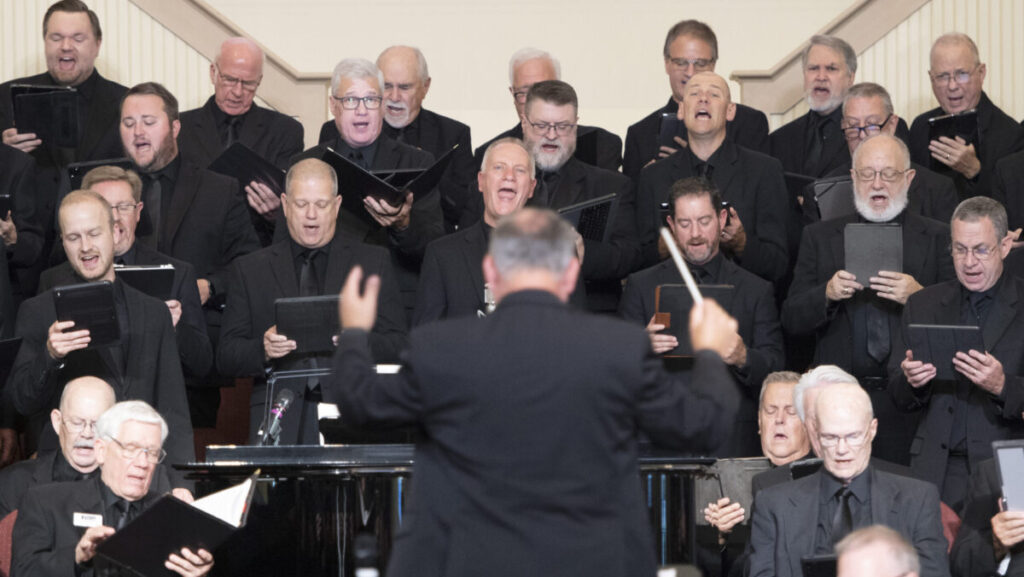
FBC Opelika hosting combined concert of Alabama Singing Men, Sons of Jubal on Aug. 8
For the first time ever, Alabama Singing Men will join Georgia’s Sons of Jubal for a concert at First Baptist Church Opelika on Aug. 8.

Crowder tops Billboard Hot Christian Songs Chart for the first time with ‘Good God Almighty’
“Good God Almighty,” the toe-tapping, can’t-help-but-sing-along song by Crowder, hit No. 1 on the Billboard Hot Christian Songs Chart April

Pat Barrett uses songwriting as a journal, a way of processing emotions
“Act Justly, Love Mercy, Walk Humbly” is not just a paraphrase of Micah 6:8b, in which the question, “What does
Christians worshipping at home during pandemic spikes hymn database
In 2020, we celebrated holidays at home amid the COVID-19 pandemic. We worked at home, attended school at home, even
Share with others: