
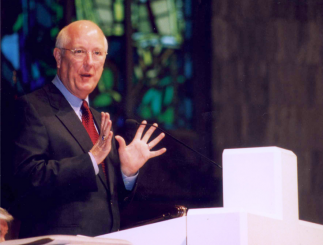
The sadness in Sammy Gilbreath’s voice was unmistakable. Standing before participants at the recent Alabama Baptist State Evangelism Conference, Gilbreath shared that baptisms for Alabama Baptists were down again for 2014. The exact number according to the Alabama Baptist State Board of Missions (SBOM) is 17,434, down from the 2013 total of 17,791. This is the fifth straight year of decline in baptismal totals.
What is happening in Alabama is happening across the Southern Baptist Convention (SBC). Frank S. Page, president and CEO of the SBC Executive Committee, recently reported that baptisms across the SBC have declined to their lowest level since 1948. The last year of record (2013) shows 310,368. Gilbreath, who serves as director of SBOM’s office of evangelism, did not share exact numbers as he spoke but indicated SBC baptisms for 2014 would drop even further.
In the year 2000, Alabama Baptists reported baptizing 25,939. The SBC total was 416,094. Obviously there has been a serious decline. Not all churches report their statistics so the numbers may not be exact but the trend line is undeniable.
Baptisms per church
When the numbers are broken down by churches there were almost 10 baptisms per cooperating church (9.97) in 2000. In 2013 that number was about seven (6.73). Again the numbers are not exact but they are close.
Gilbreath used the opportunity to promote training events led by the state office of evangelism to help equip church members to share their faith. This year Alabama Baptists will focus on training in preparation for 2016 when the state emphasis will be sharing one’s faith with non-Christians, he said.
Speakers during the annual evangelism conference offered a variety of explanations for the decline in baptisms. Baptists don’t really care about the lost, Baptists are not sensitive to the Holy Spirit, Baptists don’t bring lost people to church anymore — these were just some of the conclusions. And there is truth in all of them.
Compassion for those who do not have a relationship with God through faith in Jesus Christ may not be as widespread as in days past. We may hesitate to share a word of faith when we feel that inner nudging of the Spirit. In most places Sunday morning worship is designed to strengthen Christian believers because that is who attends on Sunday mornings.
Other speakers contended that evangelism should be “red hot” and excited the crowd with stories of how God was transforming churches and people through ministry evangelism.
The examples were numerous: tutoring programs, sports ministries, English as a Second Language classes, support for local officials, respite care, divorce recovery groups and more.
Participants were challenged to identify needs in their communities and then meet those needs. In helping people where they hurt the Church demonstrates the love of God and earns a hearing for the gospel, speakers explained.
Interestingly Jesus used a similar approach for much of His evangelistic efforts. In Matthew 4:23 the Gospel writer describes how Jesus combined “preaching the good news of the Kingdom and healing every disease and sickness among the people.” The result of this approach as reported in verse 25 was, “Large crowds from Galilee, the Decapolis, Jerusalem, Judea and the region across the Jordan followed Him.”
Caring for human need
Even in the last week of His life Jesus still combined preaching with caring for human needs. In Matthew 20:29–34 the writer tells the story of two blind men who asked Jesus for their sight. The concluding verse says, “Jesus had compassion on them and touched their eyes. Immediately they received their sight and followed Him.”
What was true in Jesus’ day is still true. When people know you care about them they are more open to listening to what you have to say.
Alabama Baptist churches are doing a lot of creative things to care for those around them. Several churches work with expectant mothers to help them understand and cope with all the changes taking place. One church pairs young mothers in the community with grandmother-types from the church. The goal is to help the young mothers learn basic habits of child care, cooking, home management and other everyday necessities.
Several churches sponsor divorce recovery groups to help those caught in the hurt of this terrible trauma to know they are not alone. Some churches provide basic car care for widows.
Hunger ministry
Hunger is a major ministry for many churches. The latest study by the U.S. Department of Agriculture reported Alabama has the third highest percentage of hunger among all states. One in 6 residents lives with food insecurity. Among seniors it is 1 in 5; among children, 1 in 4.
Letting people know you care about them may earn a hearing for the gospel but one still has to present the gospel. One has to care enough about the person receiving ministry to share the most important message in the world — “that God so loved the world that He gave His one and only Son.”
One has to know how to share what Christ has done in one’s own life and how to use the Bible to relate the Jesus story. One has to be willing to implement all the preparation and actually convey the gospel.
That is why Baptist believers have to really care about those who do not know Jesus Christ. That is why believers have to be sensitive to the Holy Spirit’s leadership and why it is important to help people hear the gospel.
How one responds to the invitation God extends through Jesus Christ is still the most important decision a human being will ever make. That is why the decline in baptisms in Alabama and SBC life is disturbing. It indicates that fewer and fewer people are coming to faith in Jesus Christ.
The first response to this problem may not be more words. To make evangelism “red hot” we may have to pay more attention to earning a hearing for the gospel through caring for people. Then we must be sure to share the clearest example of God’s love for them — the gospel message of salvation through faith in Jesus Christ.


Share with others: