
By Sondra Washington
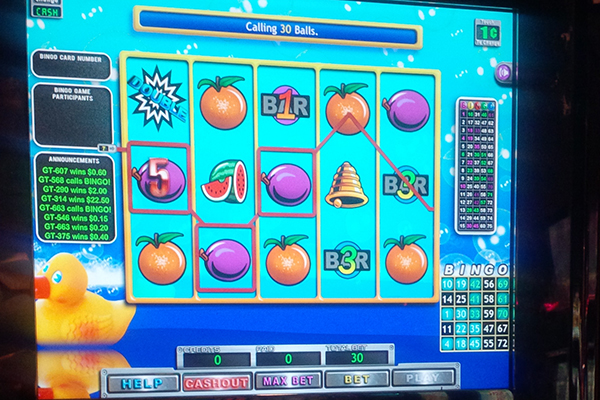
Electronic bingo — is it illegal gambling or a new method of playing the same charity game offered for years in Alabama? This question became a hot-button issue late last year in Walker County when local leaders allowed electronic bingo in the area on devices many say resemble slot machines.
At the heart of the matter is a local constitutional amendment legalizing “[t]he operation of bingo games for prizes or money by certain nonprofit organizations.” But Walker County District Attorney Charles Baker says the law is “muddy” and “wrought with unanswered questions” on payout limits, conflict resolution and qualifications for licenses.
Recently Baker and Sheriff John Mark Tirey filed a lawsuit asking a judge to determine “whether or not the machines being used and the manner they are being used are legal” under the amendment, which dealt with traditional Bingo cards when it was implemented.
“I believe we have the most unregulated gambling in the United States in Walker County,” Baker said. “If, in fact, a court determines that the machines are legal, we need a gaming commission with awesome power to regulate, issue and revoke licenses.”
The bingo parlors, which some say look like casino halls, function through a co-op that oversees operations and divides revenue each month among approved nonprofits, according to Jasper’s Daily Mountain Eagle.
Yet questions abound regarding parlor profits and whether the co-op is legitimate since bingo companies often advertise seeking charities to support.
Many churches, schools, fire and rescue groups, clubs, associations and agencies have participated in the co-op and some have already withdrawn from the profit sharing, according to the Daily Mountain Eagle.
“I have read that some of the organizations did not know that they were involved in it,” said Dan Ireland, executive director of Alabama Citizens Action Program.
Although a local act states that bingo can be played for no more than five consecutive hours in a given day and two days in a given week “except for special permit holders,” companies in the area have found a way to increase operation times, Ireland said. “They have enlisted the names of several organizations where they can operate for 24 hours a day.” This is not bingo for charity but a case of gambling halls preying on the names of charities to operate round the clock, he said.
“This is just an unfortunate thing that the bill is apparently so loosely written that you skirt the intent of the law and have wholesale gambling at the level that it is happening in Walker County. … I think everyone ought to be looking at Walker County to see what can happen when you open Pandora’s box relating to gambling,” Ireland said.
State Sen. Charles Bishop, who represents Walker County, hopes to pass legislation in the upcoming legislative session, which opens Feb. 5, that will outlaw bingo played on electronic machines. “People in Walker County were completely tricked into this,” he said. “What [the bingo businesses] are doing is making a tremendous amount of money and giving a little bit of money to charities. They’ve come up with so-called bingo on these electronic machines … and they are basically slot machines. It’s gotten to the point that … so many have popped up, that people are … asking where the casinos are.”
Although Bishop feels the majority of county residents would support his bill, he is not confident all of the congressional delegation from Walker County will.
“If one of the delegation members votes against it, it wouldn’t pass,” Bishop said, noting a potential conflict of interest with one representative. Even if his bill fails, Bishop vows to continue fighting against gambling. “I think [electronic bingo is] illegal and I hope to be successful in stopping it,” he said. “We can’t have Walker County become a gambling center in Alabama.
“I think our elected officials could have prevented it from ever happening but they chose not to,” Bishop added. “This group (electronic bingo owners) takes in several million dollars a quarter, and even if this bill is successful, several million dollars would have left Walker County — most of it from people who could least afford to lose it.”
Other area officials and religious leaders, including Alabama Baptist pastors, have joined the fight against the “casino-like” bingo halls.
In September 2007, more than 20 Walker Baptist Association pastors drafted a letter questioning the nature of “‘charity bingo’ parlors” and sent it to “everyone,” according to Director of Missions Lucky Teague.
“These establishments seem to have hardly any connection with traditional bingo and a definite and obvious connection to the gambling industry via electronic slot machines,” the pastors wrote. “Is it not possible to close the evident loophole that has been discovered by the gambling industry? Is it too late for our elected politicians and law enforcement officials to act?”
The group’s sole response came from Attorney General Troy King’s office and explained the responsibility of local leaders in deciding how bingo should be played in their jurisdiction. The response, by Special Deputy Attorney General Kenneth Steely, was in an Oct. 1, 2007, letter to Teague. “In Walker County’s situation, the Walker County Commission has constitutional authority to determine how bingo may be played in Walker County …,” Steely wrote. “This includes authorizing the use of electronic equipment or devices to conduct the bingo operation.”
The county commission has not made a ruling to prevent it and instead increased the annual permit fee from $50 to $500 per machine during a September 2007 meeting.
“Walker County bingo halls have paid license fees for 1,505 electronic bingo machines, bringing $752,500 into the county’s coffers,” according to a Dec. 7 article in the Daily Mountain Eagle. “(County license inspector Jerry) Stricklin had earlier estimated that there are about 2,000 machines in the county, which would mean the Walker County Commission could gain as much as $1 million from license revenue.”
Chairman Bruce Hamrick said the commission is awaiting the court’s judgment on the machines’ legality. Meanwhile he said it is following the county attorney’s lead.
“Bingo is a form of gambling, but there is a local constitutional amendment that allows bingo to be played for charities in the county,” Hamrick said. “Our county attorney, Hank Wiley, says we don’t have any authority to shut down the bingo halls. … We are not saying that we are for or against anything.”
Teague is astounded that people could accept the bingo parlors as legitimate charity operations.
“People who have gone there have told me that there is no difference in these machines than in the ones they use at the casinos in Tunica, Miss.,” he said.
Like Bishop, Teague vows to continue fighting against gambling. “I’ve had several pastors tell me that since the charity bingo parlors have opened, there are far more assistance requests for groceries, payment of utility bills and various other daily needs in the home,” he said. “There are 71 (Alabama) Baptist churches in the county, and we are not the only ones against it. If we have to make an appeal to them to take further action against gambling, we can and we will.”

Share with others: