
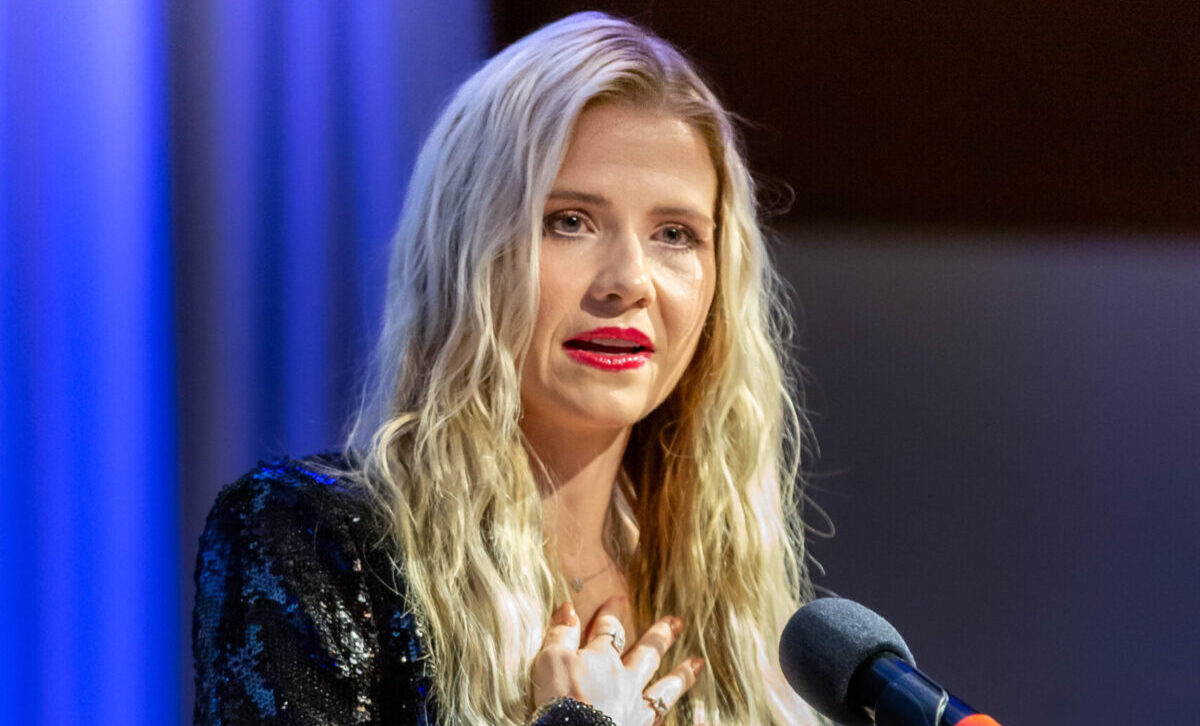
It’s something no one thinks will happen to them — being taken from a middle-class home to an outdoor camp to be sexually assaulted daily for months. However, it happened to Elizabeth Smart, who is an activist, author and founder of the Elizabeth Smart Foundation.
Smart shared her story at Blanket Fort Hope’s annual gala Feb. 12. Blanket Fort Hope is an Alabama-based nonprofit that recently finished its Restoration Home, which will provide specialized care to young girls who have been victims of child trafficking.
Subscribe to The Alabama Baptist today!
SIGN UP for our weekly Highlights emails.
When her living nightmare began, Smart was simply looking forward to high school. Her younger sister, who was her best friend, shared a room with her. They were in bed together when it happened.
“That night, I remember going to sleep, and the next thing I remember was hearing a man’s voice saying, ‘Don’t make a sound. I have a knife at your neck. Get up and come with me.’
“When I first heard that voice, I didn’t respond because that could not actually be real. I mean, I was in my bedroom. I was in my home. I was surrounded by my family. Bad things didn’t happen in my life back then. Bad things don’t happen in my home, and so I didn’t need to respond. I just laid there. And then I heard the voice repeating the same words again,” Smart said.
Smart was found nine months after she was abducted. Eventually, through the support of friends and family, therapy and living through a highly publicized trial, she was able to heal — and eventually help others through the Elizabeth Smart Foundation and her activism.
“Unfortunately, sexual abuse happens everywhere. (It) happens at home, happens at school, happens at work, happens in church — like all the places you think you’d be safe — but it does happen everywhere. So it is important to address it everywhere.
“I mean, when you’re talking about chastity, purity, waiting for marriage, abstinence — I don’t have a problem with any of that. … However, if you’re going to have that conversation, you also need to make the differentiation between consenting, loving intimacy versus sexual abuse, rape and exploitation,” Smart said.
Listening and compassion
Asking, “Why didn’t you …?” is the worst thing to say. Instead, Smart advocates saying, “I believe you and I’m here for you.”
“I think it’s important to keep in mind it’s not our place to question a survivor. It’s not our job to find out all the facts,” Smart said.
Instead, trauma-informed forensic interviewers should be called upon to find out what happened so an investigation can happen without further traumatization.
“If [a survivor] wants to talk to you, the best thing you can do is just listen and show compassion. If they don’t want to talk to you about it and they just told you that it happened, that is a leap of courage already.
“Let them know you believe them. Let them know that you love them, that you’re here for them. But also, you’re happy to go get ice cream with them. You’re happy to go to the movies with them. You’re happy just to continue on with your relationship because in my experience, most survivors still just want to be treated like a normal person,” Smart said.
More to the story
In December 2025, Smart released her third book, “Detours: Hope and Growth After Life’s Hardest Turns.” While her first two books discuss her story and healing, “Detours” was written because many look to her for answers on how to become “fine” and “normal” after going through trauma.
“‘Detours’ came about because everybody has trauma in their life. I mean, no matter what it is, big or small, we’ve all only experienced our own worst day. So everyone’s life, if you will, takes detours. I mean, nobody just goes straight through life exactly how you planned it.
“I tried to pinpoint as much as I could — kind of those healing highlights or the moments that kind of stood out to me in my own healing journey — and I tried to write about it and make it as relatable as possible,” she said.
In addition, a Netflix documentary called “Kidnapped: Elizabeth Smart” was released Jan. 21. It shares how her family and community wouldn’t give up, which finally led to catching the perpetrators.
“I felt a lot of shame around what had happened. I wanted to hide the sexual abuse as much as possible. I mean, looking back now it was naive of me to think that that was possible.
“I never heard anyone openly talk about rape or sexual abuse growing up — or any kind of abuse for that matter. I mean, it was always, ‘Keep your skeletons in the closet. Keep your dirty laundry hidden.’ I just didn’t hear people openly speak about it, so that ended up making me feel like I was the only one who had experienced it and it was lonely.”
She noted, “When the trial took place and I spent all these hours up on the stand and all of this information came out, I just remember thinking, that’s not all of my story. My story deserves some context, and if it’s going to be out in the world, then I want to be the one sharing it, and I want it to serve a purpose.”
For more information
More information about the Elizabeth Smart Foundation can be found at https://www.elizabethsmartfoundation.org/. For information about Blanket Fort Hope, go to https://blanketforthope.org/.



Share with others: