
Church staff members play two roles at one time — They are part of a ministry team and the leader of a specific ministry of that team.
That’s not news to the Alabama Baptist Education Music Association’s (EMA) members. But those education and music ministers did learn new ways to play that dual role more effectively at their annual meeting, held at First Baptist Church, Birmingham, on Nov. 15.
In the first conference session — led by Andrew Westmoreland, president of Samford University in Birmingham — these leaders learned how to empower others, particularly those who are eager and those who are invisible.
Westmoreland pointed to Jesus’ example in dealing with both types of people.
In Mark 2:1–5, four eager people brought their paralytic friend to Him.
“They’ve got this friend who has a problem. They know Jesus is the answer,” Westmoreland said, noting they got their friend to Him by tearing the roof off a building.
But Jesus didn’t reprimand them. He overlooked their excesses, i.e., their impulsiveness and enthusiasm.
Westmoreland said the lesson is to celebrate and affirm eager people’s enthusiasm. And be sure to affirm their specific strengths, not just their positive attitude, he said.
Leaders also can help them weigh the cost of commitments and learn to say no so they don’t become overcommitted and can’t follow through with their ideas, Westmoreland noted.
However, don’t promote them too quickly, he warned. Westmoreland said they need to learn how to focus before being handed the reins of responsibility.
He said leaders need to be careful in the way they engage in follow-up because eager people can become easily discouraged.
In Mark 10:14, Jesus asked the most invisible people of His day, children, to come to Him.
The lesson in this case is to look for invisible people, Westmoreland said.
It’s something he said he strives to do better because he’s a “hurried person.”
“I’m convicted of the fact that occasionally if I would just slow down, those relationships are right there,” Westmoreland said.
He said people’s tendency is to look around and see extremes: the A-one performers and the troublemakers. But there are others who may be lonely, cautious or skeptical because they’ve been burned by leadership before.
“We need to help them form new relationships with people who are sensitive and kind,” Westmoreland said. As with eager people, he said follow-up with invisible people requires care because once they develop a bond with someone, they will most likely want to stay in touch.
The second session — led by Teman Knight, pastor of Heritage Baptist Church, Montgomery, and Dale Huff, director of the office of LeaderCare and church administration of the Alabama Baptist State Board of Missions, focused on building a powerful ministry team and maintaining it when conflict arises.
“It’s easy to say, ‘Our mission is to reach our entire city’ or ‘Our mission is to fulfill the Great Commission,’” Knight said.
But he noted that within the ministry team leading a church to fulfill its stated mission are leaders with more specific concerns like how big the choir is or how many people are involved in Sunday School.
“The truth is you can function as stars and get a lot of good work done,” Knight said.
However, the combined efforts of a team produce a greater result, or synergy, because its leaders are willing to sacrifice their personal agendas, he said.
“The Holy Spirit gets involved and He multiplies that synergy,” Knight said.
He shared the six characteristics of a powerful ministry team, which all involve cooperation:
• common purpose,
• clear roles,
• accepted leadership,
• effective processes,
• solid relationships and
• excellent communication.
Of course, working toward a common vision doesn’t mean everyone on the team will be best friends or will agree on everything, Knight said.
But “you’ve got to trust each other. You’ve got to love each other. You’ve got to be kind to each other,” he said.
Huff, who serves as EMA’s adviser, pointed out that life is dynamic and in every relationship, there comes the pinch, the ouch, the uh-oh.
So when conflict comes, he said the issues at the root of that conflict need to be addressed.
“Deal with it early. Deal with it quickly,” Huff advised.
He noted that the Bible’s advice is contrary to human nature. People tend to avoid dealing with broken relationships, but verses like Matthew 18:15 say to go to the person with whom you have a conflict.
“When there is some difficulty, you move to get it corrected,” Huff said.
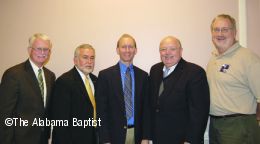
Following the sessions, there was a banquet with special guest After Class, an instrumental string trio. Two awards were presented during the banquet. The Paul Stewart Excellence in Music Ministry Award was presented to Jerry Dykes, former minister of music of First Baptist Church, Sylacauga (now senior adult choir director). The Christian Educator of the Year Award was presented to Larry Armstrong, retired associate pastor of education and administration of Eastern Hills Baptist Church, Montgomery.


Share with others: