
Southern Baptist messengers gathered at their annual meeting in New Orleans June 19–20 approved a $7.5 million Southern Baptist Convention (SBC) operating budget and $181.9 million Cooperative Program (CP) allocation budget for 2012–13. This is $4.1 million less than the previous year’s CP allocation budget, indicating a move away from the traditional method of basing the new budget on previous year’s receipts. In a time of declining budgets, allocations to entities were unrealistic, which created budgets that are unsustainable, a spokesperson for the SBC Executive Committee said at a separate meeting prior to the vote on the budget.
In the operating budget, a total of $2.6 million is budgeted for SBC administration expenses and $4.9 million is allocated toward operating expenses for the Executive Committee. The CP allocation budget directs $137.2 million to ministries through the convention’s two missions entities, $41.6 million to theological education through six seminaries and $3.1 million to concerns about ethics and religious liberty.
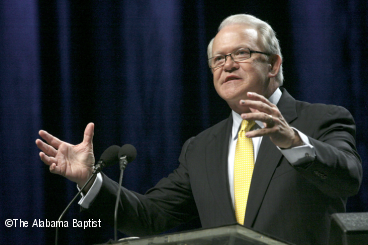
Frank Page, president and CEO of the SBC Executive Committee, used a World War II analogy during his report to warn that the CP, which fuels SBC missions and ministry, is running low.
A student of history, Page said the Germans were defeated in the Battle of the Bulge after a solid start because they ran out of fuel.
“Their machines stopped working. They were technologically very superior, but they couldn’t go anywhere. Their tanks became sitting targets for our tanks and our soldiers,” Page said.
He then told messengers: “We’re running out of fuel in the Southern Baptist Convention. The fuel for a Great Commission Advance, which is what I would like for us to see happen, is the fuel of the Cooperative Program.”
Southern Baptists can talk about missions and even summon the resolve to engage in missions, he said, but without providing fuel for the missions task, the Great Commission will be left to someone else.
“We need a rally point that is both biblically based and historically faithful, and we believe that is the Cooperative Program,” Page said. That is why, he said, Southern Baptists must heed “God’s call to be a tithing body of believers.”
Page called for individuals throughout the convention to commit to a 10 percent tithe of their income for the cause of advancing the Kingdom of Christ.
“When the average American Southern Baptist mirrors the culture and gives 2.3 percent of his or her income to causes that would be considered charitable or church-related, we’re never going to be able to impact the lostness of the world like we ought,” Page said. “So I’m calling for a 10 percent tithe on the part of our people.”
During the past year, 15 percent of churches in the convention have expressed specific interest in Page’s 1 Percent Challenge, he said, referring to increasing gifts through the CP by 1 percentage point of their budgets.
Page said the CP enables Southern Baptists to diversify their missions investments by supporting ministry on the local, state, national and international levels.
“We no longer talk about giving [through] the Cooperative Program. We talk about giving to missions and ministries through the Cooperative Program. We want you to hear that distinction very well,” Page said.
Messengers also approved items that impact the internal operations of the convention:
4Approved a request from the North American Mission Board to adopt fiscal year Oct. 1 through Sept. 30.
4Adopted revised Convention Site and Housing Guidelines for annual meetings, reducing the number of necessary hotel rooms to 4,000 and the number of minimum hotel rooms within two miles of the convention center contracted for the annual meeting to 1,500. Both figures were reduced by 500.
4Adopted the 2016–17 SBC calendar of activities.
In other convention business, 19 motions were presented by messengers and all but one were referred to SBC entities or ruled out of order. Entities will report on those referred during the 2013 SBC annual meeting in Houston, Texas.
The motion not referred would have prohibited messengers from using a platform microphone when debating motions or making nominations as a way to “increase the fairness” of convention deliberations. The motion was defeated on a show of ballots.
(Compiled from BP stories, TAB contributed)



Share with others: