
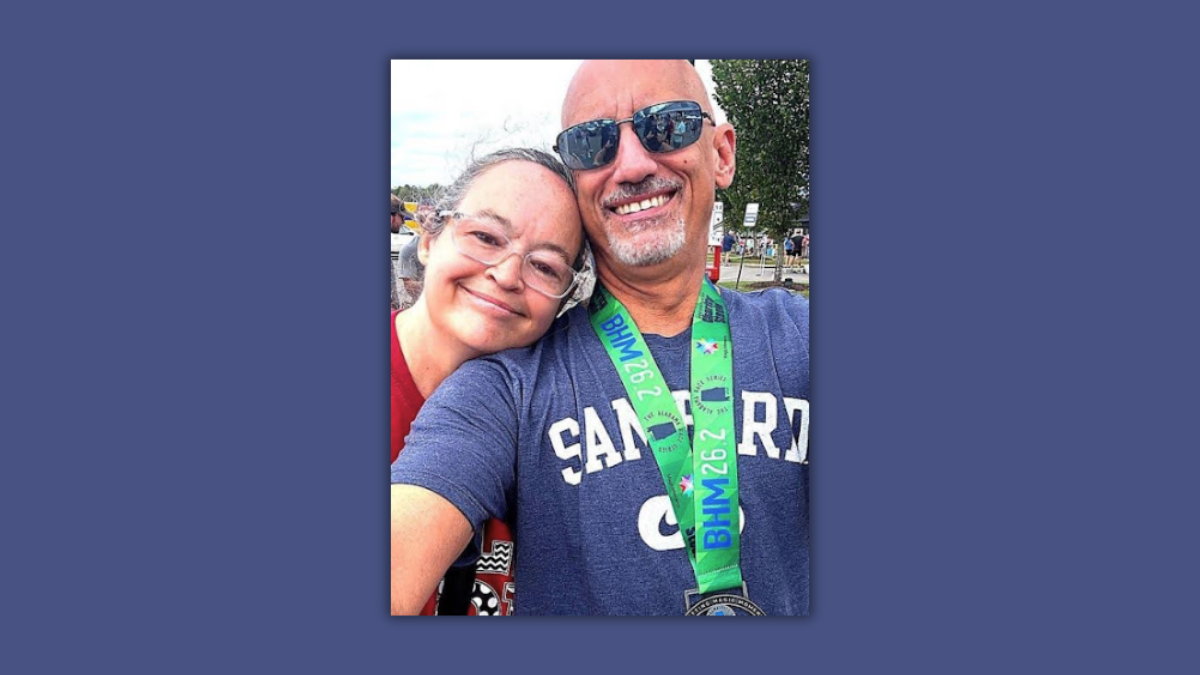
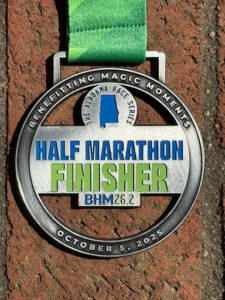
I felt amazing. That was the problem. At 58, I was in the best shape of my life. I’d lost 30 pounds, ridden over 1,000 miles and run hundreds more. After months of training with my adult kids, I was ready for the Birmingham Half Marathon on Oct. 5, 2025.
Then came August’s routine health checkup before starting another semester of teaching at Samford University.
Subscribe to The Alabama Baptist today!
SIGN UP for our weekly Highlights emails.
A routine test indicated a need for further testing. An MRI and biopsy provided the shocking news — I had an aggressive form of prostate cancer that had begun to spread. This made no sense — I had zero symptoms, maybe the tests were wrong?
My doctor ordered a PSMA PET scan to check for distant metastatic disease — the kind with no cure, the type that had killed one of my mentors. Late Friday afternoon, Oct. 4, I’d lie in that machine while it searched my body for a death sentence. Then I’d wait. The results wouldn’t come until Monday. Sunday morning, I would lace up my running shoes and run 13.1 miles — still not knowing if I had a few years to live or decades.
Hills that foreshadow treatment
Sunday morning arrived cool and clear in Birmingham. My family knew, and they were worried. Laura, my wife of over three decades and mother of our seven children, was facing the possibility of becoming a widow far sooner than we’d ever imagined. But we had trained for this race for months, and I was going to run it. My doctor had given me the green light.
What they didn’t know was what I knew: this might be the last half-marathon I would ever run.
As the starting horn sounded, I wasn’t thinking about my time. I was entering into a 150-minute conversation with God about accepting whatever path He was calling me to run.
For months, one verse had been burning in my heart — my theme for 2025:
“But I do not account my life of any value nor as precious to myself, if only I may finish my course and the ministry that I received from the Lord Jesus, to testify to the gospel of the grace of God” (Acts 20:24).
God had been using me at Samford, at my church, where I teach the men’s community group, and in the sports industry. I’d been working hard to extend my “health span” so I could make this verse a reality for decades to come.
But what if God’s plan was different? What if His way of accomplishing Acts 20:24 in my life wasn’t through 20 or 30 more years of ministry in that context, but through suffering well in whatever time He gave me?
The first five miles came fast — too fast, probably. Then came the super-steep hill at mile five, and my body started screaming. As I pushed up that incline, I imagined it was hormone treatment. Could I endure it? Would I give up?
“Lord,” I prayed, pushing through burning legs, “whatever path You put before me, I pray you will give me the strength and fortitude to accomplish Acts 20:24.”
The Birmingham course is the hilliest half-marathon I’ve run in 20 years. Around mile 11, a particularly long hill seemed endless. My legs were completely exhausted.
Each hill became a different aspect of treatment: radiation, surgery, chemotherapy. “God, I can suffer through this,” I pledged. “I will not stop. I will glorify You no matter how hard it gets.”
I thought about one of my mentors who died eight years ago from this same cancer. He had helped me launch Samford’s sports industry program. I learned so much from him and watched cancer take him. Now this same cancer might be taking me.
When your family runs beside you
Around mile 11, as I hit that endless incline, my youngest daughter, Abigail, caught up to me. I could see my oldest son, Daniel, just a few hundred yards behind, pushing through his own pain. Several other family members were out on the course too — some running, most of them waiting at that finish line. We had all been training together for months for this day.
The thought of them — suffering alongside me, believing in me, waiting for me — became fuel. I wasn’t running alone. I wasn’t suffering alone.
Abigail and I locked eyes. “Make it to the next mailbox,” we’d say to each other. “Top of this hill.” Two people, both exhausted, both refusing to quit, encouraging each other step by painful step.
There’s something profound about suffering alongside those you love, all pushing toward the same finish line. Paul writes in Philippians 3:10 about “the fellowship of sharing in [Christ’s] sufferings.” I was experiencing a shadow of that — with Christ in my prayers, with my daughter running beside me, with my son pressing on just behind us, with my family scattered along the course and gathered at the finish.
This is what the body of Christ looks like. This is what it means to bear one another’s burdens. Not removing the suffering, but running through it together.
Mile 12 came and went. Then the hardest moment: a killer steep hill with one mile to go. My leg muscles started seizing. Cramps threatened to stop me completely. The last 200 yards stretched uphill to the finish line, and I could barely feel my legs.
But I could see them waiting. My family. The finish line. The end of this race and the beginning of a much harder one.
The lesson Job learned
I’ve walked through devastating trials before. Eight years ago, our 21-year-old son, Avery, died a shocking death during his senior year in college. We’ve watched two children through major open-heart surgeries, including one three months before this race.
But here’s what I learned: the lesson Job ultimately learned — about the depth of trust that comes through suffering.
Job’s friends had answers. They had explanations. They had theology to explain his suffering. But Job didn’t find peace in any of their words. He found peace only when he encountered God Himself in a new and deeper way.
Through his suffering, Job came to know God in a way he hadn’t before. “I had heard of you by the hearing of the ear,” Job confessed, “but now my eye sees you” (Job 42:5). This wasn’t Job moving from unbelief to belief — from being unsaved to being saved. This was a righteous man moving from secondhand knowledge to direct experience. From head knowledge to heart knowledge. From knowing about God to truly seeing God.
When you encounter God in this way — when you truly see His sovereignty, His goodness, His wisdom in the midst of your suffering — you discover a depth of trust that couldn’t be manufactured any other way. You move from believing the right things about God to resting wholly in who God is.
And that trust, forged in the furnace of suffering, was what I needed now as I faced the possibility of cancer spreading through my body.
. . .
Suffering with joy
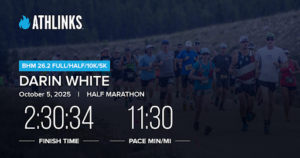
As I crossed that finish line, I looked at the timer and I couldn’t believe what I saw: 2:30:34. I had just beaten the personal record I set over 15 years ago — by seven minutes.
I cried.
Not because of the time, though, that was shocking. I cried because God had just shown me something profound: He was giving me strength for whatever lay ahead. If I could push my body to its absolute limit for 13.1 miles, suffering willingly, praising Him through the pain, then I could face surgery. I could face radiation. I could face whatever path He’s calling me to walk.
I had just proven — to myself and to God — that I could suffer with joy.
The long uncertain road
The next morning, I got the PET scan results. “No distant metastatic disease.” The cancer hadn’t spread far. I wasn’t facing a death sentence in the next few years. There was a real chance for a cure.
Surgery was scheduled. On October 21st, they removed my prostate, hoping to remove all the cancer with it.
Then came the pathology report.
The microscopic examination revealed what the PET scan couldn’t see: the cancer had already escaped beyond the prostate. Not distant spread — but it had breached the walls. What the imaging missed, the pathology found.
The PET scan was a victory of sorts. I wasn’t going to die in the short term. But it wasn’t a get-out-of-jail-free card either. Surgery wasn’t going to be one-and-done.
The gift of forced dependence
When I was running that half-marathon two days after my scan, I was preparing myself to suffer well if the cancer had spread. I was rehearsing Habakkuk’s song for what I thought might be a 3-to-5-year battle. I was pledging to rejoice in the Lord even if He gave me only a few years.
But God has given me something different — not a death sentence, but not a clean bill of health either. He’s given me uncertainty. He’s given me waiting. He’s given me a decade of tests and scans and the ever-present possibility that the cancer could return at any moment.
Every three to six months for the next 10 years, I’ll return for a blood test. Each test will tell us whether the cancer has returned or remains undetectable. If the cancer stays undetectable through all of that, then in 2035 — 10 years from now, I’ll be considered “healed.”
But here’s the reality I’m learning to embrace: God has positioned me in a place where I must lean on Him. Not just today, not just this month, but day after day, month after month, year after year for the next decade. Maybe longer.
. . .
The daily discipline of hope
Because that’s the reality. Every morning I wake up, and within minutes, the thought creeps in: “The cancer might come back.” Every slight pain, every unusual sensation in my body, every reminder that I’m now a “cancer patient” — these things threaten to become the loudest voice in my head.
Maintaining hope in the midst of this requires more than just a one-time decision to trust God; it also requires ongoing commitment. It requires daily discipline. Moment-by-moment intentionality. A constant turning of my heart back toward the gospel.
. . .
So each morning, I open Scripture and let God remind me of what is true. That I am loved with an everlasting love. That nothing can separate me from the love of God in Christ Jesus. That even if the cancer returns, even if I only have a few years left, even if 2035 never comes for me on this earth — I am secure in Christ.
EDITOR’S NOTE — This article was edited for brevity and length. Darin White is the Margaret Gage Bush Distinguished Professor and Executive Director of the Sports Industry Program at Samford University in Birmingham, Alabama. He teaches biblical theology at Church at Brook Hills and writes on the intersection of sports, business and faith. He is currently writing a book on finding the good life through suffering. He and his wife, Laura, have seven children and four grandchildren.

Share with others: