
Two things can be true at the same time.
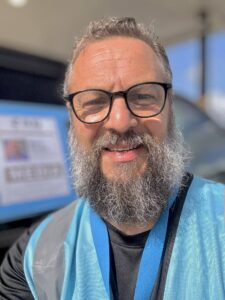
I never intended to become a fire chaplain. “It was never on my Bingo card,” as they say. For me, it came along with the job. I was going to be the pastor of the area church, so I became the chaplain for the volunteer fire department at the end of the street. Speaking of, “not on my bingo card,” how about being a pastor? That was never part of the plan either. I am a journalist.
Not only am I a journalist, but also a Baptist journalist. And I have spent the better part of my career with people, hearing their stories and sharing what God is doing in the world around us.
Until early July, I was either a chaplain or a journalist and not at the same time. All that changed July 5 when we got the news about little girls being swept away by the water in central Texas, and I knew their stories had to be told. They needed a storyteller.
RELATED: Check out more stories on the Texas flooding and response.
Along with the little girls were firefighters and other first responders fighting a raging river trying to save them. I knew their return would come with images and experiences people should not endure. They would need a fire chaplain.
It immediately became clear — both were my assignment, and I knew what I would be there for.
Lessons from the past
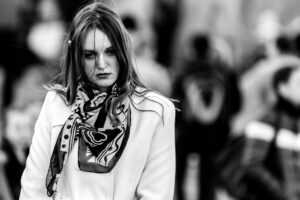
More than a decade prior, I found myself covering the Maidan Revolution in Kiev, Ukraine. More than 100 Ukrainian citizens were killed at the hands of their own government in the central square of the city. Soon after, numerous pop-up memorials were erected on the square to honor those known as the Heavenly Hundred. Constructed from the street’s cobblestones, they were adorned with photos, candles and personal trinkets. And one-by-one, people would file by in the bitter cold to lay flowers.
I knew immediately. The second I saw her — the sad girl. I knew this was the shot I was looking for. I maneuvered my way in and around memorials until I was close enough. I raised my camera, zoomed in, focused and pushed the shutter. The viewfinder confirmed it. This was the photo. And then I moved on.
But I wasn’t just a journalist. I was a missionary journalist. As such, it was my custom to carry in my backpack a handful of Gideon New Testaments in the language of the country I was in. I wanted to help get the Word of God in the hands of people who were hurting. However, having just captured “the one,” my thoughts were elsewhere.
It was not until the photo gained some recognition weeks later that I recalled the day it was taken. The girl was crestfallen. She was clearly hurting. She was alone.
Sitting comfortably in my home office looking at a framed print of the photo, I realized what I had done. I was so busy with and focused on my photography assignment that I had forgotten what I was actually there for.
Back in Kerr County, Texas, a few days ago, I had the opportunity to redeem myself.
“So, which are you?”
That was the question from the dusty, dirty fireman in the straw cowboy hat who was controlling traffic. “Are you here because you are a journalist, or are you here because you are a chaplain?”
“Both,” I replied.
“Well, I don’t know what to do with that,” he said. “Go to the next checkpoint and see what they say.”
Later that day, I found myself stuck in a long line of vehicles inching closer to the road that runs by the bed of the Guadalupe River. Suddenly, a man’s voice cracked over a loudspeaker, instructing everyone to immediately turn around and go the other way because a wall of high water was on the way. Needless to say, that is what we did.
“Well, there go all my plans for the day,” I thought. “Now, what am I going to do?”
Change of plans
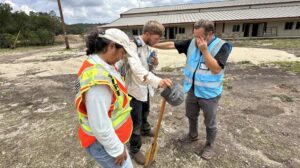
I didn’t remember seeing a fire station on my way in, but on my way back out it appeared in front of me as if it had attached a tractor beam to my truck. I was going to take sanctuary among my people.
The building was humming with coordinated chaos, and people were working frantically, not unlike a colony of freshly disturbed fire ants. It didn’t take me long to realize this rural volunteer fire department was without a local chaplain, and the Holy Spirit gripped my heart. God was about to give me opportunities to redeem what I lost in Ukraine.
Remembering that I had vowed never again to get so hyper-focused on one of my assignments that I might miss an opportunity to serve and minister to others through another assignment, I pivoted in that moment.
Tucking my media credentials inside my vest and securely stowing my photography gear away, I switched from my reporting assignment to doing what I was there for — chaplaincy.
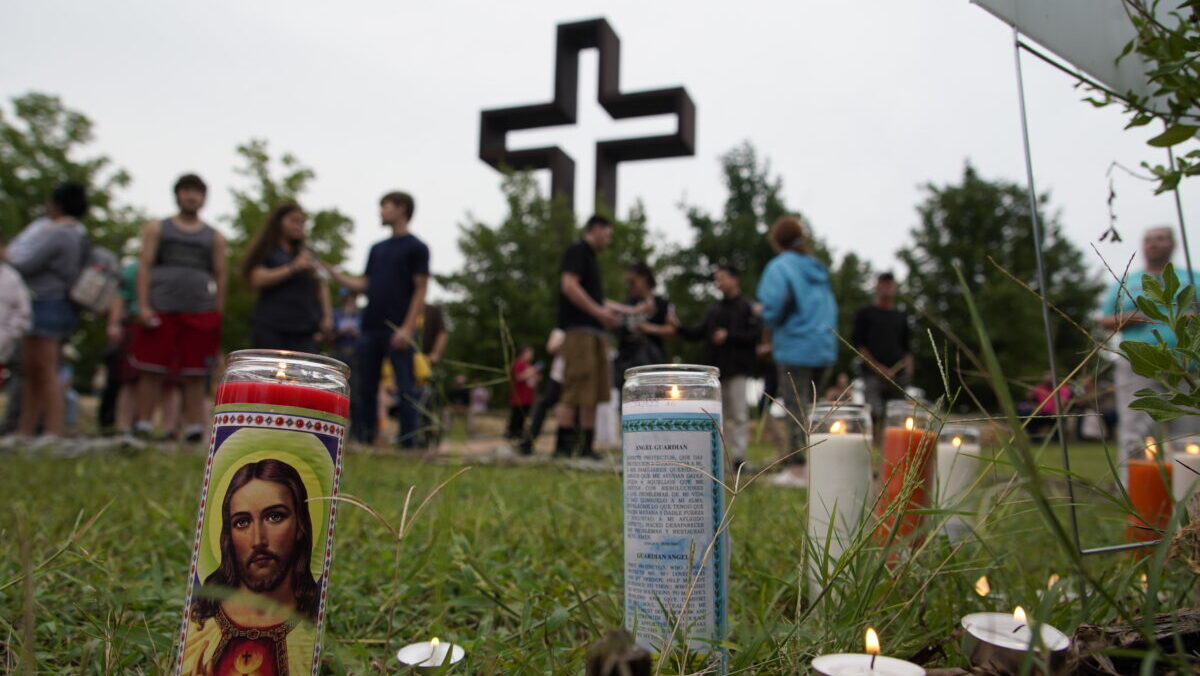
Later that evening (after escaping an unsettling time of finding myself trapped between two flooded sections of road), I made my way to the prayer garden where I was expecting to shoot photos of a prayer and worship time in honor of the deceased and missing girls from Camp Mystic.
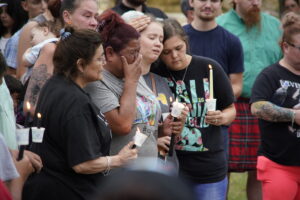
The crowd for that gathering would be easy to spot, as people were encouraged to wear white. However, it had been raining on and off all day, and when the floodwaters began to rise, the event was called off due to safety concerns. I chatted with a few ladies from the community as I watched another crowd gather — this one armed with candles, a memorial banner and homemade signs. The air was thick and heavy as the flames flickered, and family members gave short speeches.
From that point, everything changed.
I honestly don’t know how you explain “the leading of the Holy Spirit” to someone who has never had the experience. For me, it is often a powerful sense that draws me to people or puts me in certain places at specific times. And this sense began working overtime the morning of July 7.
It led me back to the fire station, much to their surprise, I think. And throughout the day, God put me in front of people who needed physical help, others who needed encouragement and a prayer, and some who simply needed a cold bottle of water and a “hang in there.”
I joined forces with a volunteer couple. We climbed into their truck and headed out looking for ways to serve and minister — and to share Jesus in any way we could.
‘God provided’
The more people we served, the more people God brought into my path who specifically allowed me to complete my assignments for the day.
We got all the needed photos and recorded interviews without having to seek them out. God brought them to us. And I believe it was all due to my changed focus. The more I allowed myself to be used, the more God provided what I needed.
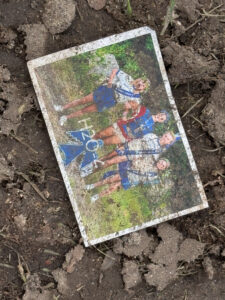
That evening, I returned to the prayer garden at the top of the hill, expecting to see it covered with people wearing white in honor of the Camp Mystic girls. I chatted briefly with the women from the community with whom I had spoken the night before, but the crowd never came. So, I sat in my truck and took advantage of the strong cell signal to send photos back to the production team at the home office.
Immersed in compiling photos from my day’s work, I jumped when I heard the tap on my truck window.
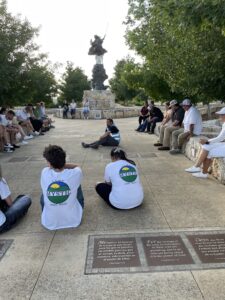
“You are a pastor, right?” one of the women in white asked. “There are some young people who showed up, and they are all wearing Camp Mystic staff t-shirts. They were expecting a service, but nobody has come to lead. Will you speak with them?”
The group of nearly 30 young people had traveled from Poland as part of an exchange/work program and were in the camp the night of the flood, though their cabins were at the back part of the camp on higher ground. Now, instead of the summer they had planned, they were mourning the lives of little girls who just days before were fighting over which group should get more cupcakes.
The more my focus shifted, the more God allowed me to speak with people who were carrying unimaginable hurt. It began with firefighters who had no chaplain of their own. God brought young people who are struggling with why they survived, while many of those precious girls did not.
He brought me a hardened law enforcement officer who admitted he finally broke down. God allowed me access to Camp Mystic where I prayed with staff who were pulling out tons of pink blankets, shoes and backpacks. And parents whose daughters survived also shared their stories.
So, who am I?
Am I a journalist? A photographer? A fire chaplain? A pastor?
Yes.
If we are followers of Jesus, then He expects us to be more than one thing.
EDITOR’S NOTE — This first-person article was written by by Marc Hooks, photojournalist correspondent for The Baptist Paper. Follow his spot news coverage on the Facebook pages of The Baptist Paper and The Alabama Baptist newspaper and look for continued coverage of the flooding tragedy in Texas at thebaptistpaper.org and thealabamabaptist.org.


Share with others: