
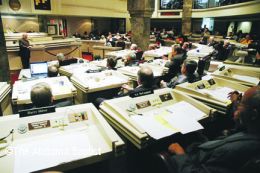
Gambling supporters repeatedly promise money from regulating and taxing slot machines that are being labeled electronic bingo. But House Bill (HB) 154, passed Jan. 20 by the Tourism and Travel Committee, would deny the state $72 million in back taxes from Greenetrack in Eutaw.
If passed by the entire legislative body, countless millions would also be denied from “an undetermined number” of illegal Alabama casinos, which could then operate without fear of criminal prosecution or law enforcement raids. That means the Governor’s Task Force on Illegal Gambling could not conduct any raids on the facilities that fall under the bill’s parameters.
The bill, sponsored by Rep. Marcel Black, D-Tuscumbia, seeks to “retroactively and prospectively” exempt gambling operations statewide from “liability for state and local sales taxes.” Cruise ships “docking at saltwater ports in the state” would also be protected.
Michael Mason of the Alabama Department of Revenue (ADOR) spoke against HB 154 during the Jan. 20 public hearing on the bill. Warning that it may be unconstitutional, he said it has “unusual exemptions” and is “an odd, odd piece of legislation.”
Tim Russell, commissioner of ADOR, also believes the bill may be unconstitutional.
“Any amusement opportunity … (must) pay 4 percent of the gross proceeds,” Russell told The Alabama Baptist. “If they (gambling operations) truly meet the constitutional definition of charity bingo, they are not taxed. Once the Supreme Court ruled that [the games being operated across the state are] not charitable bingo (visit www.thealabamabaptist.org for the story), they fall under that tax, and that tax goes all the way back to when they started.”
Although Greenetrack is the first gambling operation ordered to pay the tax, Russell said it may not be the last.
“We intend to review all of them as we go along,” he said. “Our governor has said that he took an oath of office to enforce the laws of the State of Alabama. While in office, I am going to do that as well.”
Russell’s office is not alone in opposing the bill.
A news release from Gov. Bob Riley’s office said, “The bill provides casinos with amnesty from all taxes, criminal prosecution and civil lawsuits and allows casinos to be operated anywhere in Alabama.”
Birmingham Attorney Eric Johnston, president of Citizens for a Better Alabama, called the bill unconstitutional and said charities would lose if the bill passes.
Speaking during the public hearing, Johnston said, “This act permits gambling outside the bingo amendments to the (state) Constitution.
“If they are not operating under the charity bingo amendment, then they don’t have to pay the charities anymore,” he explained.
Johnston said the bill also allows the Indians to have class three gambling without a state-tribal compact as required by federal law.
“The basic premise of federal law is that Indians are permitted to only have the level of gambling we have in the state,” he said. “This bill seeks to increase, by a statutory definition, that level of gambling. … It expands it so much that it raises it to electronic games of all sorts, which would make it actually class three gambling, which would then allow the Indians to have unlimited games.”
Johnston was one of more than 25 people who spoke for or against HB 154 during the hearing, which was held in the House chamber due to an overflowing crowd in attendance. More than 500 people were present, most of which came by charter bus from Greene and Houston counties.
Residents of the two counties pleaded with the House committee to pass the bill they say will keep their counties alive.
Representatives from the areas also promised to continue fighting for legalized gambling in their areas.
Rep. Pebblin Warren, D-Tuskegee Institute, even asked that legislators and others not in counties with casino gambling options to let the ones “of us who are” handle this legislation. Black, the bill sponsor, happens to be one of the legislators not in an area lobbying for gambling.
Rep. James Thomas, D-Selma, said he was tired of people preaching to him. “I’m not championing either side, but somebody’s got to do something,” he said. “Don’t preach to me. I’ll take my chances before the almighty God.”
Rep. A.J. McCampbell, D-Linden, said, “It’s gambling and it’s paying. … I’ll fight you for it.”
McCampbell represents Greene County, where Greenetrack is.
John Hill of the Alabama Policy Institute said the effects from this kind of gambling would be detrimental to many Alabamians. It’s not about bringing in people from other states as a form of tourism, he said.
“The majority of the people that gamble their money away (in casinos) are from the same state [supplying the games],” he said. “The gambling interest wants to prey on Alabamians, and not just any Alabamians but those that
can’t afford to travel to other states.”
Joe Godfrey, president of Alabama Citizens Action Program (ALCAP), agreed. “Big businesses are already preying upon the people of Alabama. This bill would just expand their predatory practice, and … there would not be any lawsuits against them.”
As he has done for more than 30 years, Dan Ireland, director emeritus of ALCAP, also pleaded for those losing money to gambling.
“This money (promised to counties and cities by gambling operators) is coming out of the pockets of the losers,” he said. “We ought not take advantage of our people like this.”
Ken Allen, pastor of East Side Baptist Church, Cullman, described the story of a friend he said died when she spent her money on gambling instead of “vital medication.”
“I am someone who sees the devastating effects of gambling on other people’s lives,” he said. “The gambling industry is the poster child for big business. When you can generate millions upon millions in our state and all of a sudden you give less than 5 percent to a charity, that’s just not right.”
Although Black repeatedly states he is personally against gambling, he said at press time he would introduce another pro-gambling bill Jan. 26 that will “limit, regulate and tax” slot machines (being labeled electronic bingo) by a vote of the people. According to Black, HB 154 would expire Nov. 2 immediately before the constitutional amendment could be implemented if approved by a vote of the people. Black has sponsored pro-gambling bills for years, including former Gov. Don Siegelman’s lottery legislation in 1999.
Two more gambling-related bills were recently filed in the House:
– HB299, sponsored by Rep. Randy Wood, R-Anniston, seeks to impose “significant civil monetary penalties that will make the costs associated with illegal gambling activity much higher than the potential profits.”
– HB326, sponsored by Rep. James Gordon, D-Saraland, would give the City of Prichard a constitutional bingo amendment allowing a contractual agreement between charities and firms operating bingo games for them. Unlike the other bingo amendments across the state, this bill would allow nonprofit organizations to pay consulting fees to “any individual or entity for any service performed in relation to the operation or conduct of a bingo game.”
(Jennifer Davis Rash contributed)



Share with others: