
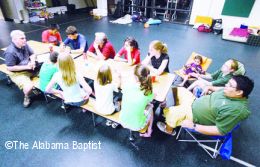
Daniel Goombi is a full-blooded American Indian, a member of the Kiowa-Apache tribe, originally nomads who left Canada to settle in Oklahoma. He is proud of his heritage, culture and tradition.
“I am a Kiowa-Apache and I do live in a tepee,” admits Goombi with a tongue-in-cheek grin. “It’s just that it’s a two-story brick tepee with central air conditioning, just a couple blocks from Wal-Mart. We wear plain clothes as you can see — no buckskin loincloths. I eat meals that weren’t just running in front of me, and I don’t hunt with a bow and arrow. I don’t whoop and holler or attack white men, wear feathers or ride a horse.”
Despite his self-deprecating humor, he views his job as a missionary as serious business.
As directors of Kansas Reservation Ministries, Goombi, 24, and wife Kimberly, 23, share the gospel of Christ on four American Indian reservations — among the Kickapoo, the Sac and Fox, the Iowa and the Prairie Band Potawatomi tribes — throughout Kansas. The Goombis, based in Lawrence, are Mission Service Corps missionaries for the North American Mission Board and church planters for Kaw Valley Association.
Goombi became a Christian at 8 years old during a revival service led by his dad in Omaha, Neb. Although he lived in Omaha most of the time, Goombi remembers that “we pretty much grew up on the reservations. We traveled as much as we could almost every weekend. And we spent almost all summers on the reservations, working with the people.”
Ministering on American Indian reservations is both heartbreaking and difficult, according to Goombi. Every tribe in Kansas is different — each has its own language, heritage, culture and beliefs.
“There are a lot of single-parent families with single mothers or even grandparents raising their grandkids. Alcohol, drug abuse and suicide are big issues. People are secluded from the outside world, and when you’re on a reservation, you’re limited to what’s around you and it’s really not much.
“The spiritual climate on the reservations is difficult,” Goombi said, “because Native Americans have a misconception of who we believers are. They think they have to give up who they are to follow God, and they believe God is still a white man’s God because of the history Native Americans experienced with organized religion.”
Goombi’s heartbreak came when he learned early on that on some reservations, 50 years had passed without American Indian children having a church or even a Vacation Bible School to attend. Goombi changed that in 2006.
“In summer 2006, the first time we held Vacation Bible School for the Prairie Band tribe, a lot of the elders of the tribe told us that it had been 50 years since an outside organization or church had come on the reservation. That’s 50 years of children growing, living their lives and dying without a chance to hear about God,” he said.
Goombi said for the most part, there are no reservations with Bible-based churches that meet on a regular basis. But as a church planter for his association, Goombi wants to plant permanent churches on the reservations he serves.
“Our hope as church planters is to have four self-sustaining churches on each of the four reservations — facilities that each tribe could call their own and a place where people would gather and worship the Lord and take advantage of the church’s programs,” Goombi said.
Parents of two daughters, the Goombis have a soft spot for children on the reservations.
The Goombis subscribe to the phrase in Isaiah 11:6: “… a little child shall lead them.”
“The kids on the reservation are really receptive to what we are doing,” Goombi said. “It’s amazing to see the kids grow, learn church songs and go home and sing them to their parents, who notice how their kids are changing. We offer them an opportunity to learn about God and have fun in a clean environment.
“Working with the kids helps us get to the families and get into the homes. The parents start asking questions and start coming around, and we’re able to share the gospel with them through their kids.” (NAMB)


Share with others: