
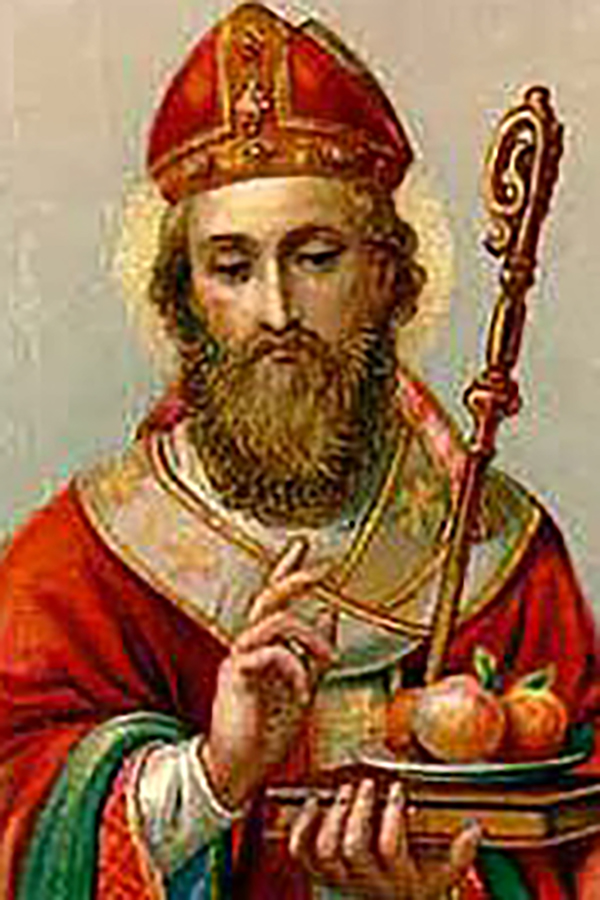
2019 marks 1676th anniversary of death of Saint Nicholas
Our 21st century Santa Claus can be traced back to a Greek Orthodox bishop in the third century.
This year marks the 1676th anniversary of his death.
Saint Nicholas of Myra (270–343) was born to Theophanes and Nonna on March 15, 270, in the village of Patara, Greece. Today Patara, near Myra, is on the southern coast of Turkey.
Serving others
Nicholas dedicated his life to serving others. His uncle, who was a bishop, ordained him a priest. Around 317, Nicholas was made Bishop of Myra.
Saint Nicholas practiced many virtues such as prayer and fasting. Giving alms may have been his greatest morality. Feeling a call to obey Jesus’ words to “sell what you own and give the money to the poor” (Matt. 19:21), he used his entire inheritance to give to the poor and the sick. He tried to keep his generosity secret, but word spread of his kindness.
He became known as the protector of children and sailors. He is the subject of many stories and legends. One famous story is that he saved three poor sisters from a life of slavery or prostitution when he gave them each a dowry, consisting of a purse of gold coins, so they could marry. Another story tells how he became the patron saint of sailors. He was on a ship nearly destroyed by a terrific storm, but he rebuked the waves, causing the storm to calm. He is the patron saint of many cities that have harbors.
During Roman Emperor Diocletian’s reign Bishop Nicholas was exiled and imprisoned for his faith. Emperor Constantine, the Roman emperor who established Christianity as the legal religion, released him. Afterwards Nicholas attended the Council of Nicaea in 325.
He died Dec. 6, 343, in Myra, and was buried in his cathedral church. A liquid substance, called manna, formed in his grave. It was claimed to have healing powers, fostering the growth of devotion to him.
Less then 200 years after his death the Eastern Emperor Theodosius II ordered the building of the Church of Saint Nicholas in Myra.
Saint Nicholas was the most popular saint in Europe during the Renaissance (1300–1600). After the Protestant Reformation he maintained a positive reputation, especially in Holland.
Connection to Christianity
As immigrants from the countries of Scandinavia, Finland and Iceland settled in the United States, the image of Saint Nicholas, or “Sinterklaas,” as he is referred to among the Dutch, slowly changed to that of “Santa Claus” — without the strong connection to Christianity.
The anniversary of Saint Nicholas’ death, Dec. 6th, became a day of celebration. In several Western European and Central European countries Saint Nicholas is celebrated as a great gift giver, and he is revered by several denominations in the United States.
EDITOR’S NOTE — Joanne Sloan, a member of First Baptist Church, Tuscaloosa, has been a published writer of articles and books for 30 years. She has a bachelor’s degree double majoring in history and English from East Texas State University (now Texas A&M University–Commerce) and a master’s degree specializing in English from the University of Arkansas (1978).
Share with others: