
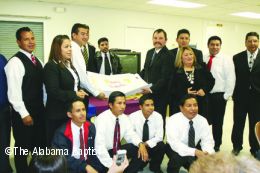
Carlos Lemus, Hispanic missionary for Autauga and Chilton Baptist associations, and Hispanic Baptist pastors in Alabama saw a need — there were not enough Hispanics trained to plant and serve Hispanic churches in the state.
With a Hispanic Baptist Bible Institute in northAlabama, they needed a Bible school in central Alabama, but no one knew how to get one started.
That was until Cary Hanks, catalytic missionary for the Central Alabama Baptist Hispanic Ministry Coalition, and Pablo Moscoso, pastor of Iglesia Cristiana Agape (Agape Christian Church), Hoover, came on the scene.
“Those two [men] helped us to achieve our dreams,” Lemus said.
Hanks, who previously served with the International Mission Board in Ecuador for 15 years, came to Alabama in January 2009 from the State Convention of Baptists in Indiana, while Moscoso came from New Jersey in 2008. They quickly connected with the Alabama Hispanic Baptist Fellowship and started working on the possibility of a Bible school for Hispanics.
“I came in with the idea, realizing that for a Hispanic work to grow, we needed to start training leaders,” said Hanks, who serves as the institute’s coordinator. “As it turned out, all the pastors here have been wanting it for years.”
After looking at several options, the fellowship decided to go with the Instituto Biblico Bautista Hispano (Hispanic Baptist Bible Institute) in Louisville, Ky., becoming one of its extension centers. And in January of this year, the Hispanic Baptist Bible Institute opened its doors at First Baptist Church, Hoover.
“Basically what we are looking (to do) is to provide this training to those students that, first, cannot speak English (and), secondly, [do not have a high] level of education,” Lemus said. “Most of those students we have right now in the Bible institute don’t have a high school or college degree to be ready to go to colleges or seminaries. There’s no other option except the Bible institute. … Otherwise they will not have a formal Bible training.”
Completing the training takes three years. In their first year, students work on a certificate of ministry, taking eight classes that include Old Testament 1, New Testament 1, Theology 1 and Education and Missions. Second-year students work on a diploma of ministry, taking eight classes that include Old Testament 2, New Testament 2, Church Planting and Church History. In their third year, they take four courses, including homiletics (the art of preaching) and eschatology (the theological study of end times), for a superior diploma. Classes are offered one at a time and meet for four consecutive Saturdays starting in January.
“We hope [many] will sense the call to full-time ministry or bivocational ministry, and that’s why we don’t stop with one year,” Hanks said. “By the time they finish the three years, they’ll be equipped to be involved in basic ministry — equipped to plant churches, evangelize and disciple others.”
Already Hispanics are coming to the institute from all around the state, from places like Birmingham, Chilton County, Lineville, Pinson and Tuscaloosa, and from Hispanic churches like Iglesia Biblica Berea (Berea Bible Church), Heflin, which has about 10 members studying at the institute.
Juan Villanueva, pastor of Berea Bible and a student at the institute, said the institute has been a good thing for his church.
For one thing, there is more excitement among members, and during their Friday night Bible study, those who are students at the institute are sharing what they are learning with others. In addition, Villanueva now feels he has several people he can trust to fill the pulpit when he is out of town.
“It’s very good because when we have homework and then we come to our houses, we continue to study,” Villanueva said. “And it’s good because we are studying with a purpose, and you know someone will tell you if what you are thinking is according to the Bible or not.
“It’s very important because if we want to teach other people, first we need to learn,” he added.
On Dec. 4, 17 students graduated with a certificate of ministry — the institute’s first graduating class. Once students complete a year, they graduate with the certificate or diploma corresponding to that year. By the end of three years, students will have graduated with one certificate and two diplomas. The reason graduation is held after each year is because Hispanics tend to be more “project-oriented than process-oriented,” Hanks said.
This year, the professors received certificates, too, as the graduates surprised them with framed certificates thanking them for their work, love and commitment.
The graduation ceremony was followed by a reception.
“We are trying to cultivate and fertilize … Baptist Hispanic work in the future,” Lemus said. “We’re just preparing these leaders so when the time comes, they’ll be able to work with the local church or be a church planter.”
For more information, contact Hanks at 205-602-0082 or cary.cabhmc@hotmail.com.

Share with others: