
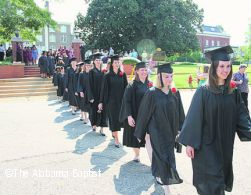
Participants in Judson College’s 95th annual Rose Sunday service Aug. 22 were happy after a rain-soaked weekend to find a clear morning, though very warm, as they walked the few blocks from the college to Siloam Baptist Church, Marion.
Underclassmen donned white gloves and many wore hats while seniors wore caps and gowns for the traditional processional and worship service marking the commencement of the new academic year which began the previous week. Each senior wore over her heart a single red rose — the college’s signature flower.
Rose Sunday was first observed on Sept. 19, 1915, but has its origins much earlier in a practice begun by the founder and first college president Milo P. Jewett. Jewett underscored the value of worship by walking with students to Siloam Baptist every Sunday.
Judson seniors began the day, appropriately in front of Jewett Hall, by passing through a woven ivy chain, crafted and held by the underclassmen in their honor — another long-standing tradition at the college.
Judson president David E. Potts then lead the procession to the church for worship.
In his presidential address, Potts brought laughter from the crowd by reading some “general regulations” from early college catalogues.
Students had to have permission from the principal to leave campus, to receive any magazines or newspapers and to open accounts in Marion. They were allowed to spend no more than 50 cents per month from their “pocket money.” Letters were subject to inspection unless written to parents or guardians, and two offenses merited expulsion: dipping snuff and “communicating with unmarried gentlemen.”
Potts then turned to the purpose of the day, urging students to trust God in times of adversity.
He noted that the founders of Judson College were no strangers to difficulty.
Gen. Edwin D. King was a Marion planter who suffered during the War of 1812. Julia Tarrant Barron gave land for the building of the college, and was instrumental in the establishment of Howard College (now Samford University) in Birmingham and the Southwest newspaper (now The Alabama Baptist).
After the Civil War, Barron was penniless, Potts noted.
And Jewett, Judson’s first president, was an abolitionist who faced censure from fellow Southerners.
Potts urged students to find strength in Christ.
He quoted from the book, “Harbingers of Hope,” by former Samford University provost William Hull in which he writes of his ALS disease.
“I am slowly but surely being saved: from depending upon my own strength to depending upon God’s strength . . . [with] gratitude that I can spend my days helping you to live out a story worth telling to others.”
Potts concluded his remarks, “I pray that something you hear or sing or pray or speak today will resonate within your soul and something so bright will reside within you that darkness will never come again and that you will ‘live out a story worth telling to others.’”
After music by the college’s concert choir, John Nicholson, Siloam’s pastor, delivered a challenge to the students based on Psalm 143:5–6.
“We stretch out our hands to God, not to receive anything other than his presence in our lives,” Nicholson said. “He is the one for whom we are truly thirsty.” (JC)




Share with others: