
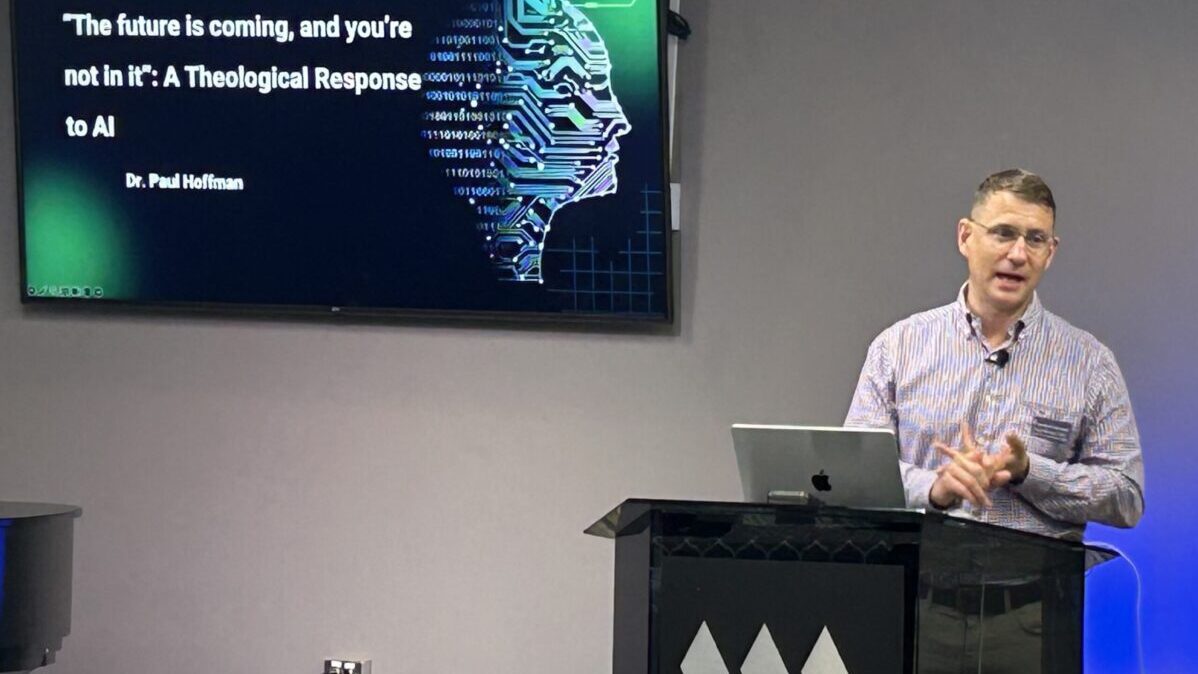
Modern pastors must exercise “selective ministry” in the world of Artificial Intelligence, according to a professor at Samford University.
“We must sanction ourselves in moderation,” Paul Hoffman, associate professor of biblical and religious studies, told a group of ministers from Birmingham Metro Baptist Association on April 15.
Looking for more articles on artificial intelligence and faith? Here are a few to check out.
What should worship leaders be asking?
“AI can help us with graphics and editing, but a ‘stop sign’ would be writing sermons or worship songs or delivering sermons — as some ‘avatars’ are doing now in Europe — or planning worship.
“The major question for us in worship should be, ‘Is God pleased?’”
Hoffman quoted journalist Kelsey Piper who defined AI as “the effort to create computers capable of intelligent behavior.”
On the move
The march to AI began in the 1960s with the invention of the computer, Hoffman asserted, then continued with the advent of the Internet. The U.S. military is responsible for much of AI development in attempting to provide national security.
The major philosophical question today is whether AI will advance or hinder human flourishing, Hoffman said.
He suggested AI has produced some good things, including medical diagnostics, drug discovery, fraud alerts in the banking world and better security with surveillance and threat detection. And there have been advances in Bible distribution.
“We have some 4,000 dialects in the world without Scripture, and AI is now being used to help us publish the Bible,” Hoffman explained. “This could be the literal fulfillment of Jesus’ word in Matthew 24:14 that ‘the gospel will be preached in all the world as a testimony to the nations and then the end will come.’
“I suggest we want AI to contribute to flourishing, but be subject to human agency and authority.”
Keeping AI in its place
Humans “create things of beauty, such as art and music,” Hoffman said. “We were endowed with this by our creator, and we don’t want to give away human autonomy. We want AI to be a tool rather than a partner.”
A survey released last year found two-thirds of pastors use AI in sermon writing, Hoffman noted, and 61% said they use AI either daily or weekly.
“I imagine this information was collected in 2024, so I’m sure the percentages are greater now,” he added.
At Hoffman’s request, several participants gave examples of how they utilize AI.
“I use it to find applications,” one pastor said. “It’s like finding materials in books of illustrations — we’ve always done that, and we adapt what we find to our own situation.”
Another participant said he completes his studies and asks AI to create slides to use along with the sermon.
“Yes, AI can be our friend,” Hoffman acknowledged.
“Technology has always created tension, and this is true now since everyone has a computer in their pocket or purse. The contrast is what we gain in knowledge can be negated by decreased social skills.
“Some studies show that our young people suffer incredible anxiety and insecurity due to constant cellphone use.”
Hoffman suggested people must stay connected in conversation, neighborliness, hospitality, friendships and nature — what one researcher calls “hearth habits” since the hearth used to be the focal point of the home.
Not for everyone
But some fear AI.
“It’s been called the ‘black box effect’ when humanity creates something they don’t understand,” Hoffman said.
“The greater fear is ‘general AI’ that lives and reasons, but we don’t have that yet. The European Union has taken steps to create guidelines for AI development and now it is under high control.
“But technology will never ‘outfox’ God. He’s in ultimate control of His creation.”
Hoffman and collaborator Sean O’Callaghan published, “AI Shepherds and Electric Sheep” in 2025, proposing ethical issues in the use of AI.
Hoffman can be reached at phoffman@samford.edu.


Share with others: