
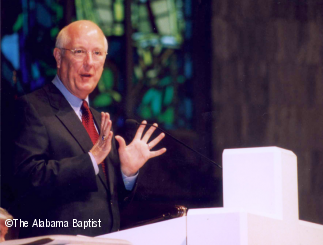
Few things are certain when Southern Baptists gather for their annual convention meeting. But the election of Fred Luter Jr. as president of the Southern Baptist Convention (SBC) is as certain as anything can be. Luter, who currently serves as first vice president of the SBC, will likely be elected without opposition. If someone else is nominated, it will be for personal reasons, not as a serious challenge.
Alabama Baptists know Luter as the popular preacher and pastor of Franklin Avenue Baptist Church, New Orleans. He has spoken at numerous state functions and is always well received.
Alabama Baptists also know him as an effective pastor who successfully shepherded his congregation following Hurricane Katrina even though major portions of the congregation temporarily relocated to three different cities, including Birmingham.
Luter also is an African-American and, if elected, will be the first African-American to serve as president of the SBC. That his election will take place in New Orleans is filled with historical irony, not because the city is Luter’s hometown but because New Orleans has been in the middle of Southern Baptists’ struggle with race relations.
In 1969 Southern Baptists gathered in New Orleans for their annual convention amid fear and trepidation. The week before the annual meeting, a highly respected state paper editor titled his editorial “Disruption of the Convention Is Possible.” He wrote, “There is a prospect, however, for something very dramatic and dangerous to happen in New Orleans. This is the possibility of the convention being confronted by ultraextremists with ‘Black Manifesto.’”
Racial tensions were high across the nation in the late 1960s. An African-American group led by James Foreman had invaded churches from New York City to New Orleans in the weeks before the SBC annual meeting demanding economic reparations for the injustices suffered by blacks through slavery and racism. SBC officials planned what to do if the group targeted the New Orleans annual meeting, but the 1969 convention passed without incident.
It was the 1970 annual meeting when a group of 15 African-Americans stormed the stage in Denver and demanded to speak to the convention. The program committee granted them 10 minutes. That the incident did not turn violent was due in no small part to the masterful work of Lee Porter, who was first vice president at the time.
But it was not the threat of confrontations or the demands for reparations that moved Southern Baptists forward on race relations. In 1968, the year Martin Luther King Jr. was assassinated, SBC messengers adopted a statement titled “The Crisis in our Nation.” In a section titled “Confessions,” the statement said, in part, “As Southern Baptists … claiming special ties of spiritual unity with the large conventions of Negro Baptists in our land, we have come far short of our privilege in Christian brotherhood. Humbling ourselves before God, we implore Him to create in us a right spirit of repentance and to make us instruments of His redemption, His righteousness, His peace and His love toward all men.”
The statement went on to call Southern Baptists to be involved in the “social issues of our day,” including race relations, as individuals, as churches and through SBC institutions.
Looking back, many say the 1968 statement provided denominational approval for aggressive actions in race relations.
The SBC Home Mission Board (now the North American Mission Board) and the SBC Christian Life Commission (now Ethics & Religious Liberty Commission) were the first to take actions with expanded emphases in race relations.
It was not until 1974 that messengers once again faced the question of race relations. That year an African-American pastor from Frankfort, Ky., was nominated for second vice president. In nominating Charles King, pastor of Corinthian Baptist Church for 25 years, Herman Bowers, pastor of First Baptist Church, Frankfort, said it was time for messengers to show they were serious about race relations. King, who formerly taught at Tuskegee Institute, won on the second ballot out of a field of seven candidates. He was the first African-American to serve as a national officer of the SBC.
African-American leaders asked if King would be allowed to “go through the steps” and become SBC president. The question reflected a culture of moving up in leadership much like Alabama Baptist presidents have done for the past decade. But before that question could be answered, King died of a stroke weeks short of the 1975 annual meeting.
It was 20 years before another African-American was elected second vice president. Gary Frost, pastor of Rising Star Baptist Church, Youngstown, Ohio, was elected in 1994 after serving on the SBC Executive Committee. In 1995, Luter became the third African-American to serve as a national SBC officer when he was tapped as second vice president.
Adoption of apology
That same year Southern Baptists officially apologized for the denomination’s role in slavery and for condoning racism for much of the denomination’s history. Charles T. Carter, pastor of Shades Mountain Baptist Church, Vestavia Hills, at the time, chaired the SBC Resolutions Committee that year and spearheaded the adoption of the apology.
Another 15 years passed before Southern Baptists had another major development in race relations. As part of the Great Commission Resurgence, leaders wanted to be sure the denomination focused attention on all people. The result was an SBC resolution affirming ethnic diversity in SBC leadership and participation approved in 2011 in Phoenix. Again, entities were encouraged to involve ethnic Baptists in governance and instructed to report on steps they took to encourage ethnic diversity.
That same year Luter was elected first vice president, the first African-American to serve in the convention’s second-highest office. Almost immediately, demands began for his election as president. When that happens, as we expect it will, Southern Baptists will have made history by electing their first African-American president.
Luter’s election also will illustrate the steady, focused work done in local communities among cooperating churches, in associations and state conventions that have concentrated on building bridges and cooperation between blacks and whites.
While there “are miles to go before we rest” in race relations, Southern Baptists have come a long way. Today the SBC is acknowledged as the most diverse denominational body in America. Unlike 1969, messengers will not gather in New Orleans fearful of being “invaded” by African-Americans. Instead, most anticipate electing an African-American as SBC president. That is a historic change worthy of note.
Share with others: