

The single mother of three walked several miles to get food for her family. When she arrived at the food bank run by Green Valley Baptist Church, Hoover, the staff worried she would not be able to carry the food home such a great distance. The Haitian woman explained she would make two trips if necessary. One of the church’s deacons drove her home with the food instead.
Another woman told the Judson Baptist Association Ministry Center that when she had almost run out of food, she stopped eating so her son could have what little was left. By the time she came to the center and received food, she hadn’t eaten for three days.
These stories of desperation illustrate the growing crisis of hunger in Alabama, evidenced by a new U.S. Department of Agriculture (USDA) report that rates the state among the worst in the nation for food insecurity. The report — Household Food Security in the United States, 2009 — was released in late November.
As the economic downturn takes hold, more and more families can’t find enough to eat, straining food banks and churches, reports indicate.
“What we’ve been hearing from our partners in the faith community is that they are overwhelmed,” said Kristina Scott, executive director of the Alabama Poverty Project. “They are running out of food; they are seeing a greater need for food than they can respond to.”
The USDA report indicated 15 percent of Alabama households — above the national average — were food insecure, meaning they had difficulty providing enough food for everyone in the family because of lack of resources. Of that number, Alabama was No. 1 in the nation in very low food security — 6.8 percent. This means some people in the household had to eat less and their normal eating patterns were disrupted because they couldn’t afford enough food.
Larry Logan, executive director of the United Way Community Food Bank in Birmingham, indicated the scope of the problem in the food bank’s winter 2010 newsletter.
“This past year (of 2009), the food bank distributed 7.1 million pounds of food,” he wrote. “This is a record breaking year for distribution for us. Unfortunately, the only reason we distributed such an amount is because the need was unprecedented. We could have easily distributed 14 million pounds had we been able to. That is simply how much people need help right now.”
Scott pegs the state’s poverty rate of 16.6 percent as a major reason why food insecurity is so high in Alabama; if people can’t make enough money to support themselves, they might not be able to afford enough food. But she indicated it is not the only reason.
“We all need to look at a combination of short-term and long-term factors,” Scott said.
In many rural and low-income neighborhoods, grocery stores can be hard to come by. Those that are available are often small stores that charge higher prices than large retailers such as Wal-Mart.
“If you’re poor, you might not have reliable transportation to get to a store that has food at a more reasonable price,” Scott said.
In addition, Scott says struggling families with children are likely to face even greater burdens as the holiday season approaches and schools close.
“Fifty-four percent of public school children receive free or reduced-price lunches in the state,” she said. “Those children get most of their meals in school.
“As we come into the holiday season, we know those children may not have access to reliable nutrition at home,” Scott added. “Food banks and food pantries will see even more demand for nutrition during the holiday season.”
“If you think about it, low income families are much more likely to have parents that do shift work, so it can be hard to be home to make the kids dinner when they get home from school, especially if you don’t have reliable transportation,” she continued. “It can be very complicated to meet the needs of your family if you’re struggling to keep the lights on and pay the rent.”
Even the poor in Alabama who receive food stamps (839,921 people as of August 2010) have a challenge buying enough food. Although the program is meant to supplement other income, the average benefit for a family of four — $68.88 per week as of 2009, according to an Associated Press article — adds only about $3 per meal.
The consequences of food insecurity are felt in a very real way, the USDA report indicates.
Some of the households surveyed nationwide said they ran out of food without money to buy more, could not afford balanced meals or their children were not eating enough. A small number (.2 percent) even said their children had gone an entire day without eating.
Rates of food insecurity were twice as high among single parent households compared to those headed by a married couple. Rates were also double among black and Hispanic households compared to white households.
In what might seem like a contradiction, research is showing a connection between food insecurity and obesity.
Todd Post, senior editor of the Hunger Report with the Bread for the World Institute, said when people can’t afford nutritious food, they tend to buy cheaper food that is more filling but less healthy. In places where grocery stores are scarce, people’s options are limited to what they can find at convenience stores. This unhealthy diet produces nutritional deficiency and obesity, which can lead to Type 2 diabetes.
“There’s a connection between obesity and hunger that people don’t realize,” he said.
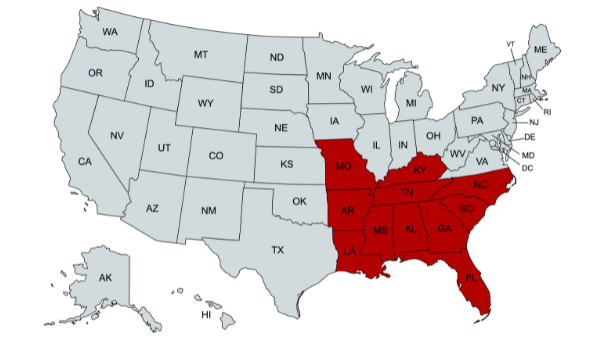
Of the 13.5 percent of Americans who suffered from food insecurity in 2009, while the South fared worst regionally.
Scott attributes the South’s poor performance to a variety of factors that also affect Alabama, including high poverty rates and low levels of educational attainment. If more Alabamians are to rise out of poverty, they will need to be trained to compete for the high-tech jobs of the future.
“We need to take some time to make education a priority,” she said. “We’re not competing with Central America for sock factories any more.”
Amid the state’s challenges, a number of Christian-run ministries in Alabama are working to provide food to those who need it. Such ministries include national organizations like The Salvation Army and city ministries in Birmingham, Huntsville, Mobile and Montgomery. Alabama Baptists also have more than 20 well established hunger-related ministries statewide.
“I have seen the very generous heart Baptists and other Alabamans’s of faith have, and their deep desire to reach out to those in need,” Scott said.
She emphasized that fighting hunger will require more than short-term aid such as handing out food. While such efforts are important, Scott said it is vital to solve the long-term problems that create food insecurity. To do that, she suggested partnering with food-insecure communities to produce solutions that will last.
“I really hope we can come together as a larger community and address these long-term needs.”



Share with others: