
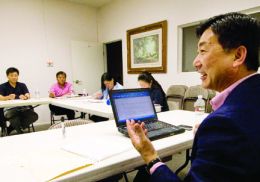
Just as Hannah lovingly presented her baby son, the prophet Samuel, to God, Bok Soon Kim, the Korean mother of Song Sik Kim, dedicated young Song to serve the Lord when he was but an infant.
Fifty-three years later, Bok Soon has gone on to be with her Lord but Song’s still serving God.
“When I was in high school, my mother finally told me she had dedicated me to the Lord,” said Kim, now a church-planting missionary ministering to Koreans in California. Once he learned of his mom’s giant act of faith, Kim said he was burdened constantly until 1980, when at 25 years old he finally answered God’s call to preach. “I was 100 percent sure that God called me.”
Now, jointly supported by the North American Mission Board and the California Southern Baptist Convention, Kim and his wife, Fanny — also a native of South Korea — have worked the last dozen years as church-planting missionaries in the Golden State.
California has a total population of almost 37 million people, and about a million of these are of Korean descent. Of this million, Kim estimates that some 800,000 are nonbelievers, and there are only 200 Korean Southern Baptist churches in California to reach and disciple them.
Living in Fullerton — about 25 miles southeast of Los Angeles — but with an office in Fresno, Kim is away from home 7–10 nights each month preaching, teaching and recruiting and training Korean pastors and seminary students as volunteer church planters.
Kim said the challenge for these young Korean church planters is that they lack experience and that church planting will be voluntary, second to their full-time role as local pastors or seminary students. The volunteer church planters do not receive salaries.
“We need more churches, more church leaders and more pastors,” he said.
With its 2,500 members, the largest of the 200 Korean churches in California is New Vision Church, Milpitas, about 50 miles southeast of San Francisco.
But New Vision is one of the few Korean churches in California that owns its own building, Kim said.
“It’s hard to find worship places,” he said, explaining that Korean Baptists are competing for space with other ethnic-group churches, such as Hispanic churches.
“We have to partner with Anglo, Hispanic or other churches and borrow their building for our services,” he said. “Real estate is so expensive in California. If we have to rent an office building or warehouse, it may cost $2,000 to $3,000 each month just for rent.”
Kim said reaching California’s Koreans requires a two-pronged strategy — one for ministering to first-generation Koreans and another strategy for reaching younger, second-generation Koreans.
“Probably 80 percent of the Korean population here is first generation,” he said. “They were immigrants from Korea, and their mother tongue is Korean. Their English is limited so that’s why we need English as a Second Language classes for most of them.”
Kim said worship services for first-generation Koreans are usually 100 percent in the Korean language. But it’s harder to reach the next generation, he noted.
“Second-generation Koreans speak good English because they grew up in the U.S.,” he said. “They want an English-speaking church in a cultural Korean setting, which is hard. We’re losing a lot of second-generation Koreans.”
Another challenge of working with the Koreans, according to Kim, is that Koreans are inherently a very shy people.
“They just attend a service or meeting and watch,” he said. “Americans, on the other hand, are very active. So when Koreans and Americans get together, there’s a wide cultural difference.” (NAMB)

Share with others: