
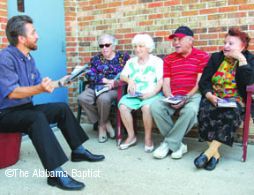
Little Anatoliy Odnoralov often came home after school with a bloody nose — the result of just another day as a Christian at his school in the North Caucasus region of the old Soviet Union.
"Since early childhood, I knew the price for my convictions," he said.
Odnoralov was the third-born son of an ordinary shoemaker, who, along with his wife, was a faithful believer in Jesus Christ. Unfortunately they were believers living in a godless, atheistic nation dedicated to the persecution of Christians.
"The school where we were studying mocked us for our convictions and belief in God," said Odnoralov, a North American Mission Board church-planting missionary ministering to the Russian and Jewish communities of Denver.
Although the Odnoralov children were excellent students in Soviet Russia, they were treated as second–class citizens by teachers and fellow students alike.
Continually harassed by the KGB, the former Russian secret police and intelligence agency, and the Soviet Union’s Committee on Religious Affairs, Odnoralov’s father was constantly summoned by the authorities. Accused of the inappropriate education of his children, they threatened him either with prison or with the taking of his beloved children.
The constant KGB badgering led to a series of lost jobs, and the Odnoralovs finally fell into poverty. Tragically the senior Odnoralov was killed in a road accident in 1982, leaving teenage Anatoliy and his 12 siblings in the care of their widowed, asthma-afflicted mother.
Anatoliy Odnoralov — whose life story could be a TV miniseries — suffered yet more, almost unbearable, religious persecution while serving in the Soviet army. After surviving the army, he attended Ukraine Bible Seminary; immigrated to the United States; married his wife, Natasha; and attended the Oklahoma Bible Institute in Oklahoma City. The Odnoralovs have four children.
In Denver, Odnoralov operates the International Center of Hope, a ministry focusing on the 60,000 Russian-speaking immigrants in the greater Denver area. Only 3 to 4 percent of them are believers, while 80 percent are Russian-speaking Jews. He and his wife also work to plant new churches to reach -Russian-speaking Jewish communities in Denver.
The chief project of the center is teaching English as a Second Language to as many as 100 Russian immigrants at a time. The center also offers computer, music, art, Russian history and Hebrew language classes. All of the classes are offered at a nominal charge. In addition, the center sponsors home Bible studies for Russian-speaking people. Odnoralov said they prefer studying the Bible in private homes rather than in local churches.
"It’s very important that people want to come to us, of their own free will," he said. "We want to establish relationships with them. We also have a big youth group, and we have summer camps to attract kids who do not know Jesus. We see kids accept the Messiah, and they pass on the good news to their friends and family members."
By forming relationships, Odnoralov said the Russian people can observe how Christians live. "We are open to them. They see our everyday lives. They see our households. We are not afraid to show them how we live. So we have mutual understanding and then they open up to the gospel."
He said it’s often difficult to minister and witness to Russian Jews. "There have been many dark periods for the Jews — like the Holocaust — in which so-called Christians were cruel to Jews. That’s why Jews nowadays are resentful and very skeptical about Christians."
Most of the Jewish immigrants from Russia are atheists, according to Odnoralov.
"Others are willing to admit there’s a God but they’re not ready to accept Jesus. They want to attend a synagogue rather than a church. Others say, ‘There is a God but I’m waiting for the Messiah.’"
Calling themselves Messianic Jews to emphasize what they believe, Odnoralov and his volunteers tell the Russian immigrants not only that the Messiah has already come but is also coming a second time at some point in the future.
"It’s very difficult for Russian-speaking people, especially Jewish people, to accept this good news," he said. "We usually have to work for a long time to create faith in them. As the apostle Paul said, ‘the veil on the Jews’ eyes can be lifted only by Christ Himself.’"
There was a time when Odnoralov wanted to stay always in Russia, where he was already a missionary doing important work. He had no desire to immigrate to America.
He asked himself, "Why do I have to go to America if I am serving here? But God created extraordinary circumstances and I had to go to the States. When I came here, I was asking God, ‘God, why am I here? What am I supposed to do?’"
Eight months into his new life in the United States, an old Jewish man helped open Odnoralov’s eyes. At the time, Odnoralov was handing out Christian literature to Russian-speaking Jews on the downtown streets of Denver.
"One day, an old man, a Jewish man, came up to my table," Odnoralov said. "He asked me why I had come there, bringing my strange God and Christian literature. I told him I was bringing the literature just to give out and let people read it. The old man looked deep into my eyes and said, ‘I’m an old man. I will die soon, but my people will live until the Messiah comes.’"
Odnoralov said the Holy Spirit immediately spoke to his heart, telling him to look into the eyes of the old man, into his heart.
"The Holy Spirit told me that the Jewish man’s eyes were empty and without hope. ‘I want you to speak, to tell these people about Me. Tell them without stopping,’ the Holy Spirit said. At that moment, I finally understood my call." (NAMB)

Share with others: