
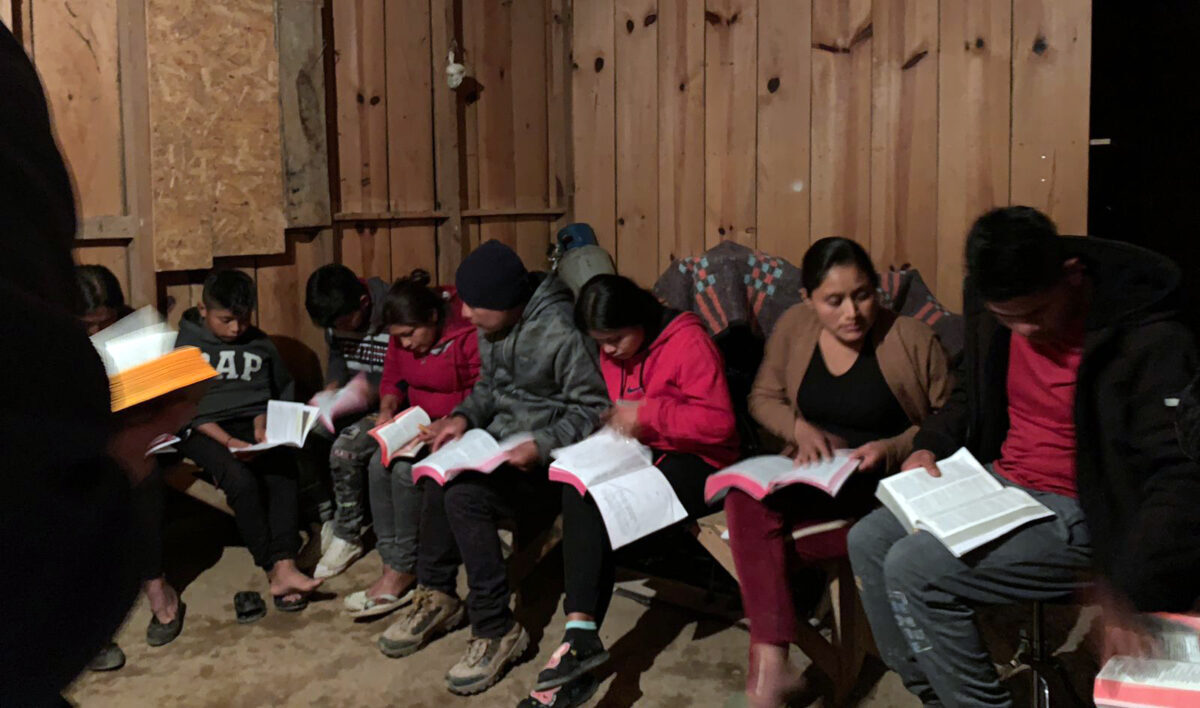
A locally renowned musician found himself sitting in the one-room jail cell of the local police station. In addition to an illustrious career as a pianist in a band, he was his community’s cantor.
Unflustered at his current situation, Thiago patiently waited, praying and contentedly waiting for the Lord’s will to be done.
Let’s back up a little bit.
Call to worship
Communities, especially in rural areas in Mexico, elect a member of the community, a cantor, to be a representative of the Catholic church. Small villages don’t often have their own priest, and the cantor performs many of the duties of a priest, who makes rotations to visit. Thiago’s community paid to have him trained how to perform funerals and other rites.
International Mission Board missionary Chris Armstrong serves among the Mixtec people, Thiago’s people group. He said beneath a thin layer of Catholicism is a very deep sea of animistic beliefs. While in Catholicism, people pray to saints as a medium for their prayers to be heard by God. In Indigenous communities like Thiago’s, where folk Catholicism is practiced, the saint is worshiped like a god, and they use the word for “god” in their language to refer to the saint.
When the community holds their annual fiesta to honor the community’s saint, Thiago, as cantor, would call people to come to the church to worship and view the procession of their god around the church.
Thiago is also a musician in a well-known Mixtec music group who’ve been performing together for around 20 years. The leader of the group committed his life to Christ after hearing the gospel from Jake Glover, an IMB missionary.
Glover, Armstrong and other IMB missionaries use 10 evangelistic Bible stories to share the gospel among the Mixtec.
Thiago also committed his life to Christ — a joyous moment, but also one that carried a weighty consequence.
“What do I do now?” Thiago asked. “My community wants me to lead them in worshiping this idol, and now I realize that’s wrong, and I don’t want to do that anymore.”
Armstrong and Glover pointed him to Scripture.
“You’ve decided to follow Jesus,” Armstrong told Thiago. “You now are equipped with the Holy Spirit. You know how to read the Word. You do what you think is right, and we’ll support you.”
Thiago went back to his community and resigned from his position as cantor.
“I’ve decided to follow Jesus,” he told them.
This didn’t sit well with the community. They invested money in him to provide the service for the village. Thiago was told he couldn’t quit. If he did, they’d throw him in jail and fine him heavily.
The threat didn’t change his mind. So, that’s how this story began — Thiago sitting in a concrete cell.
Church members came and visited him as he patiently waited and prayed. After five days, the community convened and surprisingly decided to let him go and not enforce the fine.
Pursuing another calling
Thiago is now one of seven men Armstrong is training and preparing for church leadership. Thiago preaches in the church regularly, leads the Lord’s Supper and recently baptized a new believer.
The church has 50 baptized believers who worship in their heart language, Mixtec. Armstrong said the church is healthy; the missing piece is formal leadership, which they are putting into place.
The Lord accomplished much in a short time that is worthy of appreciation.
The Armstrongs and Glovers arrived in the area in 2021 with Daniel and Lara Koon. In just five short years, they’ve gone from the start of a ministry to a healthy church.
The Glovers have already moved to a different country to begin a new ministry. The Koons moved to the next county to start a new work. Though they are starting over, they aren’t doing it alone. Thiago’s church is coming alongside them.
The Armstrongs are moving toward working themselves out of a job after local leadership is established and after they take a stateside assignment in the U.S.
They still plan to partner with Thiago’s church in the new area where they’ll move.
“We’ll still regularly work with these brothers,” Armstrong said. The idea is that they continue to gain independence and autonomy and establish themselves as a local church, and then we walk alongside them in planting other churches.”
Gospel goes viral
Digital engagement is furthering the reach of this Mixtec community. After band members committed their lives to Christ, they began posting Christian content — Bible stories and recorded Christian songs — online. This allows the gospel to go further and move faster.
The Armstrongs also have a digital engagement partnership with Mixtec churches in the U.S., including one in Richmond, Virginia, and Montgomery, Alabama. They also work with a Baptist association in California to plant a Mixtec church in a town with no Baptist churches.
“You never know what God is going to do in your life and how things are going to change,” Armstrong said. “But for today, we just want to keep using the resources, connections and gifts that God has given us to continue to reach the Mixtec people. Until He changes that, it doesn’t matter where they are.”
Some names changed for security.
EDITOR’S NOTE — This story was written by Tessa Sanchez and originally published by the International Mission Board.



Share with others: