
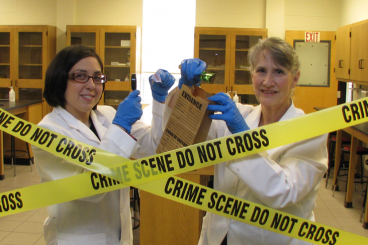
A new class in forensic sciences will turn a University of Mobile science lab into a “crime scene,” complete with a bloody footprint and clues students will investigate using scientific methods.
Gail Shelly and Larissa Parsley Walker are team-teachers of the upper level course that combines practical applications of chemistry, physics and biology with current techniques used by the criminal justice system in processing evidence at a crime scene.
“There is a pressing need for qualified personnel in the field of forensic science, and we hope to provide our upper level science majors with a look at this interesting multidisciplinary field,” said Shelly, professor of chemistry at the Christian university.
Walker, assistant professor of biology, said she enjoys watching television shows such as “CSI” that use science to solve a mystery, and so do her students.
“However, as enjoyable as these shows are, they rarely give a true representation of the science involved in a real criminal investigation. To help dispel some of these misconceptions, Dr. Shelly and I decided to develop a new, cutting-edge course in forensic science,” Walker wrote in an online journal on the university’s website. The professors will write about the course in the online journal and include clues that students will use to help solve the crime.
The journal, “Investigating Forensic Sciences,” is posted at www.umobile.edu.
Students get their first look at the “crime scene” during science lab Aug. 27 when the room is cordoned off with crime scene tape. Students will collect and analyze evidence throughout the semester to determine what happened in the lab and find the culprit.
“They will study the various techniques used by real-world criminologists, including analysis of broken glass, soil, fingerprints, drugs, tool marks, ballistics, hair, fibers, blood stains and explosives. Blood typing and DNA analysis will also be performed,” Shelly said.
(UMobile)


Share with others: