
Indonesian Muslim extremists warn that Christmas may be canceled in the Maluku Island this year
Candles will be used by people around the world during the Christmas season.
But lighting a candle in Indonesia’s Maluku Islands this holiday season could result in some form of punishment.
In fact, Christmas may be canceled altogether in the Maluku Islands, located in eastern Indonesia, if Muslim extremists there have their way.
Threats are circulating against the use of Christmas bells or candles in the islands, particularly on Ambon, said Southern Baptist representative Charles Cole.
Anyone who displays such symbols of Christmas or Christianity reportedly will be subject to punishment.
This means “basically they (Muslim extremists) don’t want any Christmas celebration,” Cole said.
Exterminating Christians
Muslim radicals seem to have stepped up their efforts to rid Indonesia of Christianity.
Tensions are heightened in part because a major Muslim holiday occurs just three days after Christmas this year.
“With this approaching holiday there seems to be an agenda to end the presence of Christians throughout the Malukus,” Cole said.
Violence broke out between Christians and Muslims on the Maluku Islands Jan. 19, 1999.
The almost two years of fighting have left thousands dead and hundreds of churches and mosques destroyed.
The conflict in 1999 was mainly confined to southern Maluku, especially the city and island of Ambon, but it spread to northern Maluku by the end of the year.
On Jan. 17 of this year riots erupted on Lombok, a resort island near Bali in central Indonesia.
As tourists were hastily evacuated from Mataram, the capital city of Lombok Muslim mobs ran through the streets shrieking, “Burn, burn, burn all Christians.”
Five-star hotels resorted to writing “Muslim owned” on doors and wall to prevent rioters from torching the premises.
Reportedly 3,000 Christians fled the mayhem, leaving shops and churches to be burned and looted.
The violence was perpetrated by extremist Muslim groups on the island, where Muslims form a majority of the population.
Moderate Islamic leaders have been quick to condemn and apologize for the violence.
Still, the most significant aspect of the January riots is that they represented the first time the Maluku violence had spread to greater Indonesia, where extremist Muslims had been campaigning for months to incite a general “jihad” (holy war).
As of today as many as 500,000 Christians have been driven from their homes and more than 4,000 have been killed by Muslim “jihad” paramilitary warriors who have publicly declared they will push all Christian off the island or kill them.
Medical care limited
The fighting has forced aid organizations to leave, and food, clothing and medical care are in short supply. Christian leaders in Ambon have said they feel the world is ignoring the crisis.
Recently Muslim fighters targeted a water taxi that was transporting 12 people.
All 12 passengers were shot. No information is available on their condition.
This attack follows a raid by jihad warriors on a village in Maluku during the week of Nov. 27.
Fifty people, both Muslims and Christians, were killed in the bloody attack.
The Associated Press reported that a national police spokesman confirmed the killings, while local government officials said they had no information about the clash.
In addition, Muslim extremists forced 700 Indonesian Christians to recant their faith under threat of death. Ninety-three Christians were murdered after they refused to convert to Islam.
Jihad warriors also blocked hundreds of Christians form boarding rescue ships waiting t take them to safety.
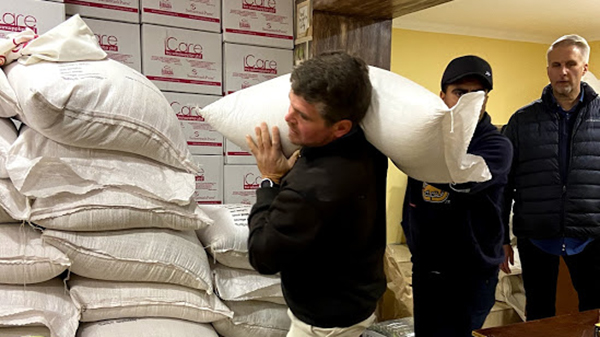
The International Mission Boar has dispatched a team t Indonesia to assess the humanitarian needs of the thousands of refugees.
One such need is for housing. As Muslims invade villages, they often burn people’s homes and possessions.
Entire families then are forced to live in an area the size of a typical American bedroom.
A church in California already has committed to send a construction team to Indonesia to build barracks for the homeless.
The most important need, however, is for prayer, Cole said. Missionaries ask churches and individuals to pray for Christians in Indonesia, especially during this time of year.
Vance Worten, an International Service Corps member serving on the relief team in Indonesia, asked for prayer for the more than 600 Christians on Kesui Island who are currently being held hostage.
Cole also asked for prayer. “Pray that (children) will have a sense that God has not forgotten them nor neglected them, that they can have hope in Him and enjoy His presence with them,” he said.
“Remember (the elderly) as they’ve seen everything they’ve ever known destroyed… that they might have joy within their hearts.”
And as families in America gather at church for Christmas services, missionaries ask the church to pray for Christians in Indonesia who no longer have churches in which to gather.
“Many of these Christians will not have a church building to celebrate Christmas,” Cole said.
Contributions to hunger and relief efforts on behalf of persecuted Christians on Ambon may be sent to: International Mission Board, Hunger and Relief Fund, Ambon Refugee Relief, P. O. box 6767, Richmond, VA 23230.
Every dollar donated will be used entirely for relief projects.


Share with others: