
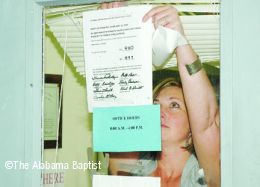
“The people have spoken,” Argo Mayor Paul Jennings said after citizens voted no to electronic bingo gambling. Less than an hour after the polls closed April 21 at the Argo Town Hall, the results of a nonbinding referendum were known — 440 yes, 497 no.
“It’s a good thing to know what the people want,” said Jennings, who initiated the vote. “When you get elected, you lose your right to your own opinion. If you don’t, you’re not representing the people and I’m representing the people.”
Argo Community Action Team member Phillip Nelson said he was relieved but also surprised with the vote. “We had three little signs and a group of individuals spreading the word, but nothing like what was happening from the other side (calls, letters, etc.),” he said.
Citizens for and against electronic bingo gambling had two weeks to “campaign” after Jennings announced the referendum at the April 6 Town Council meeting. While citizens expected a council vote on a “bingo” ordinance to be proposed by the mayor that night, Jennings said the council was at a 3-to-3 standstill about the issue.
So instead of the council voting, Jennings said he wanted to hear from citizens in an official manner, not just through random phone calls and e-mails.
But after the April 21 voting results were revealed — a combined vote total similar to the number of people voting in the last mayor’s election — Jennings said he would adhere to what the people wanted and would not pursue the issue further.
“I will not be proposing the ordinance,” Jennings said, noting he did not anticipate any council members proposing it either. But “according to the (recent) budget that was passed, May 6 will be the last day of the Fire Department. … The people have spoken and I hope they are aware of what their actions are causing.”
Several Argo citizens, however, say there are ways besides electronic bingo gambling to meet the town’s budget shortfall.
“I’m glad it’s over and I’m glad the vote came out like it did,” Kevin Cooper said. “I don’t think the Fire Department will be dead. I think there are other options that can be explored. It’s going to be hard but we can do it.
“That’s why I’m out here (at the polls) tonight,” he added. “I want to show my support and help figure this out.”
Bob Shariett agreed.
“I think it would have been much easier with the bingo, but I think it will be better without the bingo,” he said after volunteering all day at the polls. “We’ve just got to work, and we need other people that didn’t vote to help us. It takes a village.”
Sharon Shariett, who also volunteered at the polls, said some Argo citizens have already started working to help meet the town’s financial needs.
“We’ve got an action team working and trying to do anything we can to raise money,” she said, mentioning an Easter egg hunt, photos with the Easter bunny and a May festival.
Donations of nearly $60,000 have also come from families in Argo, a roadblock fund-raiser and local businesses.
But Jennings said the fund-raising efforts are just not enough to sustain the town’s budget needs.
At press time, a meeting was set for April 27 to discuss the financial situation and what cuts would have to be made, he said.
“It is not disappointing,” Jennings said of the vote. “It’s just, what’s the answer?”
Mississippi businessman John McLeod, who already had plans drawn up for a 15-acre electronic gambling complex on U.S. Highway 11 in Argo, said, “They are in, by far, the most dire financial straits I have ever seen.
“I hope they work it out,” he said. “My hope is that they do find an economic solution whether in partnership with us or another fashion.”
McLeod and three business partners created Roadhouse Gaming Systems LLC, a company organized specifically for the hoped for Argo facility, after approaching Jennings earlier this year. McLeod said one of the “gaming” manufacturer’s representatives suggested he contact Jennings because he had announced he was pursuing electronic bingo gambling as an option for the town.
“[The manufacturer’s representative] knew of me and my reputation and what we had done here and in other states,” McLeod said. “I picked up the phone and introduced myself.”
While he would not provide the other states in which he owns gambling businesses, McLeod did confirm that he, along with another set of business partners, owns Ba-Da-Bingo in Carbon Hill.
“We have a combined 75 years’ experience in the business,” McLeod said of himself and his partners.
He acknowledged that electronic bingo gambling is not the only option for Argo. “I think it was an option,” McLeod said. “But just defeating a proposal by the mayor does not solve the problem. That just removes an option.
“We had already escrowed $250,000 at RBC bank (in Trussville) … that we would have tendered 48 hours after passing [the ordinance allowing electronic bingo],” he said. This would have been the first of the quarterly business fees Roadhouse Gaming Systems planned to pay, equaling $1 million annually.
McLeod said the company also planned to give Argo $50,000 a month for charities such as the Fire Department, Police Department and others. “That’s $1.6 million a year guaranteed income to Argo,” he said. “That would have them completely out of debt in 18 months.”
For now, McLeod sits in a holding pattern waiting to see if Argo citizens and/or the Town Council will reconsider the electronic bingo gambling issue.
He added that the vote by Argo citizens does not change the overall status of electronic bingo gambling. “It is not a matter of stopping electronic bingo; it is just a matter of not participating,” McLeod said.
“It is deemed legal right now,” he said, referring to the ruling by St. Clair County Circuit Judge Charles E. Robinson that allows electronic gambling in Ashville. (Argo is in St. Clair County.)
And “the attorney general (Troy King) declared it legal even though he is against gambling. He went on record.”
But King’s findings are not an official opinion, nor a ruling.
“The 2004 findings are not an opinion. … And they are specific to the counties we looked at,” he said in an earlier interview with The Alabama Baptist.
The confusion over King’s findings, plus the fact that the legality of electronic bingo gambling is unclear even though several current laws and court rulings indicate it should be illegal, is one reason Nelson and other gambling opponents do not want to touch this issue right now.
Then there is the concern that one business would basically “own” the town and the fear that other gambling facilities would be built in Argo if it were allowed at all, Nelson said.
“I hope the bingo interests will leave us alone and not try to force it,” he noted.
To read King’s findings and other stories related to electronic bingo gambling, visit www.thealabamabaptist.org.




Share with others: