

According to the U.S. Department of State, modern Iranian history began with an uprising against the then–ruling shah in 1905. While there have been periods of peace and stability since then, it has mostly been a time characterized by upheaval and conflict, including overthrows of rulers, a takeover of the U.S. Embassy in Tehran and a war with Iraq. Today Iran is at the center of an international controversy over its development of nuclear capability.
In ancient times, the nation of Iran was known as Persia. The Persian Empire expanded and contracted over the course of several centuries, but it was always centered on the area now known as Iran. Ruled at various times by such greats as Cyrus, Darius I and Xerxes I, conquered by Alexander the Great, invaded by Genghis Khan and visited by the famed traveler Marco Polo, Persia played a significant role on the stage of ancient history. Its strategic location on the famed Silk Route brought travelers and traders to the area as early as 3500 B.C. as they sought silk from China for outlets in Eastern Europe.
The Safavids, members of a militant Islamic sect, were in power from 1501 until 1722, establishing an Islamic theocracy in the region, which was fragmented into various Mongol tribes. They converted, either voluntarily or forcibly, a majority of Persia’s Muslims from the Sunni to the Shiite sect of Islam. The Safavids, like other dynasties, eventually lost power but their impact remained. Persia entered the last century with the revolution of 1905, which ended with a new constitution and new limits on the power of Iran’s rulers, known as shahs. About the same time, oil was discovered, but it was more than half a century before the nation began to profit from the discovery.
The last two shahs, Reza Khan Pahlavi and Mohammad Reza Pahlavi, who were father and son, respectively, brought modernization to the nation. Some of the changes included reforms in education, transportation and land ownership. Women were allowed to earn an education and to abandon the practice of covering their faces with veils when in public.
Some of the national reforms under Reza Shah Pahlavi, whose rule began in 1921, were designed to lessen control of the powerful Islamic clergy. He established a secular legal system and a secular judiciary, and he removed control of the educational system from the religious leaders and transferred it to the government. In 1935, Iran became the official name of the nation. Mohammad Reza Shah succeeded his father in 1941 following the elder shah’s abdication. In 1951, Iran nationalized its oil production and ownership.
By the mid-1960s, the economy of Iran had begun improving, with large amounts of money flowing in as the black gold flowed out.
In 1963, the shah announced his White Revolution, which was a continuation and extension of modernization efforts. Some in the nation, particularly Islamic clerics, opposed the changes, which were seen as leaning toward the West.
The Ayatollah Ruhollah Khomeini, a high-ranking Shiite Islamic leader, actively opposed the shah’s new initiative. Exiled in late 1964, the ayatollah spent more than 14 years living outside the country, primarily in neighboring Iraq.
In spite of the infusion of oil money, the massive military, industrial and construction program of modernization put a strain on the newly rich nation. Inflation, political corruption, increasing repression and a widening economic gap between rich and poor created further discontent, resulting in a series of violent demonstrations and the ultimate exile of the shah in early 1979.
When the shah left, the exiled Khomeini returned. The nation soon held a referendum and voted overwhelmingly to become an Islamic republic. The new government was an unusual mixture of democracy and theocracy, with an elected president and the ayatollah, a religious “supreme leader” who is considered the most powerful person in the nation. Ayatollah Ali Khamenei is the leader today.
On Nov. 4, 1979, Iranian students, angered by the entry of the exiled shah into the United States for cancer treatment, invaded the American Embassy in Tehran, taking hostage the 66 American citizens who were in the building. Although some were set free, it was not until 444 days later that the remaining 52 were released.
The United States broke diplomatic relations with Iran on April 7, 1980. The Swiss Embassy assumed representation of U.S. interests in Tehran in 1981. The Iranian Embassy in the United States was also closed, and Iranian interests are now represented in the United States by Pakistan.
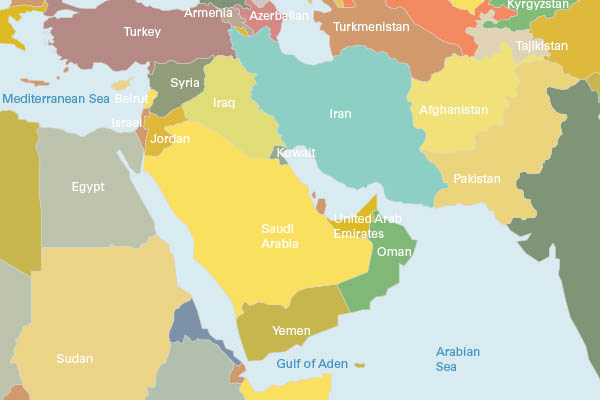
In the fall of 1980, neighboring Iraq invaded Iran, ostensibly to control the waterway between the two countries. The U.S. State Department described the underlying reasons as including “each nation’s overt desire for the overthrow of the other’s government.” The war ended in 1988 with a cease-fire and no gains for either nation.
More recently, Iran has raised tensions in the Middle East and the rest of the world with its resumption of a nuclear program that was abandoned after the Islamic Revolution of 1979. Although Iran agreed to suspend development in 2003 and 2004, it violated both agreements. In July 2006, the United Nations issued a resolution demanding that Iran stop all nuclear activities. More recently, the International Atomic Energy Agency suspended aid for almost half of its technical aid projects in Iran. On March 24, the United Nations issued broadened sanctions, including an import/export ban on Iranian weapons and a ban on all but humanitarian or development aid. The issue remains unresolved and fluid.

Share with others: