
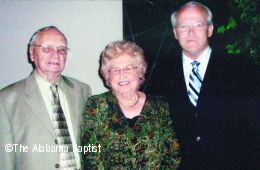
When Frank Page was a child, his parents were not Christians, but God used an older couple, Raymond and Elsie Hampton, to draw him to Christ, Page said as he recounted some formative influences on his path to the presidency of the Southern Baptist Convention’s (SBC) Executive Committee (EC).
His family was very poor and new to the Greensboro, N.C., area when the Hamptons reached out to them by inviting the children to Vacation Bible School and Sunday School at Southside Baptist Church.
“In one of those somewhat classic situations, during the invitation I went forward and I asked the pastor if he would help me come to know Christ,” Page said. “He prayed with me, and I prayed a prayer of confession and repentance and of begging God to come into my heart.
“Right there in front of the congregation there at Southside Baptist Church on that Sunday night I gave my life to Christ. I was baptized shortly thereafter, and then later my brother, my sisters, my mom and dad were as well.” Page was 9 years old.
Page acknowledged some struggles that are part of the Christian journey.
“Certainly there are many challenges of being a Christian. The ongoing struggle with sin in life as Paul talked about toward the end of his life, how he struggled even at the end to do what he should do and not do what he shouldn’t do,” he said. “That’s a continued challenge for me and I know for every believer to deal with the sinful nature that besets me and besets us.”
Last November, Page’s oldest daughter, Melissa, died tragically at age 32. In subsequent days, Page said he, his wife and his two younger daughters “have truly experienced God’s graceful hand.”
“God’s grace is sufficient, and we have seen it, we have experienced it. He doesn’t give us more than we need, but He never gives us less than we need. So we’ve seen His hand of provision,” Page said.
“Someone once asked, ‘How have you handled the death of your daughter?’ And I always respond and say, ‘I could never put that in the past tense. I handle it every day. … You deal with it every day. Some days are harder than others.’”
As he begins his tenure as president of the EC, Page, a former president of the SBC and former pastor for 34 years, said he believes he has been called by God to fill the role, and he cited an awareness of how God has ordered his life to shape him for the position.
Looking back, Page said he can see that in those 34 years God led him to pastor churches of varying sizes and styles, from small country churches to large city churches. Along the way, Page cooperated with Baptists on the associational, state and national levels.
“Everybody knows Southern Baptists are independent in nature and in polity, but to know that we do try hard to work together, I believe God has blessed that, and that’s a joy for me to know that I have partnerships at various levels with various people all over the world who are Southern Baptists.”
During a brief greeting to EC members in Nashville on Sept. 21, Page, president-elect of the EC, emphasized the importance of partnerships in the gospel ministry.
“The Bible tells us in Philippians Chapter 1 that there is a partnership in the gospel. The New King James Version calls it a fellowship, but most versions call it a partnership in the gospel,” said Page, who will assume the role of president Oct. 1.
“I want to pledge to you my partnership with you. I pledge that to you, and when I say I am a partner with you, that means a great deal to me because partners work alongside one another. They take care of one another.”
Page said the Greek term paraclete, though often translated “comforter” or “encourager,” comes from classic Greek literature in which two Greek soldiers were paired together.
“When the fighting got intense and even became hand-to-hand combat, one’s paraclete backed up to your back and you fought to the front and to the side, knowing that someone was behind you protecting that which you could not protect yourself,” Page, who was elected in June, told EC members.
“To me, that’s a partnership. That’s where I want us to be, that we care for each other in that way, that we stand with each other in that way.”
While he is excited about the days ahead, Page said he realizes that the role of president of the EC is “way beyond” his ability.
“There are forces swirling about us in our convention, in our society, that do not bode well for partnership ministry. There are forces that pull us apart, that pull us into more individual directions,” he said.
“But I pledge to you to do all that I can to be your partner and to work together to see the gospel spread and the Great Commission accomplished.”
At subsequent EC meetings, Page said, he will present a 10-year vision and strategy, which will include a goal of seeing the International Mission Board reach every unreached people group with the gospel message.
“I’m going to be the CEO. Do you know what that means? Chief Encouragement Officer,” Page said. “I want to encourage the North American Mission Board by the year 2020 to be able to share the gospel with every man, woman, boy and girl on this continent.”
Page also intends to support the convention’s other entities, including the seminaries.
“Some say this whole ship is sinking,” he said. “Some say fast, some say slow. But I will tell you this: Without partnerships, it is a lost cause.”
What is needed more than anything for a Great Commission resurgence, Page said, is a “Cooperative Program (CP) resurgence.”
“The truth is that the pie [CP] has to get bigger,” Page said. In order for that to happen, he said the EC will work in conjunction with Baptist state conventions to promote the CP.
Asked if the EC would promote “Great Commission giving” — one of the recommendations of the Great Commission Resurgence Task Force — Page underscored: “We will celebrate all missions giving, but we will promote the Cooperative Program.”
However, Page emphasized that “we are not going to beat people over the heads” with the idea that they have to give through the CP in order to be a good Southern Baptist.
“We are going to promote the vision of our Lord Jesus — that being the Great Commission — and ask people to come together to support a vision, not a program,” Page said. (BP)


Share with others: