
Tension built Tuesday afternoon as messengers lined up at microphones across the convention hall to debate the report of the Great Commission Resurgence (GCR) Task Force. The moment had been anticipated by the more than 10,000 messengers who assembled that day in Orlando, Fla., for the annual meeting of the Southern Baptist Convention (SBC). Only a handful of messengers wandered through the exhibit area. Most congregated to hear the debate and cast ballots for or against the task force’s report.
As emotions built, a messenger from Texas expressed his concern about the division he felt in the room and asked SBC President Johnny Hunt to lead the group in prayer. Without asking messengers to approve the request, Hunt complied. During the prayer, Hunt said he did not feel division in the room but only passion for the Great Commission.
Hunt’s words came less than an hour after SBC Executive Committee (EC) President Morris Chapman urged messengers to vote against the report (see story, page 4). Chapman devoted the final address of his 18 years at the helm of the EC to pointing out shortcomings and dangers of the report. Leading up to the meeting, he had been an outspoken critic of the report. And during the debate, an early effort to kill the report “because of the division [it] has created among Southern Baptists” was successfully pared by the GCR Task Force.
Passion or division, which was more prevalent during the annual meeting?
Before messengers gathered, one prominent convention personality lamented that Southern Baptists were more divided than he had seen in years. He pointed to the four candidates for president as evidence of the division. Two candidates endorsed the task force report. Two called for its defeat. Also cited as proof of division were two candidates for SBC Pastors Conference president instead of one predetermined choice.
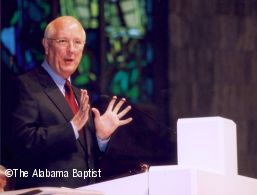
At the pre-convention meeting of the EC, more evidence of division surfaced. Former SBC President Frank Page was elected to succeed Chapman as EC president (see story, page 3). But that vote did not come until after almost two hours of closed-session debate. The closed session was the first in 18 years and provided cover for a sizable number of EC members to challenge Page’s nomination, which had earlier drawn the ire of a number of megachurch pastors. During the closed session, a number of EC members questioned Page’s conservative credentials because he had not been a leader in the conservative resurgence.
Page was elected by a 44–30 vote, participants shared. Page did not challenge the numbers when asked about the vote. He only pointed out that he got more votes than the newly elected chairman, Roger Spradlin of California. Spradlin beat out Doug Melton of Oklahoma for that position by a vote of 40–31 (see story, page 3).
At the Pastors Conference, it was hard to tell if it was concern about division or simple passion that was driving the campaign to approve the task force’s report (see story, page 6). In addition to preachers in every session promoting its adoption, 10 minutes of each session was devoted to a GCR challenge. The campaign climaxed Monday evening with task force chairman Ronnie Floyd reminding the audience that the Pastors Conference has historically played a major role in determining the direction of the SBC and urging listeners to support the report the following day. The emphasis ended when Mac Brunson, who preached the convention sermon, led those attending the Pastors Conference in prayer for the task force.
The passion for the report was obvious to all. So was the concern about division as several people spoke about “no matter what happens.”
During the GCR debate, messengers could not agree about the relationship of the Cooperative Program (CP) and the proposed giving category called Great Commission Giving. The report called for establishing the new category. An amendment from the floor omitted much of that wording and called for “continuing to honor the Cooperative Program as the most effective means of mobilizing churches” in missions.
When a show of ballots was too close to call, parties frantically huddled to work out a compromise that ended up keeping the original wording and adding the emphasis on the CP. At least in this case, passion overcame division.
When the final vote affirmed the report as amended, backers were quick to say only about 25 percent of messengers opposed the report. Others placed the opposition near 40 percent. Without a ballot vote, the exact number will always be unknown. Even though winners usually write the accepted version of history, this writer’s observation of the vote placed the opposition closer to 40 percent than 25 percent.
That everyone who voted passionately held to his or her position was obvious. But the passion could not hide the division evidenced by the vote.
The struggle between passion and division did not end with the vote. The next morning, messengers challenged a decision by the task force to seal its records for 15 years. Members said it was necessary to maintain confidentiality for some who testified before them. Those wanting the records made public argued that Southern Baptists should do their work in the open. In the end, messengers concluded it was more important to keep confidentiality than it was to practice transparency.
Both passion and division were still on display, as messengers huddled in small groups to talk about what happened the day before. Feelings pro and con had not subsided. What became evident was messengers were not in agreement on what they had done. Some argued that following the vote, SBC entities had no choice but to implement all the task force’s recommendations.
Others argued that each of the recommendations asked the respective entities to “consider” the proposed action. Many cited the exchange between Missouri Baptist Convention Executive Director David Tolliver and task force member Al Mohler. Tolliver attempted to refer the report to the EC for evaluation and reactions from various entities and state conventions before decisions were made.
Mohler, speaking for the task force, said the task force agreed with Tolliver’s desire and that was what the report did (see video of the exchange at www.thealabamabaptist.org).
To use an analogy from last week’s editorial, the first inning of the GCR ballgame is over. Now the second inning will be played out in a variety of places where division and passion will continue to be visible. And there will be subsequent innings.
But remember, the game is about what methodology Southern Baptists should use to display their common passion to penetrate lostness.
Southern Baptists must be careful to make sure their differences about methodology do not over shadow their unity concerning passion for the Great Commission. If that happens, then all will ultimately lose.

Share with others: