
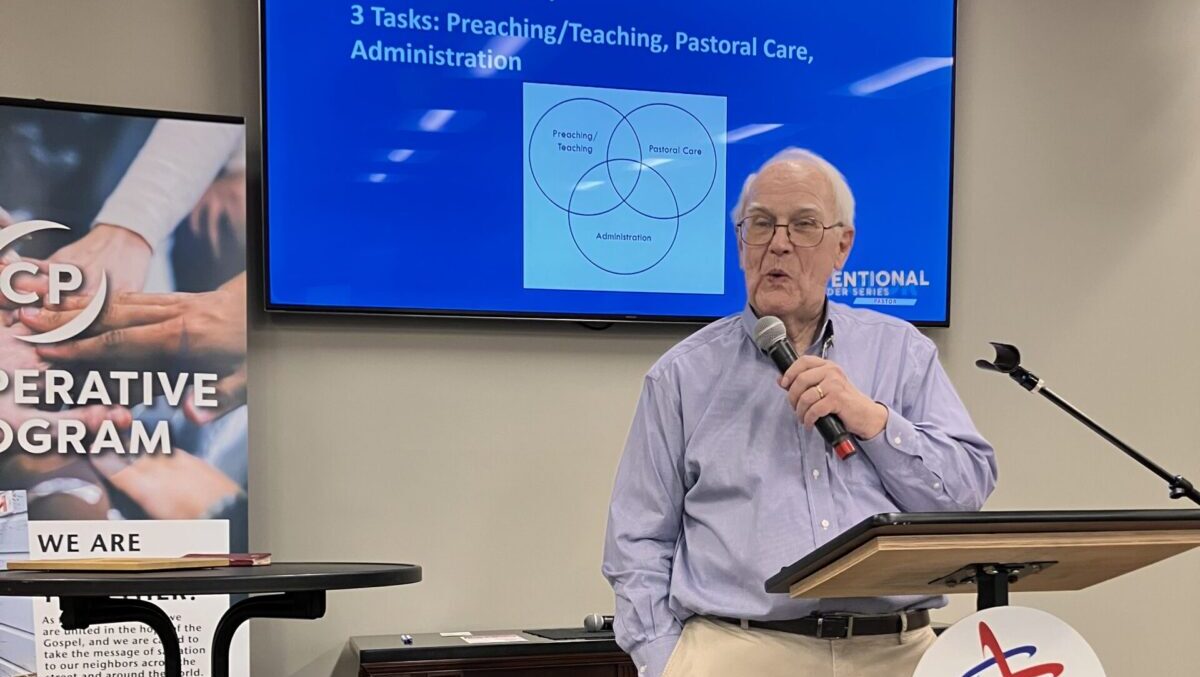
Dealing with people is “a social science, and it’s hard to be exact about human personality,” according to a retired leader for the Alabama Baptist State Board of Missions.
“That’s why we use words like ‘probably’ and ‘usually,’” Dale Huff, retired director of the SBOM office of LeaderCare and church administration, told a group at the Intentional Leader event April 21. “Pastors can’t control how people treat them, but you can control how you treat others. You can treat them ‘Jesus-like.’”
Subscribe to The Alabama Baptist today!
SIGN UP for our weekly Highlights emails.
Huff, who recently completed his 21st interim pastorate, said the work of the pastor is identified by three interlocking circles: preaching and teaching, pastoral care and administration.
“We have to work on all of these areas and constantly grow,” he said. “The weakness of your weakness is what can get you into trouble. We are students who learn, who read constantly and who listen to suggestions from others about personal improvement.”
Pastors at every ministry stage need mentors who can be honest with them, and at the same time have “Timothys” they mentor, Huff asserted.
“As you climb up, lift up,” he encouraged the audience.
Huff recalled that he attended Crescent Hill Baptist Church in Louisville while in seminary and was impressed with the pastor, John Claypool, who often said, “Be kind to every person, for every person bears a burden.”
“Some suggest 25% of those you preach to on Sunday morning are in grief,” Huff noted.
“Grief is loss and there can be all kinds of losses such as death, job changes and financial reverses.”
Priorities
Pastoral care involves the congregation, staff and family, Huff said.
“[D]on’t overlook your own family” in pastoring, Huff added. “Many pastors look back with regret at lost opportunities to invest in spouses and children. Don’t be a flop as a pop.”
Much of Huff’s work with Alabama Baptists involved meeting with and advising pastor search committees.
“We used to call these ‘pulpit committees,’ then we learned that the pastor does more than stand in the pulpit,” Huff said. “Preaching and teaching [are] important, but the pastor also leads and cares for people.”
Huff said he encouraged pastors to always go where God leads them, but to do so prayerfully and with due diligence.
“Ask the [pastor search] committee about what to expect, and read the bylaws,” he said. “Find out who is authorized to do what in the church. Learn the church’s conflict history. This is often indicated by the short tenure of pastors — four years or less.”
Navigating conflict
Conflict management was another of Huff’s major tasks before his retirement.
“Where two or three Baptists are gathered, there is liable to be conflict,” he quipped, citing a survey conducted in Southern Baptist associations revealing that the major source of conflict is power.
“It’s not the color of the carpet, as we sometimes joke, but it’s who decides the color of the carpet,” Huff asserted.
“I often drove home at night with a broken heart after what I saw and heard. We say we have congregational government, and this is true, but you don’t always settle conflict with a vote.”
Huff acknowledged conflict is inevitable and though most can be worked through, it can intensify when people personalize and spiritualize.
“Pastors need to be careful, too, about spiritualizing issues and citing God’s will casually.”
Huff noted there is a difference between power and control.
“A pastor is a change agent, and this requires some measure of power,” he said. “But power becomes control when it turns manipulative. The pastor sees where the church is and where it ought to be, but he should always include people in the process, asking them to pray with him about God’s will for the church.”
Pastors must choose carefully the substantive changes they’re willing to pursue, and Huff advised pastors to go slowly and perhaps take a year to determine new direction.
“After a year, I might decide other things are more important than I first thought,” he explained.
The next installment in the Intentional Leader series is scheduled for July 14 with Tim Beougher, Billy Graham professor of evangelism and church growth at Southern Baptist Theological Seminary.



Share with others: