
Fourteen years ago at the state pastors conference, I was parking cars,” said Zach Terry, senior pastor of Capshaw Baptist Church. “It’s neat to serve a God who moves people out of the parking lot to the pulpit.”
“I’m trying to think if you’re the guy who messed up my car that night,” joked Buddy Gray, pastor of Hunter Street Baptist Church, Hoover.
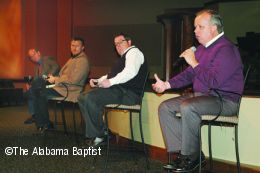
The friendly dialogue was part of a question-and-answer time during the morning service of the Alabama Baptist Pastors Conference at Gardendale First Baptist Church on Nov. 15.
This was the first year the pastors conference included a question-and-answer session, something Kevin Hamm, president of the conference and senior pastor of Gardendale First, hoped would encourage pastors to “learn from one another and grow together.”
Hamm moderated a panel of pastors — which included Terry and Gray, two of the six conference speakers — who answered questions from the floor or sent earlier by e-mail. The other members of the panel were the other Alabama Baptist pastors on the conference program: Ed Litton of First Baptist Church, North Mobile, in Saraland and Lawrence Phipps of Vaughn Forest Baptist Church, Montgomery.
One of the questions was “How do you deal with criticism and resistance?”
“Preachers in the South are like house cats; we are well-fed and stroked often but (also) often evaluated and criticized,” Litton said lightheartedly.
But in all seriousness, he said, that criticism does hurt but that’s why a pastor must place his security in God, not in what others say.
Terry agreed and added that there are times when criticism is good.
“You’ve got to remember in every criticism, there’s an ounce of truth,” he said. “Sometimes your critics will be your best friends. Sometimes I’ve written critics and I’ll say, ‘Thank you. That is a faithful wound of a personal friend.’”
Hamm asked if there was a pastor in the room who had never been criticized by a church member. No one raised a hand.
“Criticism is part of ministry and it does hurt and all of us experience it,” Hamm said. “There’s an innate desire as a shepherd to please everybody, and when someone doesn’t love you back, you think, ‘What’s wrong with me?’”
He then asked the panelists to discuss how the recession has impacted the ministry of their churches.
“To be honest, we haven’t handled it well,” Litton responded. “My staff and I were slow to understand it. It sent a message … that we were disconnected because we were.”
Phipps said he was guilty of something similar in his church.
“I was doing the thing that was the wrong thing to do. I was telling my people that God owns it all and He’s going to supply, and I was telling my congregation that I wasn’t in touch with where they were,” he said.
Even though those statements were true, Phipps said he wasn’t meeting people where they were. “Our people weren’t giving, saving and living on the rest,” he said. “It wasn’t about unemployment. … We started having to deal with the fear issue.”
Audience member Tony Banning, pastor of Pine Grove Baptist Church, Bay Minette, echoed his struggle and said the issue of fear has been the greatest struggle in his church.
“The economy is causing people to live in fear instead of living in faith. I’d like to hear how you all have dealt with that,” Banning said to the panel.
“One thing that happens is that when your god is attacked, you become fearful,” Gray said. “This is a way for us to find out who it is that we really worship. If [your God] is Jesus Christ, then He is the same yesterday, today and forever. I want to encourage you to teach your people how great our God is.”
Phipps noted that about a year and a half ago, America’s god — its financial systems — wasn’t just attacked; it died.
“That god isn’t coming back to life. … We’ve been setting our God up there with all the other gods,” he said.
Share with others: