
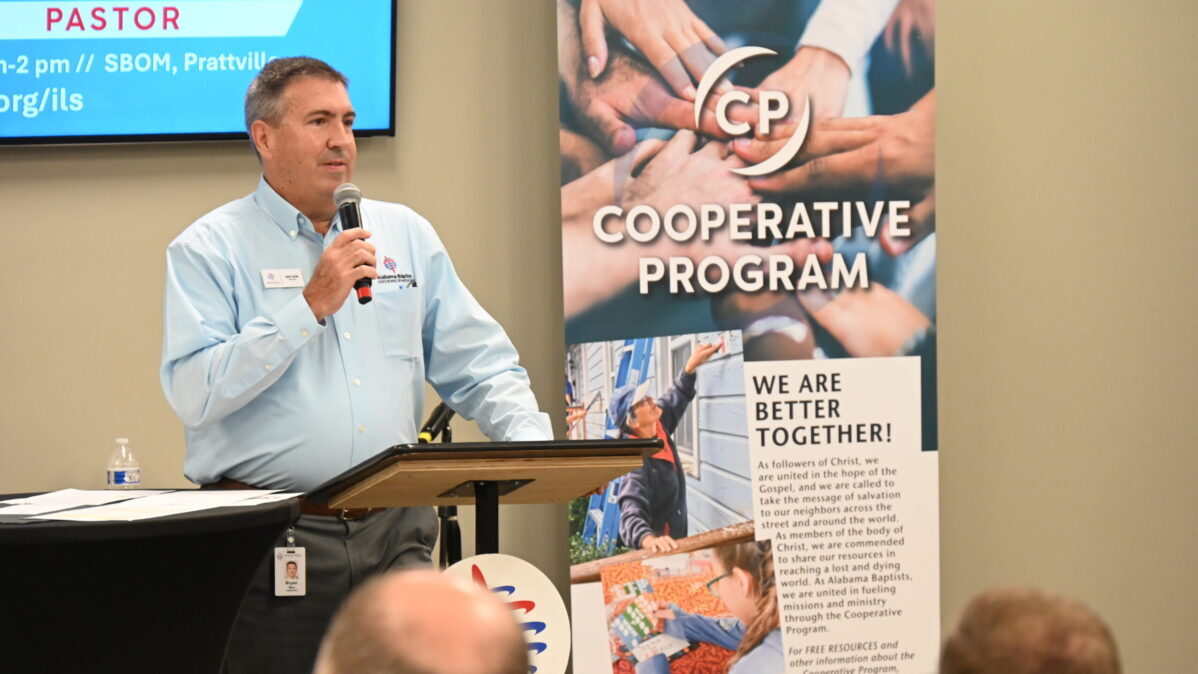
The last event in the third year of the Intentional Leader program focused on Shepherding Well.
Hosted at the Alabama Baptist State Board of Missions office in Prattville, the conference featured several SBOM staff.
Bryan Blass, director of the Office of LeaderCare, told of his call to vocational ministry after several years of work in sales.
Subscribe to The Alabama Baptist today!
SIGN UP for our weekly Highlights emails.
Two mentors “encouraged me to pursue God’s call and told me that people would be both my greatest joy and my greatest disappointment,” Blass recounted.
“Today I deal with conflict resolution as part of my ministry. I tell pastors they’re called to love and lead the sheep, even though sometimes sheep bite!”
Blass cited Paul’s counsel in 1 Timothy 4 for pastors to give themselves to love, faith and purity.
“Faith means that we suffer graciously when persecuted, persevere when nothing spectacular is happening and we forgive even when the offender continues to offend,” Blass asserted. “And purity is a prerequisite for fellowship and intimacy with God.”
The process
Ken Allen, director of the office of associational missions and church planting, counseled participants to build healthy relationships, seek wise counsel and model kindness in dealing with the disappointments of ministry.
“Don’t ‘get in the mud,’” he said. “Don’t seek vengeance or retaliation. Resist sarcasm, gossip or bitterness. Instead of defending yourself, listen to the critics. Ask, ‘What would you suggest?’ and ‘What do you think is the next step for us as a church family?’”
Allen noted pastors should seek to understand the church culture and value what church members value, including “listening well.”
“I think we’d admit that often we don’t listen,” Allen said. “We’re more focused on how we’ll respond to the other person instead of taking time to really hear what they say.”
“The ‘product’ is what we’re after, but the ‘process’ is critical,” Allen asserted. “That’s why we need to build a team who know our heart and who help us achieve goals.
“I know there’s some disagreement about this, but I think one major change per year is about what a church can process.”
Rob Jackson, director of the office of evangelism, told the group the pastor must equip the sheep or “unleash” them to ministry. He distributed a spiritual gifts inventory and suggested participants use it or adapt it for their purposes.
‘Mantle of leadership’
Jackson noted pastors have “the mantle of leadership,” and sometimes enter seasons where they wonder, “Should I stay or should I go?”
“If you’re wrestling with this question, don’t rush the process,” Jackson encouraged. “Saturate it in prayer, seek godly counsel and trust that the Lord who called you into ministry will also lead you where He wants you next — and then you will have clarity on whether you ‘should stay or should you go.’”
During a general discussion session, Jackson said one of his greatest “do-overs” would be to take vacation allotments and spend more time with his family. He once was offered a sabbatical but turned it down and told the church he’d rather stay with them.
Pastor shortage
The leaders also agreed that the current shortage of pastors is real, and many are far less restless than a generation ago, knowing the “grass may not be greener” in another pastorate.
“I think we should try to water the grass where we are,” Blass quipped.
Four leadership events are planned for 2026; a schedule is posted at leadercareal.org.
Blass can be reached at 334-613-2210.



Share with others: