
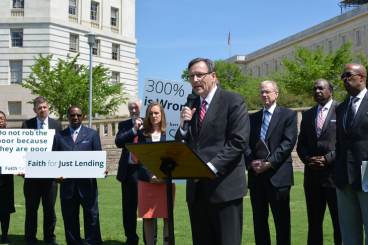
The Southern Baptist Ethics & Religious Liberty Commission (ERLC) has helped launch a religious coalition seeking an end to the predatory loan industry.
ERLC joined with other religious organizations May 14 to announce the Faith for Just Lending Coalition at a Capitol Hill news conference.
The diverse alliance that includes Baptists, other evangelical Christians and mainline Protestants seeks to raise awareness about predatory lending and motivate individuals, lenders, churches and the government to help bring an end to the practice.
Alabama Baptists also were represented at the news conference.
Commonly referred to as payday lending, the growing practice often draws poor people especially into a debt trap by charging excessive, and often misleading, interest rates, according to coalition members.
While an interest rate may be presented by a lender as 15 percent, for instance, it actually is only for the two-week period until a person’s next payday.
The annual interest rate may be 400 percent or more, making it difficult for the borrower to repay the loan. It requires years for some people to pay off their debts.
More than 20,000 in US
More than 20,000 payday and car-title loan stores exist in the United States, according to the coalition. Payday lenders also operate online in a country that has a variety of state and local laws regarding the practice.
Coalition members decried the predatory practices of payday loans in introducing their effort.
Predatory payday lending “grinds the faces of the poor into the ground,” ERLC President Russell Moore said in a written statement announcing the coalition’s formation. “As Christians we are called by Jesus, by the prophets and by the apostles to care for the poor individually and also about the way social and political and corporate structures contribute to the misery of the impoverished.”
Barrett Duke, ERLC’s vice president for public policy, said at the May 14 news conference, “God is not an economic Darwinist. He does not believe in survival of the fittest when it comes to the treatment of the poor.
“The Bible speaks clearly about appropriate ethical behavior in business,” he said. “[God] didn’t oppose financial transactions, but He did, and He does, oppose predatory activities that take advantage of someone, especially the poor.”
Messengers to the 2014 Southern Baptist Convention (SBC) meeting approved a resolution that denounced predatory payday lending and called on the adoption of government policies to end the practice.
From a biblical standpoint the SBC resolution notes, “All … predatory behavior conflicts with God’s plan for human relationships (Ex. 22:25–27; Lev. 19:35–36, 25:35–37; Neh. 5:1–13; Prov. 11:1).”
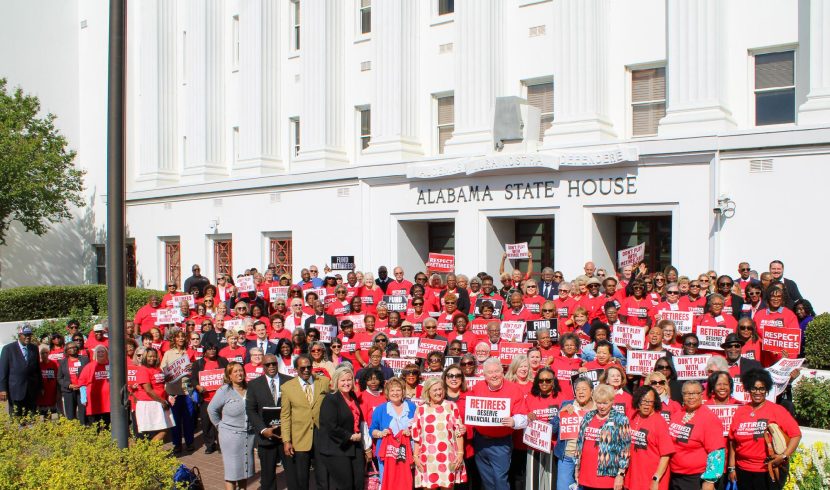
Messengers to the Alabama Baptist State Convention in November 2014 also passed a resolution condemning the excessive interest rates charged by payday and title loan companies.
At the May 14 news conference Joe Godfrey, executive director of Alabama Citizens Action Program, said, “The resolution called on state legislators to cap the interest rates at 36 percent, but the voice of the largest denomination of churches in Alabama has thus far been ignored, not by all the legislators but by some key leaders and committee chairpersons in the Alabama [Legislature].”
Alabama permits payday lenders to charge an annual interest rate of more than 450 percent and has more title-lending outlets than any other state, Godfrey explained.
“A bill capping payday loans at 36 percent is currently in the Alabama House and we are encouraging Alabama legislators to take the bill seriously,” he said. “We (also) join with others from across the nation in urging Congress to protect people nationwide from loan sharks that prey on people who can least afford these exorbitant interest rates.”
Other members of the Faith for Just Lending Coalition are the National Association of Evangelicals; Cooperative Baptist Fellowship; National Baptist Convention U.S.A. Inc.; National Latino Evangelical Coalition; Center for Public Justice; People Improving Communities through Organizing National Network; and Ecumenical Poverty Initiative.
At its launch, the coalition announced the following principles for just loans:
-“Individuals should manage their resources responsibly and conduct their affairs ethically, saving for emergencies and being willing to provide support to others in need.
-“Churches should teach and model responsible stewardship, offering help to neighbors in times of crisis.
-“Lenders should extend loans at reasonable interest rates based on ability to repay within the original loan period, taking into account the borrower’s income and expenses.
-“Government should prohibit usury and predatory or deceptive lending practices.”
Building support
Duke said in a written statement for the coalition that since payday lenders often “refuse to operate in a responsible manner, government intervention is crucial. We cannot sit idly by while some of the poorest among us are preyed on by people simply looking for a quick buck with no regard for the devastation they cause in the lives of others.” (BP, TAB)



Share with others: