
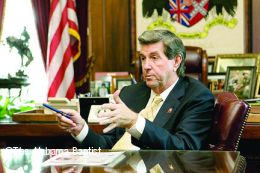
A recent Sweet Home Alabama Coalition commercial caused a media firestorm when the group accused Gov. Bob Riley of taking $13 million from the Mississippi Band of Choctaw Indians to keep gambling out of Alabama.
The Choctaws have denied the claim, and Riley called the ads “false and slanderous,” requesting TV stations around the state pull them. Many TV stations responded and are no longer running the ads, but some Alabamians may still be scratching their heads and wondering how to dig through all the layers in search of the truth.
The advertisement causing the commotion refers to a 2006 article by The Associated Press (AP) and printed in The Decatur Daily describing a lengthy report from the U.S. Senate Committee on Indian Affairs. According to the article and report, William Worfel, former vice chairman of the Coushatta Tribe of Louisiana, told “disgraced Washington lobbyist” Jack Abramoff that former Mississippi Choctaw Chief Phillip Martin spent $13 million “to get the governor of Alabama elected to keep gaming out of Alabama so it wouldn’t hurt … his market in Mississippi.”
Although Riley is not mentioned by name in the June 2006 Senate report, Todd Stacy, Riley’s press secretary, said attempts to link Riley to the Choctaws — who own and operate several casinos in Mississippi — occurred in both of Riley’s gubernatorial campaigns but were disproved.
“Every penny of the governor’s fund raising has been disclosed,” Stacy said. “You can see the individuals that gave to him and the path that gave to him. He didn’t spend $13 million on the whole campaign. He spent a little over $12 million obviously with many different sources of individuals.”
But the aforementioned AP story says understanding campaign contributions is not as simple as it may sound.
One such donation included in the article came from Michael Scanlon, press secretary for Riley during Riley’s U.S. representative years, who later worked with Abramoff for the Choctaws.
“Alabama campaign finance records show Scanlon gave $100,000 in 2002 to four political action committees (PAC) that contributed heavily to Riley’s campaign for governor,” the article states.
“The donations to PACs run by lobbyists Joe Fine and Bob Geddie were mixed with many others. The Fine-Geddie PACs contributed more than $625,000 to Riley’s campaign for governor.
“But Alabama’s campaign finance laws make it impossible to tell if any of the Scanlon donations went to Riley. When Scanlon contributed the money, he was doing work for the Mississippi Indians.”
To further clarify his position, Riley told television station WTVY in Dothan, “I have never met a Choctaw. I have never spoken to a Choctaw. I have never had a Choctaw ask me to do anything.
“I can’t remember ever, in any circumstance in my life, having had a conversation with anyone with the Choctaws or any other Indian group that might be lobbying for this. I don’t know how to make it anymore plain than this.”
Riley explained the same thing to The Alabama Baptist.
Still Ronnie Gilley, a member of the Sweet Home Alabama Coalition, supports the coalition’s commercial. Gilley owns the companies behind the proposed Country Crossing entertainment complex and electronic bingo gambling facility under construction in Dothan.
“No one would think that the Choctaw Indians wrote a check to Gov. Riley for $13 million,” Gilley told WTVY. “What no one in this state can deny is the fact that the Choctaw Indians from Philadelphia, Miss., invested $13 million in the 2002 election. The $13 million went into a multitude of PACs.
“Out of those PACs, they were distributed into different campaigns. So my question would be … did he (Riley) receive money from PACs that received money from the Choctaw Indians?” Gilley asked.
Referring to an alleged $75,000 donation given to the National Republican Congressional Committee by the Choctaws and alleged subsequent $50,000 donation given to Riley from the committee, Gilley told WTVY, “PAC-to-PAC transfers take place, unfortunately, all the time, and it’s a unique mechanism to hide contributions that go to different political candidates.”
Stacy said, “There is no truth to that at all. The RGA (Republican Governors Association) did an audit and concluded that all money coming from Mississippi Indians never reached Alabama. Mr. Gilley is rehashing old accusations that have been thrown at the governor for years. They weren’t true then. They’re not true now.”
In a follow-up AP story, a spokeswoman for the Choctaws also denied the $13 million claim and called it “outlandish and patently false.”
“The belief that the tribe could or would make such a huge expenditure without the existence of any authorization of record of the transaction is absurd if not insulting,” said Chassidy Wilson of the tribe’s public relations office.
“In this case, erroneous information was being provided in an effort to persuade the Louisiana Coushatta tribe to make large campaign expenditures on Louisiana elected officials,” she said.
Stacy maintains that audits were conducted to “get to the bottom of this” issue.
“The Choctaws did give money to groups; one of them was the RGA,” Stacy said. “All that money was corporate … and could not have gone to any governor’s race including Gov. Riley’s. Both times (Riley ran for governor), every reporter looked into it and came to the same conclusion.”
“What they (Sweet Home Alabama Coalition) want to do is point to a couple of bad guys who did some bad things and make serious leaps … jumping to conclusions that are absolutely completely false. … There is a difference in saying, ‘According to newspaper reports, the governor was accused of taking money’ and saying, ‘The governor took money,’” Stacy said.
“What they are doing is citing newspaper articles where people are making accusations and those accusations are being debunked.”
Stacy believes this commercial is just the latest attempt in a “massive” multimedia campaign coalition members are running to get legislation (Senate Bill 471 and House Bill 676) passed to legalize electronic bingo gambling in Alabama.
And, at press time, he said they didn’t have the votes.
“You’ve got a shadowy group running a sleazy campaign, and nobody knows who is funding them because they refuse to answer questions,” Stacy said. “The governor is the only one that has been answering the questions he has been asked.”


Share with others: