
The Pledge of Allegiance recently gained a renewed national emphasis as its constitutionality fell under fire. Many Alabamians – from the small-town farmer to the state’s top religious and political leaders – joined numerous other Americans in their support of the pledge, particularly the phrase “one nation under God.”
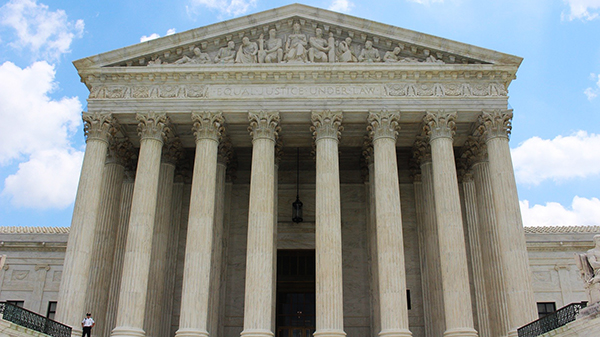
The emphatic support arose following the Ninth U.S. Circuit Court of Appeals ruling declaring the Pledge of Allegiance unconstitutional.
The ruling came in a case brought by a California father upset that his daughter’s second-grade class recited the historic pledge, which includes the belatedly added words “under God.” A majority of a three-judge panel on the court said that public school teachers leading students in the pledge constituted a violation of the First Amendment’s provision preventing government establishment or endorsement of religion.
The decision has caused an uproar and many are questioning how it could happen and the likelihood of it standing.
John Carroll, dean of the Cumberland School of Law at Samford University, said that while this is currently a hot political issue, the current legality of it is minimal.
Pending an appeal, the decision will not be implemented for two months – meaning public-school teachers in the nine Western states covered by the Ninth Circuit may still lead their students in reciting the Pledge of Allegiance.
If the ruling were allowed to stand, recitation of the pledge would be prohibited in Alaska, Arizona, California, Hawaii, Idaho, Montana, Nevada, Oregon and Washington.
Carroll believes the ruling will be overturned, however. “The weakness is that it is the wrong application of the law,” said Carroll, who served 14 years as a U.S. Federal Judge for the middle district court of Alabama. “The Ninth Circuit went too far. It applied the law in the wrong way,” he noted. “There is nothing wrong with historical references.
“The Supreme Court has made it clear that permitting religious symbols doesn’t create a religion,” Carroll explained. Holly Hollman, general counsel for the religious liberty watchdog group Baptist Joint Committee on Public Affairs, agreed.
She said the Ninth Circuit’s decision was “surprising” due to previous Supreme Court opinion on “ceremonial deism.” “Government should not make religious proclamations or urge religious worship. It is clear that state-sponsored religious proclamations r urge religious worship. It is clear that state-sponsored religious exercises are unconstitutional,” Hollman said. “But, the court has found that acknowledging that we are religious people falls short of a constitutional violation.”
Hollman noted that one reason “ceremonial deism” escapes First Amendment scrutiny is because the Court has considered such acts or utterances to not be truly religious in nature: “Such government acts would likely be upheld because they have lost their religious meaning by repetition.”
Chris H. Doss, director for the center for law and church at Cumberland, disagrees that the “under God” clause is historical. “The ‘under God’ clause was put in the pledge in 1954 in the wake of the Korean War,” he said. “I don’t know if you would call that historical. There is certainly some history there … but there was the historical practice of not having it before 1954.”
While Doss said he did not agree with everything in the ruling, he explained that it was “easy for me to understand their reasoning on their decision.” He pointed out that the meaning of the word God is not clear. “What does God mean in that phrase?” he asked. “That is a good question. …Allah, Jehovah … what is it really saying?”
Second, a man describing himself as an atheist brought the case, Doss said. This ruling is “protecting the right of the unbeliever as seen by some of the early leaders and James Madison, father of the Constitution.”
“There is a very large element that says the founding fathers said the freedom was limited to Judeo Christians, but I don’t think they have looked at all historical documents,” Doss noted.
Doss pointed out John Leland, an active Baptist leader during the last quarter of the 1700s and first half of 1800s. “He was good friends with John Madison,” Doss said.
Leland emphasized that “the nonbeliever’s views must also be protected. If not, the believer risks having his views not protected,” Doss said.
Carroll agreed that the judges’ recitation of the law is accurate but he believes their conclusion is wrong. “They jump from the analysis to the conclusion. They did not look at whether [the girl] was forced [to say the pledge] or not,” he said, noting the father did not indicate his daughter was forced.
Pointing out that the Ninth Circuit Court is the most reversed appellate court in the United States, Carroll said once the whole court hears the case “it will reverse the decision.” He said the Ninth Circuit has the largest number of judges who cover a large area. They are not close and tend to be more “maverick,” issuing their own opinions without the support of the whole court, he said.
Carroll believes the ruling will be overturned by the end of the year.
Doss agreed the appeal will happen quickly, but he believes the same legal issue will surface again in another circuit. With different rulings floating among the various circuits the U.S. Supreme Court would likely take the case and render uniformity to the issues, he noted.
Hollman said the case would almost certainly be overturned – either by the more conservative Supreme Court or in a retrial before the full 11-judge Ninth Circuit Court. The federal government may appeal to either group. (ABP, EP contributed)

Share with others: