
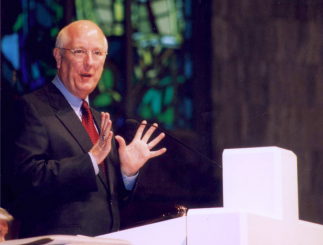
On the Monday after Thanksgiving, Robert Schuller may not have been as positive about his prospects for prosperity as he had been during most of his 60 years of ministry. On that day a bankruptcy court in Los Angeles rejected the once-powerful preacher’s final claims to assets related to the famed Crystal Cathedral and its ministries.
The loss may have been the final step in a too-familiar pattern for ministries, including churches, built around the power of a personality.
Schuller’s ministry is an amazing story. What began as a weekly prayer service in a drive-in movie theater grew into the palatial Crystal Cathedral in Garden Grove, California, the church Schuller started in 1955. At its peak, the church claimed 10,000 worshippers a week.
Schuller’s Hour of Power television broadcast was on the front end of the explosion in religious television when the show began in 1970 and helped make him an icon in much of the religious world.
Today Schuller’s cathedral has been sold to the Catholic Diocese of Orange in a bankruptcy sale and renamed Christ Cathedral. The 86-year -old Schuller has withdrawn from worshipping with the remnant that remains of his former congregation, now led by his daughter Sheila Schuller Coleman, and lost a lawsuit against the board of directors of Crystal Cathedral Ministries.
Family members say he will have to begin “liquidating” everything. But don’t feel too sorry for him. In an email to parishioners, which was later made public, Schuller asked for meals for himself and his ailing wife. He asked that the meals be left at the church where his limousine drivers would pick them up and bring them to his home.
Observers say Schuller’s troubles started long before he retired in 2006. The Hour of Power, the economic engine for Schuller’s religious empire, lost about half its audience in the 1990s. Other religious programs captured some of the religious viewing market. Then other nationally recognized preachers of a positive-thinking message — Benny Hinn, Joel Osteen and Joyce Meyer among them — cut deep into his following. The uniqueness that had once belonged to Schuller became all too common.
That created financial problems. Schuller built the Crystal Cathedral confident that donations would help pay for it once constructed — and they did. But that strategy backfired when the church added a Welcome Center. The church ended up owing about $40 million on the structure, reports indicate, when expected gifts never arrived.
At the same time worship attendance was dropping. When Robert Schuller Jr. succeeded his father as pastor of the church in 2006 attendance was between 900 and 1,000 each week, well below peak attendance.
The elder Schuller had trouble withdrawing from the affairs of the church he built. Two years after installing his son as pastor, the father restructured the church and placed one of his sons-in-law as head of the church. Robert Schuller Jr. was allowed to preach a little longer but soon resigned and was succeeded by his sister. This was another example of the general rule that nepotism in a church is a bad idea.
During this same time frame the elder Schuller became embroiled in serious disagreements with the board of directors of Crystal Cathedral Ministries, which retained the control of the Hour of Power program and related books, tapes, etc.
In the end Schuller resigned from the board in protest and the board of directors fired another of Schuller’s daughters and two of his sons-in-law who worked in the ministries. The board had no authority over the church congregation, so daughter Sheila continues to lead there.
What reports call a “series of financial reversals” led the church into bankruptcy in 2010 and the sale of the property, the separation of the church from its ministry arm and the break in relationship between the board of directors and all the Schuller family.
Observers point to a number of problems. Strong personalities attract a committed following. Even now some longtime church members pledge loyalty to the Schuller family. But, like the strong personality they follow, church members age. Frequently a strong personality of one generation has trouble exercising the same drawing power for a younger generation. The result is a decreasing audience.
Where at one time Schuller stood almost alone on the national stage with his positive thinking message, the stage became crowded as he neared retirement. Again the result was a smaller following.
Administration was another problem. Trouble in the family and trouble between the family and members of the board of directors of various ministries all contributed to Schuller’s fall.
Finances were a key issue. The positive outcomes of Schuller’s theology made him believe “if he built it they would come.” But they did not, and he left a debt for Crystal Cathedral that was unserviceable. There is a long list of vendors stiffed by the church who hope to get some of the money owed them out of the bankruptcy sale.
But the primary problem of Crystal Cathedral was the ministry was built around the personality of one man. History demonstrates over and over again that it is almost impossible for a personality-centered ministry to continue once that personality is no longer leader. Charles Haddon Spurgeon’s son could not follow him in London. No worthy successor was ever able to duplicate the impact of Dwight L. Moody in Chicago. Other examples abound.
A better option is to congregate around a purpose. Alabama Baptist churches exist for a purpose. The churches exist to provide opportunity for people to hear and respond to the gospel of Jesus Christ and then to help believers grow in Christian discipleship. Personalities come and go, but that purpose remains. It is the same from generation to generation and has been for 2,000 years.
Yes, a purpose-focused church may have problems. Challenges with leadership, with church administration, with finances and with relationships are not limited to personality-centered churches. They are common to all. But a church that is founded on the purpose of evangelism and discipleship has a foundation that can endure such storms.
A church that has a pastor with an attractive personality is blessed, but the personality of the pastor is not of primary importance. Purpose keeps people together even when personality is lacking. Alabama Baptists unite around the purpose of sharing the gospel and growing Christian disciples. May that ever be so.
Share with others: