
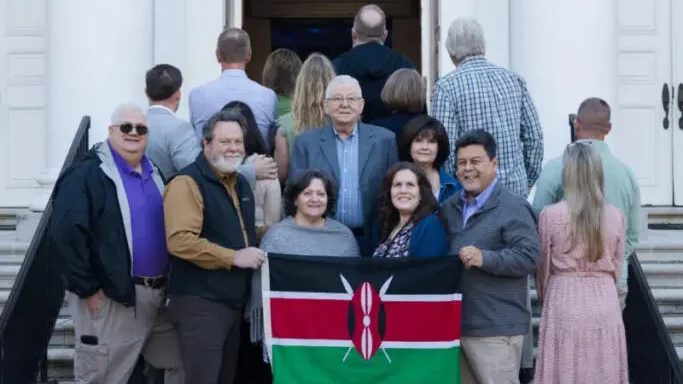
Southeastern Baptist Theological Seminary recently welcomed to campus a special gathering of alumni and their families to celebrate their 30th anniversary as the first cohort sent out through the International Mission Board’s 2+2 program.
This year marks the 30th anniversary of the 2+2 program, originally envisioned and put forth by former Southeastern professor Keith Eitel as a missions partnership between Southeastern and the IMB. At the time of the program’s conception, Eitel also served as director of Southeastern’s Center for Great Commission Studies (CGCS) and played a significant role in helping to mobilize and train 2 + 2 students, beginning with the first cohort of nine units in 1995.
Subscribe to The Alabama Baptist today!
SIGN UP for our weekly Highlights emails.
At the steps of Binkley Chapel on Oct. 16, eight of the original nine units reunited — some of them for the first time since returning from the field in 1997. The ninth unit, the only one unable to come to campus, is still actively serving on the international mission field.
In the years following its launch, the program expanded exponentially, becoming an established sending pathway for the IMB in partnership with the seminaries of the Southern Baptist Convention. Today, from Southeastern, more than 200 students currently serve on the mission field while receiving theological education — all because of the impact of the 2+2 program.
Eitel originally had the idea for the 2+2 program before coming to Southeastern, he shared in a brief history presentation during the reunion. At the time, he was particularly excited at the prospect of a seminary partnering with a denominational sending agency, thus removing major financial barriers for students to be mobilized.
The 2+2 program would allow students to spend two years on campus taking classes and preparing for their time on the field. The next two years of their degree would be spent internationally, in another country and culture, directly applying their learning in a strategic missions context.
In 1995, the 2+2 program was particularly innovative with the relative newness of online education in academia. At Southeastern, the distance learning program would not be established until about a decade later.
To remedy this need for in person training, 2+2 students received the second half of their seminary degree through modular courses, set up in the region where they served, and taught by their professors who were flown in from the states to teach students in person.
For the first cohort of 2+2 students, the experience was uniquely bonding. As the first of their kind, they received their training together and were all sent out within the same country, in Kenya. Their modular classes brought them back together for a time of community as well as education.
“I feel as though it was honestly important that you guys got not only mentoring in a vertical way, but you got mentoring in a horizontal way through each other,” Eitel expressed to them.
During the reunion last week, these old friends and fellow alumni shared stories and reminisced about their time together in Kenya. Many of those who went were already married at the time and brought children with them to the field; some of their children were born in Kenya.
Attendees enjoyed a slideshow of pictures, each full of memories and vivid reminders of the formative experience they all shared. Not long into their gathering, the group video-called with the ninth unit still serving overseas and happily reunited from a distance. Over the course of the afternoon, they spent time going around the table sharing updates from each family and testifying to God’s work in their lives and ministries.
New pathways
Of the nine units sent out in 1995, eight chose to return to international missions in the years following their graduation, their time of service combining for more than 290 years on the international mission field — across Central Asia, Sub-Saharan Africa, and Northern Africa and the Middle East. The kingdom impact of those years cannot be calculated this side of heaven.
Today, the 2+2 program continues through the many different pathways in which students can receive remote theological education while serving overseas. While modular experiences are no longer necessary, the influence of the program remains.
Keelan Cook, Southeastern’s current director of the CGCS, remarked on the impact of the program: “It created the pathway to do something that you couldn’t do before in seminaries.” This pathway, he explained, “wedded theological education to ministry preparation in a very real sense. And when that paradigm was created, it grew into an expectation on this campus, that students would consider that training as a real option. And I think so much of our mobilization efforts today are possible — and the culture that exists here is possible — because of the foundation that was built in our missions mobilization around the 2+2 program.”
To learn more about how you can receive both theological education and hands-on ministry preparation for international missions, visit sebts.edu/cgcs or imb.org/go.
EDITOR’S NOTE — This story was written by Mary Asta Mountain and originally published by the International Mission Board.


Share with others: