
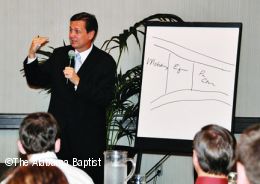
A plan to decentralize the North American Mission Board (NAMB) and reduce its staff by 25 percent, or about 70 positions, was part of Kevin Ezell’s report at his first board meeting as president of NAMB Oct. 17–20.
Trustees met in Los Angeles and commissioned 62 missionaries and toured area ministry sites.
But it was the somber note about staff reductions that made headlines coming out of the meeting.
“We can absolutely do better,” Ezell said.
Even though Ezell said major staffing changes won’t come until NAMB’s focus and a strategy to implement that focus have been determined, one of the first things he did as president was to offer a retirement incentive to employees during a meeting Sept. 30.
As part of the incentive, the retirement age was originally lowered to 55 and then recently lowered again to 54. Initial accounts are that 30 staff members have accepted the retirement offer and others are still considereing the incentive.
In addition to making staff changes, Ezell said the agency will “decentralize.”
“What I do know is that not all NAMB staff will need to be full time and based in Alpharetta,” he said. “We will decentralize but new positions will not necessarily be full-time staff.
“We will use pastors and others who are doing a wonderful job where they are but can advise us in our efforts,” Ezell continued. “We are now living in 2010; [because of technology] you do not have to have everyone [living] in Alpharetta in order to work together.”
A few weeks prior to the board meeting, he sat down with J. Gerald Harris, editor of Georgia’s Baptist newspaper, The Christian Index, for an interview.
Ezell told Harris the reason for downsizing is to be better stewards of the monies coming from Southern Baptists.
“I can’t go and look state directors in the face and talk about being better stewards of our money if I don’t start at home first,” he said. “We have not done that in years, and in any organization, there has to be some course correction from time to time.”
But it’s not just the employees at NAMB’s headquarters who may be affected; missionaries on the field will be examined as well.
“We owe it to Southern Baptists to put missionaries on the field that are qualified, doing the work and serving the churches and the people,” Ezell said. “If people are serving in the area of evangelism, we will want to know how many people are coming to faith in Christ.
“It will take awhile to change the NAMB DNA, but we will do it through attrition, retirement incentives and infusing some of the right DNA,” he added.
In addition to talking about NAMB’s future as far as structure and staffing, Ezell addressed questions about the criticism surrounding his nomination as president and his former church’s giving to the Cooperative Program.
“I understand why some have come out against my election,” Ezell said. “I don’t blame them at all, and I hope to be friends with them. But now that it has happened, the best thing for the Kingdom’s sake is that we move forward together and get this done, because that is why I am here — to try to make [NAMB] work better.
“I want to connect with as many state leaders as possible, and I hope those state executives will give our relationship a chance,” he added. “I realize I am starting behind the eight ball because some of these relationships have been strained in the past, but I want us to do it together.”
Ezell said what hurt him the most was the suggestion that Highview Baptist Church, Louisville, Ky., where he served as pastor for 14 years, is “not a giving church.”
“At Highview, we gave [directly] to church planters in order to be effective stewards, because we realized that through traditional giving channels, not enough of the money was getting to where it really needed to go,” he said.
But that shouldn’t be the case any longer, Ezell said. “That is why I want to be here (at NAMB) … to provide such a compelling vision and such an effective strategy that [churches] are going to want to give.
“I didn’t come here to go out and beg churches to just give,” he said. “They are giving and we are competing for dollars, but we want to do something that people can believe in.”
“Take Annie Armstrong. We receive more than $50 million in the Annie Armstrong Easter Offering,” Ezell said. “There is no reason why that can’t be $100 million if we provide a compelling vision and effective strategy. I know I keep saying that, but that is the missing part [of the NAMB formula].”
What already is in existence at NAMB that Ezell does not want to change is its national evangelism strategy, God’s Plan for Sharing (GPS).
“Evangelism and church planting is a dual track, and when I think of church planting, I think of evangelism,” Ezell said.
“GPS is the tool we are going to use for evangelism,” he continued. “I think our GPS is a very effective way of doing that, and we are only one year into a 10-year emphasis; I have no intention of backing up on that.”
In light of all the changes and restructuring Ezell has proposed in his short time as president, he is asking Southern Baptists “to give us a chance.”
“Anytime there is change, there is fear and uncertainty,” he said. “I would ask for people to just give us a chance, to give me some time.
“I would ask that they draw their conclusions when we have had a chance to make some kind of impact,” Ezell continued. “You can’t turn this around overnight; this is a big entity.
“Southern Baptists need some wins; we need some banners in our rafters,” he said. “My intention is to give them some early wins so they can say, ‘NAMB gets it! They are starting to change.’
“We are going to work hard to be the missions agency that Southern Baptists desire and deserve,” Ezell concluded. (Compiled from wire services)



Share with others: