
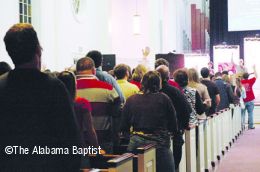
Alabama served as home to the KALEO conference with the highest attendance yet as about 500 high school, college and seminary students gathered at Samford University in Birmingham Feb. 6–7 for KALEO: Alabama ’09.
KALEO, a branch of the North American Mission Board’s Missions Prep Network, is a program for teenagers and young adults interested in pursuing or learning more about what it means to have a “call to ministry and/or missions”, explained Donald King, Missions Prep Network and KALEO events director.
Through three plenary sessions and four breakout sessions, students had the opportunity to connect with more than 20 prominent Baptist leaders from in and around Alabama and more than 130 student ministry leaders, pastors, parents, KALEO staff and others in attendance.
Greg Morris, a student at the University of Alabama, said he is eager to share with others what he learned during the KALEO conference — “to better understand the meaning of ‘called.’”
And that is the purpose of KALEO, King added. It is “an opportunity for those that are just beginning that journey of answering God’s call to ministry to be encouraged by peers at the same place in life and to sit under the teaching and training of those who have been there.”
In the Feb. 7 morning session — Confirming God’s Call — Jeff Iorg, president of Golden Gate Baptist Theological Seminary in Mill Valley, Calif., explained three types of call experiences:
- a universal call to Christian service and growth (1 Pet. 1:14–16)
- a general call to ministry leadership (Luke 5:1–11)
- a specific call to ministry assignment (Ex. 3)
“Every Christian is called to serve and grow,” Iorg said. “When you came to Jesus Christ, in that moment, you received a call to Christian service and growth. This can be expressed through any honorable vocation.”
This was just the message Mike Nuss wanted conveyed at the conference, which served as the Alabama Baptist State Board of Missions’ (SBOM) 2009 state collegiate event.
“I wanted to make sure we were going to address concerns that students who were not necessarily going into ‘vocational ministry’ had about using their secular vocation for ministry purposes,” said Nuss, director of the SBOM office of collegiate and student ministries.
“Not everyone is going to be a preacher, youth minister, etc., but everyone has a universal call to Christian service. Students need some practical help to know how they can use their vocation to fulfill that call.”
Allie Rapcan, a student at the University of South Alabama in Mobile, said she learned how God can use her as she uses her civil engineering degree.
Rapcan also learned not to be afraid to ask questions if she doesn’t see how ministry can be applied to a situation. “Express (that) you don’t know how to find ministry opportunities in what you are doing, and others will think of a way you haven’t.”
While Morris said he is not sure about his calling and future career yet, he now understands how he will interpret his purpose. “It doesn’t matter where we are because it’s about sharing God’s love.”
It was the idea of sharing God’s love and becoming a reflection of Christ that Tim Lovett, senior pastor of Huffman Baptist Church in Birmingham Baptist Association, emphasized during the Feb. 6 evening session — Knowing God & His Will.
“Focus on becoming a reflection of Jesus Christ,” Lovett said. “If Jesus grew, you can grow. If Jesus obeyed, you can obey. We make it much harder than it’s supposed to be. … If you aren’t being a good person now, what makes you think getting into the ministry can change that? What will change you is your relationship with the Father.”
David Platt, senior pastor of The Church at Brook Hills, Birmingham, in Birmingham Association, agreed that in order to share God’s love and the gospel, there must be a relationship with Him. Speaking during the Feb. 7 evening session — Mission Possible — Platt said it isn’t about finding God’s will, it is about “walking in it every day.”
“God is raising up a generation that will no longer sit back and wait for a tingly feeling to go down our spine to rise up and do what He’s called us to do. … He never told us to organize Sunday School, organize church buildings or establish mission boards. Those things are only good as they push us to accomplish the one thing He has called us to do — make disciples of all nations,” Platt said.
Bethany White, 27, of Moulton, said the information she took away from KALEO is invaluable. “[KALEO] helped me learn a lot of things I wish I’d known a lot earlier,” White said. “It helped me know which way to go and about making better decisions with what God wants me to do with my life.”
Nuss said while he believes the conference was a success, the fruit in students’ lives will be the true determinant. “We exceeded our attendance expectations, but the real measure of success lies in the hearts and lives of the students, leaders and parents who were a part of the conference,” Nuss said. “If every person at the conference lived up to his or her God-given potential, then the impact for God’s Kingdom would be immeasurable.”
___________________________________________
KALEO, a branch of the North American Mission Board’s (NAMB) Missions Prep Network, offers students the opportunity to learn more about living out a call to ministry and/or missions.
Initiated in 2006, the program is an opportunity for teenagers and young adults in the early stages of “answering God’s call to ministry to be encouraged by peers at the same place in life and to sit under the teaching and training of those who have been there,” said Donald King, Missions Prep Network and KALEO events director.
The initial vision for such a program began six and a half years ago when NAMB realized the basic Christian principles of evangelism and discipleship being shared with those “called” to missions would be beneficial to anyone going into any area of ministry. So NAMB created the Missions Prep Network as a way of nurturing upcoming ministry leaders.
“Student missionaries or US/C2 missionaries don’t necessarily serve as career missionaries but often go on to serve as pastors, church staff, etc.,” King said, noting it makes sense for them to get the same information and training as career missionaries. “But not just for missionaries. We broadened the umbrella to include anyone called to serve in any area of ministry, realizing we’re still going to benefit in gaining missionaries.”
NAMB personnel then realized if they could target students specifically, begin working with high school freshmen and maintain solid relationships with them during and after college, then they would be able to provide 10 to 12 years of intentional ministerial training.
From there emerged the KALEO conferences, which have taken place in Louisiana, South Carolina, California, Kentucky, Texas, North Carolina and Alabama.
The conferences are partnerships between a state Baptist convention and NAMB. Other Southern Baptist groups and entities — such as the International Mission Board, LifeWay Christian Resources and local Baptist associations — help sponsor the conferences.
For more information about KALEO, visit www.kaleoconference.com.


Share with others: