
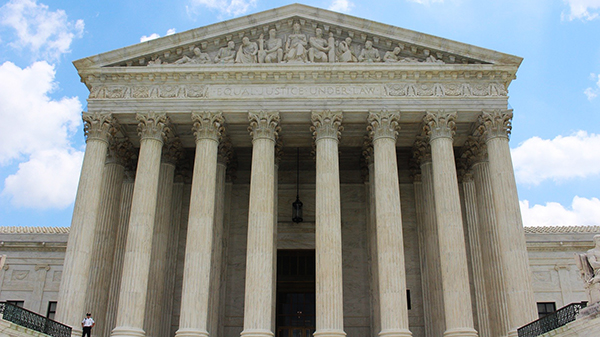
WASHINGTON — The U.S. Supreme Court upheld March 20 a lower court’s opinion that a federal ban on Internet obscenity is constitutional. The high court affirmed a ruling by a special panel of the 2nd Circuit Court of Appeals in New York by issuing a summary disposition without hearing oral arguments in the case — thus providing a rare victory at the judiciary’s highest level for foes of online indecency and obscenity.
The case, Nitke v. Gonzales, involved photographer Barbara Nitke, whose sexually explicit photos have included sadomasochistic poses. Her work has been published and displayed in galleries, but she also placed it on the Internet. Nitke and the National Coalition for Sexual Freedom (NCSF) challenged the obscenity provision of the Communications Decency Act (CDA), a 1996 law that prohibits the distribution of obscenity over the Internet to children less than 18 years of age. The three-judge panel in the 2nd Circuit unanimously agreed, however, that Nitke and NCSF had failed to show CDA was guilty of “substantial overbreadth.” (TAB)


Share with others: