
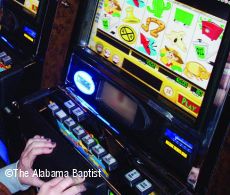
Promising jobs and millions in taxes for Medicaid and education, the Sweet Home Alabama bills would seem to be the state’s economic savior. But legal experts who have studied Senate Bill (SB) 471 and House Bill (HB) 676 say the bills throw “table scraps” to Alabama citizens and “open the flood gates” for large-scale, high-stakes electronic gambling around the state.
And when the once identical bills passed from their respective committees with differing amendments, even more questions surfaced about the legislation’s true purpose.
Before the barrage of amendments, both bills sought to change the state’s charity bingo to a for-profit industry and set up nine “points of destination” across Alabama with large “self-regulated” electronic bingo gambling facilities valued from $25 to $100 million. Two facilities were to be located in Calhoun, Greene, Jefferson, Lowndes and Walker counties while one facility would be placed in Etowah, Houston, Mobile and Macon counties. Now, Calhoun County has been removed from both bills.
In the House version of the bill, Lowndes County was also removed as was the connection to the Poarch Band of Creek Indians.
In the Senate version of the bill, Walker County facilities were removed and a facility was added in Mobile County. The Mobile Racetrack was the original “point of destination” for Mobile County. The new facility would be located in any Alabama Foreign Trade Investment Zone in Mobile County similar to the one in Prichard, which is a special tax district that allows for the importation of duty-free and quota-free articles.
Rep. Lea Fite, D-Jacksonville, presented the House amendment to remove Calhoun County from HB 676 noting that the people of Calhoun County already voted and it was only for “high-stakes paper bingo.”
“In Calhoun County, we have determined our own destiny (and) we want to continue to determine our own destiny and not have someone else do it for us,” he told The Alabama Baptist in an April 2 interview.
Contrary to comments made by the bills’ sponsors and supporters who stated that legislators from the included areas worked together on the bill, Fite said he did not know who included Calhoun County in the initial bill or why it was placed there.
“To my knowledge, none of the Calhoun County delegation was asked to be in the bills,” he said.
Sen. Quinton Ross, D-Montgomery, admits “many groups and individuals that came together to draft this legislation” including members of the Sweet Home Alabama Coalition — the group headed by executives of the Ronnie Gilley Properties, LLC, which is planning to build a large entertainment complex and electronic bingo gambling facility in Houston County.
“I have spoken with and worked with many people in drafting this legislation,” Ross said. “It has been a process that has gone on for many months and I believe, as the bill came together, individuals and organizations realized they had a common set of goals and interests so they created the Sweet Home Alabama Coalition.”
Both the Sweet Home Alabama Coalition and some state legislators like Ross say the bills will stop gambling expansion in the state.
“My bill ensures that bingo is only at a limited number of destination facilities rather than the hundreds or potentially thousands of fly-by-night facilities that can and do crop-up on street corners near our neighborhoods,” Ross told The Alabama Baptist.
But other state leaders like Sen. Jabo Waggoner, R-Birmingham, do not agree.
“When it creates more facilities in Jefferson County and other counties, I feel that’s expanding it (gambling),” said Waggoner, who issued the only dissenting vote against SB 471 before it passed out of the Senate’s Tourism and Marketing Committee April 1. “I plan to vote against it at every opportunity I have. … I am opposed to any gambling legislation I feel will not deliver the kind of Alabama I think we need to have.”
A supermarket owner, Fite likened the potential growth of electronic bingo gambling to someone in his line of work acquiring new stores.
“If there is money to be made (in another location), I’m going to put a grocery store there,” he said. “I’m scared it’s (gambling) going to keep expanding. … I don’t want gambling on every corner. I want some guarantee that this stuff will be strictly regulated, and it could never be expanded.
“If a camel gets his nose in the tent, he’s in the tent,” Fite added.
Ashville Mayor Robert McKay, who just won the right to operate electronic bingo gambling in his city thanks to a ruling from St. Clair County Circuit Judge Charles E. Robinson, is also against this legislation.
“The Sweet Home Alabama bill is terrible,” he said. “They’ve (the Sweet Home Alabama Coalition) pooled their money together and are running these ads. What we don’t like is that they left us out of that amendment. They want to leave St. Clair out of it and monopolize it for the big-game interest. They want to control it.”
“We want to play electronic bingo, but we are not for Sweet Home Alabama,” McKay explained. “It is supposed to start with a legitimate charity anyway. These people are opportunists. We are a legitimate charity.”
One of the bills’ most advertised promises is the elimination of illegal gambling in Alabama by limiting bingo operations and creating a state gaming commission to “regulate bingo … and enforce the gambling laws of the state.”
“As for the regulation of bingo, the bill provides for the establishment of a gaming commission to help oversee bingo in Alabama,” Ross said. “To me, this is a win-win for the state.”
But Eric Johnston says the bills’ bark is bigger than their bite.
“They don’t really have any substantive authority,” said Johnston, president of and general counsel for the Southeast Law Institute in Birmingham. “They are really superficial. They can regulate the issuing of a license and opening of a facility but they don’t have any oversight over what kind of gambling activity the facility would have.”



Share with others: