
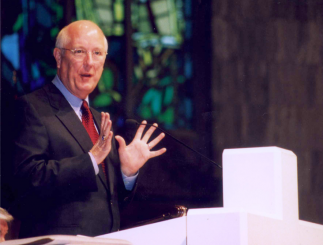
He spoke with all the confidence of a new business owner at a grand opening. The future was so clear to him it was as if it had already happened. After all this was a dream — no, a promise — he had been chasing for decades. Now it was about to happen. The promise that had been his inspiration was becoming reality.
“When you have eaten and are satisfied,” Moses said to the Israelites, “praise the Lord your God for the good land He has given you” (Deut. 8:10).
“Enjoy the blessings that await you,” Moses told the people he had led for 40 years. They were not to feel guilty that he would not be with them. Their spirits were not to be dampened that others who began the journey toward the promise would not be there either. This was their time. They were to eat and be satisfied.
The bounty they were to enjoy came from God who had given them such “good land.” He is the One who owns the cattle on a thousand hills (Ps. 50:10), the One who declares, “The world is Mine and all that is in it” (Ps. 50:12).
Israel would have to work for the promise. They would have to cross the Jordan River. They would have to take Jericho and other cities. It would be hard work demanding determination and commitment. Some would even die in the process but transforming a promise to reality always demands sweat and tears, even today.
Faithfulness to God
Only by praising God for the good land He had given them would the children of Israel remember to keep God’s commandments, His laws and decrees. For Moses, stewardship of the blessings of God grew out of a relationship with God. Faithfulness to God was never a set of external rules one could check off in order to earn God’s favor.
Moses knew the temptations of the “good life.” After all he had been reared amid the plenty of Pharaoh’s places. He understood the people of his heart were about to experience a total transformation, what sociologists today call upward mobility.
In place of their steady diet of manna and quail they would become accustomed to the milk and honey of the promise land. Their worn out tents would be exchanged for “fine homes.” Instead of the constant wanderings of a nomadic people they would become city dwellers building permanent settlements. No longer would their flocks get the scrubby leftovers for feed. Now their flocks would have the choice grasses and be first in line for water from the wells.
Instead of a poor people living hand-to-mouth Israel would become prosperous and prominent as all they had increased.
How easy to look back at the change in circumstances and become proud, even arrogant; to boast, “My power and the strength of my hands have produced this wealth for me” (Deut. 8:17).
We have seen that process at work with our own eyes. People once faithful to God during all the troubles of want become indifferent to God in times of plenty. Their testimony is not “see what good things the Lord has done.” It is more about their ability, their accomplishments. Such people do not praise God. They do not keep His commandments, His laws and decrees.
When one does not offer God the sacrifice of praise and worship it is easy for pride and arrogance to flourish. One’s attitude toward material blessings is a reflection of one’s attitude toward God.
Moses offered an antidote to the temptation of pride and arrogance — memory. Beginning in Deuteronomy 8:14 he reminded them that it was God who brought them out of slavery. It was God who delivered them through the waters. It was God who guided them through the trials of the desert. It was God who provided healing from the attacks of deadly snakes and scorpions. It was God who miraculously fed them with manna and gave them water out of hard rock.
God’s love and care
When the Israelites were unable to help themselves God acted in their behalf “so that in the end it might go well with you” (Deut 8:16). Each act was a reminder that they did not live by the power and the strength of their own hands. Each act was an expression of God’s love and care.
The appropriate response was humility, not arrogance.
For most of us it is impossible to look back at our lives without seeing moments, circumstances or people that altered our lives for the better. Those incidents were not luck or chance or fate. They were God working “so that in the end it might go well with you.”
All who know God through faith in Jesus Christ also can remember, “I once was lost but now am found, was blind but now I see.” And we can remember that salvation is possible only because “God was in Christ reconciling the world to Himself” (2 Cor. 5:19).
Lest anyone misunderstand what he is saying Moses speaks plainly. In Deuteronomy 5:18 he declares, “But remember the Lord your God for it is He who gives you the ability to produce wealth.” There it is. The theological foundation for wealth. It is God who makes it possible. Therefore the human response is a humble spirit; a spirit that remembers God; that keeps God’s commandments; that exercises stewardship of all God gives as an expression of gratitude.
Stewardship, said Moses, is more than external rules about tithes and offerings. Stewardship is an expression of remembering God’s grace and goodness with a humble and thankful heart.
Like Israel of old those who trust in God continue to dream about the possibilities of life. We continue to pursue those dreams with sweat and tears. We celebrate successes with thankfulness and joy. And we submit the fruits of our labor to God as an expression of gratitude for the One who loved us and gave Himself for us.

Share with others: