
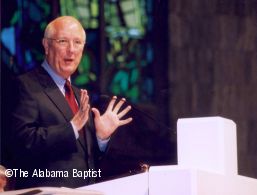
Most Southern Baptists were stunned by the headlines announcing a possible name change for the Southern Baptist Convention (SBC). After SBC President Bryant Wright announced he had appointed a task force to study a name change, it took a reminder by the chairman of the SBC Executive Committee that Wright had the authority to appoint the task force without approval by the Executive Committee before that group let the topic go.
Thankfully Wright recruited volunteers for the task force who would pay their own expenses as well as the committee’s expenses so the SBC’s already strained budget will not have to underwrite another unplanned presidential project.
In making the announcement, Wright said a new name was needed to “maximize our effectiveness in reaching North America.” The problem with the current name? “The convention’s name is so regional … it is challenging in many parts of the country to lead churches to want to be a part of a convention with such a regional name,” he continued.
Those words do not sound like calling for a study. They do not form questions. They make statements. That makes the effort look more like putting machinery in place to accomplish something on which a decision has already been made. That is unfortunate.
Some writings that have appeared in the past six weeks advocating a convention name change seem to support that conclusion as they demonize those who question the action. If one is for church planting in the Northeast, far West or other areas underserved by Southern Baptists, then one favors a name change. Only those who are against church planting are against a new name, the writings imply.
If one favors the SBC being a national body embracing all areas of the nation, then one is for a name change. Only those who want the SBC to be a regional body with a regional vision reflecting a regional culture are against a name change.
If one is for a denomination that includes multiethnic congregations and leaders, then one is for a name change. Only those who want to remain a denomination with a history of segregation led by Anglos are opposed to a name change.
If one wants to prove the negative impressions people have about Southern Baptists wrong, then one is for a name change. Only those who embrace all the negative stereotypes are opposed to a name change.
Such charges are untrue and unfounded. They do not further serious, dispassionate discussion. They only inflame emotions. That is not supposed to be the result of a “study.”
One of the first questions that should be asked is whether “Southern” is a descriptive word or part of a brand name. In 1976, a seven-member committee appointed to study a possible name change for the SBC reported, “The name Southern Baptist has become identified and associated with certain doctrinal positions, traditions and other emphases.” Is that still true in 2011?
Does “Southern Baptist” cause one to think of those from a certain region of the nation? If so, then it is a description.
Does “Southern Baptist” cause one to think of those who believe the Bible and are committed to evangelism and missions? If so, then it is a brand.
The 1976 committee wrote, “A name change would be interpreted by some as abandoning this heritage and these invaluable traits.” Would that be an issue today if the convention’s name were changed?
Not every word that describes a region of the nation has a negative connotation. “Southwest” is a regionally descriptive word, yet Southwest Airlines did not change its name when it began serving Chicago, Baltimore or Providence, R.I., because the word relayed a brand that was valuable to the company. The word spoke of value, service and convenience. Is a similar thing true of the SBC?
One poll found that more than 40 percent of 18–24-year-olds said knowing a church was a Southern Baptist church would negatively affect their decision to visit or join that church. The finding was based on what respondents described as judgmental, mean-spirited and politically partisan actions.
At the same time, the disaster relief efforts by Southern Baptists in New Orleans following Hurricane Katrina have reportedly resulted in great opportunities in areas of evangelism and missions in a region that was once very difficult for Southern Baptists.
It is not the convention’s name that makes a difference to most people. It is the “content of its character,” to paraphrase a great Baptist preacher. Simply changing our name will not change our character nor help us overcome those things that have resulted in some people’s negative image of Southern Baptists.
But “Southern” is not the only word that some find objectionable in the SBC’s name.
Some object to the word “Baptist.” A growing number of churches are dropping “Baptist” from their names in order to be more appealing to non-Christians. Instead of “Baptist,” one finds such phrases as “Christ-followers.” Is the word “Baptist” to be up for grabs as well in a possible name change?
If Southern Baptists needed a new name, then the best opportunity was missed in 1995 when the denomination was restructured in the Covenant for a New Century. Since that time, little has demonstrated that Southern Baptists are interested in considering a name change. In 2005, when then-SBC President Jack Graham proposed a name change study, messengers refused to even consider the recommendation and voted against a study by a 55 to 44 percent margin.
There is little indication that the opinion of Southern Baptists has changed since that time. To many, the study of a possible name change is just another issue that stands to divide Southern Baptists, not an issue that can help heal the rifts in the fellowship that have emerged in the last few years. That makes the whole study idea ill-timed.
But the study is being done, and its findings will be reported. Maybe throughout the process Southern Baptists will be able to acknowledge that those on both sides of the name change issue are motivated by high and noble reasons. All want to reach the world for Christ.
Differences exist about how best to accomplish that goal.


Share with others: