
At about 10:30 each morning, some 800 children break from their school studies and line up for a midmorning meal of porridge.
Brighton Mtikomola, the school’s principal, says attendance has climbed 50 percent since the meal program began three years ago. In Malawi, a country of 15 million that’s beset by chronic hunger, it’s the only reliable meal of the day for most of the kids.
"They come from home, they haven’t eaten anything else, so when they come here, take this sort of food … it makes them increase their performance. They have more energy," Mtikomola said. "Three quarters come here with empty stomachs."
While the soy or maize for the Kasungu feeding program comes from many countries, the largest contributor is the United States through the Food for Peace program, which began in the 1950s as a means to use U.S. grain surpluses to help countries hit by food crises.
But today, the Food for Peace program has grown into a $1.2 billion giant, and critics argue U.S. food aid may actually stifle African farmers and perpetuate dependence in recipient countries.
What’s more, they say Food for Peace benefits private contractors more than the hungry.
The United States is the world’s single largest donor of food aid but there are intermediaries — agribusinesses and shipping companies, which by law must be American — that consume a good part of the U.S. food aid dollar. The General Accountability Office says two-thirds of the U.S. food aid dollar goes toward administrative overhead, and just one-third — 33 cents — buys food for hungry people.
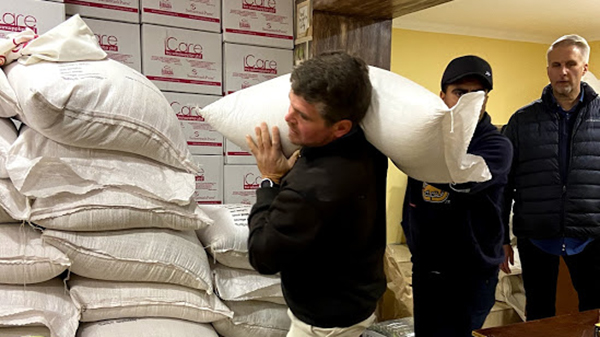
Last year, one of the largest private food aid charities, the Atlanta-based CARE, decided to stop accepting U.S. food donations beginning in 2009.
"We felt very strongly that the inefficiency and the waste that was happening throughout the current system just had to be addressed, and if we didn’t take a stand and try and make a change, then this would just continue," Cecily Bryant of CARE-Malawi said in an interview with Religion & Ethics NewsWeekly.
Bryant argued it would be much more efficient if U.S. assistance came directly in the form of cash. That money could be used to train farmers and to buy grain locally, cutting costs and delivery time while developing markets for African farmers.
In fact, several aid agencies generate cash to run such programs by taking donated American commodities and then selling them in local African markets, a practice called monetization.
But Bryant said that food alone "isn’t going to change anything in the long run."
"What we’re doing … is really trying to get to the end-of-the-line causes of what’s happening here. We’re working with farmers to teach them to harvest greater yields, to be able to market surplus once they reach that level."
The United Nations’ World Food Program is now using cash it gets from non-U.S. donors to increase local grain purchases, and last year bought 90,000 tons of grain from Malawi.
"That’s a huge amount of food and the largest amount we’ve bought ever from Malawi," said Domenico Scalpelli of the WFP. "A lot of it was not only for Malawi. A great deal of it went to Zimbabwe, Democratic Republic of Congo. We bought food even for west Africa. … Part of the philosophy behind it is to try and bring up local farmers and traders to the point where they can compete internationally."
It is a goal some in Washington support. The Bush administration has proposed sending a quarter of the value of U.S. food grain in cash.
While the proposal has the support of many Democrats on Capitol Hill, it gets nowhere in the powerful House and Senate agriculture committees, whose members come primarily from farm states. They continue to insist that food aid be entirely in the form of commodities grown in the United States and shipped on U.S. flag vessels. (RNS)
Share with others: