
If your church is suddenly overtaken by Millennials with their eyes stuck on their phones, you can thank Pokémon. And several Alabama Baptist churches and at least one association have experienced this latest fad.
Yes, Pokémon. The Nintendo-owned franchise, which produced colorful cards and later video games, is back — this time luring young adults out of their apartments and into museums, parks and places of worship.
How? Technology, of course. Pokémon’s newest iteration is a free augmented reality app that brings its now-adult fans’ fantasies to life.
The app uses players’ phone GPS to locate where they are, then makes Pokémon appear on the phone screen in real-life locations so players can “catch” all 151 virtual creatures.
Viral sensation
The app has become a viral sensation among teens and young adults, overtaking Tinder and Twitter in daily users. Online research company SurveyMonkey reported July 13 that Pokémon Go is now the biggest mobile game in U.S. history. Millennials are walking around with their phones, finding “PokéStops” and “Gyms” at local places of interest: libraries, parks, art galleries, subway stations, zoos and more.
But, as some gamers are discovering, virtual Pokémon also can be found at several churches too.
The game’s PokéStops and Gyms, where players can gather in the real world to capture and battle their virtual Pokémon, are based on user-submitted locations.
As a Millennial who grew up trading Pokémon cards with his friends, Tyler Armstrong is excited about the “cultural phenomenon.”
“I remember the first Pokémon game I ever played — I was four years old,” said Armstrong, who is now minister to students at Twelfth Street Baptist Church, Rainbow City. “I showed it to my students (at church) and they absolutely loved it.”
Armstrong and other Twelfth Street Baptist staff members are currently brainstorming how to best minister within the gaming culture, especially since their church is a PokéStop. Armstrong has already been able to have conversations with three teenagers between the ages of 12 and 15 who biked to the church to catch a Pokémon.
“I let them charge their phones in my car and got to talk to them for about an hour,” he said. “[Our] conversation led back to church and what they thought about Jesus. We had a really good gospel conversation through something completely worldly that I used to our advantage as a believer.”
It’s also bringing his youth group closer together.
‘Unique opportunity’
“When you have a seventh grader connecting with a 10th grader over a game, that’s huge.”
Wendell Dutton, director of missions for Cherokee Baptist Association, had a different response initially to discovering that the associational office was a PokéStop.
“At first I kind of viewed it as it’s kind of a nuisance or security issue” but Dutton has since shifted perspectives after talking to the teenagers and young adults who have come by the office.
“It’s a unique opportunity, I think … to reach out and minister to these people. … We’ve used it as an opportunity to start some conversations about how it’s good to be looking for Pokémon, but make sure you’re looking for Jesus too.
“It’s unique how the Lord opens doors to us if we’re just sensitive,” he said. “I think our churches in this generation and in this time, we have to be really open and sensitive and I think the Lord is using this (game) as an avenue.”
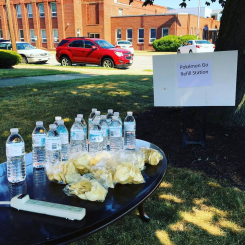
Daniel Woodcock, pastor of The Cornerstone Church, Gadsden, echoed Armstrong and Dutton. His church’s downtown location has made it a hub for gamers because of its three PokéStops. Just four days after learning about the game, Woodcock and his staff had already hosted gift certificate giveaways, passed out movie tickets and distributed refreshments to the mass of gamers flocking to the church.
And once they’re “literally leaning against our building,” Woodcock said, he gets a chance to make connections.
“The majority of people I’ve talked to are young singles and they’re just blown away that a church is embracing what they’re doing. … People said, ‘I didn’t know a church would do something like this and be accepting.’
“I love how the apostle Paul said we’re to be all things to all people. Society is heavily involved in games and social media. I personally don’t play [Pokémon Go] but I care about these people.”
And that care is driving The Cornerstone Church to maximize on the game’s potential for spreading the gospel.
“You’ve got to be creative with sharing the gospel,” Woodcock said. “[The game] is more just an opportunity to be like Jesus and love on [gamers]. … You can’t beat this.”
Church attendance — or at least skulking around church parking lots — isn’t the only unintended result of the game.
Some players have warned about racism and suspicion that people of color may face while exploring their neighborhoods for Pokémon, while others have found the game to help with weight loss. There are reports of armed robbers using the game to lure victims, and a 19-year-old Wyoming resident said she found a dead body while looking for Pokémon.
Unfortunately for churches trying to draw in youth, it doesn’t look like there’s a way to register a location as a PokéStop or Gym yet. But turning your church into a “charging station” for players might do the trick.
Here to stay?
Whether it’s a hyped-up game that will be gone in a month or here to stay, as Armstrong believes, there’s no denying that for now it’s bringing gamers to church doors.
Armstrong said, “It’s definitely an interesting phenomenon and it’s something that the Church needs to capitalize on.” (Maggie Walsh, Religion News Service)
———————————
State missionary sees new game as open door
By Brian Harris
Special to The Alabama Baptist
Ughh — another social media phenomenon. That was my first thought. My wife even made fun of me since I’m a 38-year-old adult with two kids, but here I was downloading the new craze, Pokémon Go, to my phone. My reasoning: I need, as the digital marketing strategist, to know what it’s all about.
During lunch the next day when I finally opened the app, a small character appeared in my map nearby. I clicked on it to see the augmented reality view which brought the character to life via my phone screen. There it was, a Weedle right by the meat at Moe’s. I flicked my Pokeball at it and captured it.
Big deal, right? How could this be used to connect with people? I read up about the PokéStops and Gyms where you gain points and are often associated with local landmarks … a lot of them churches. These require that you physically go there unlike most games.
Going to church
This didn’t go unnoticed as my Twitter feed began to fill up with people saying that Pokémon wants them to go to church apparently. The game was actually getting people to the building.
Churches began to notice the new visitors and some even went as far as to give out food, water and open their doors.
Another option was to set lures to attract the virtual creatures to PokéStops … which also attract people. Churches were then able to greet them and invite them to attend a weekend gathering. One church reported 17 first-time visitors to their campus after setting a lure. One person in conversation said, “I thought you had to be a member to be allowed to attend church.”
So yeah, it’s weird, it’s new — but people are using it. They’re walking around and quite possibly they are at your church for the first time. Sounds like an opportunity to me.
EDITOR’S NOTE — Brian Harris is the web, social media and email strategist for the Alabama Baptist State Board of Missions.
———————————-
For tips on how your church can minister through Pokémon Go, visit thewardrobedoor.com.


Share with others: