
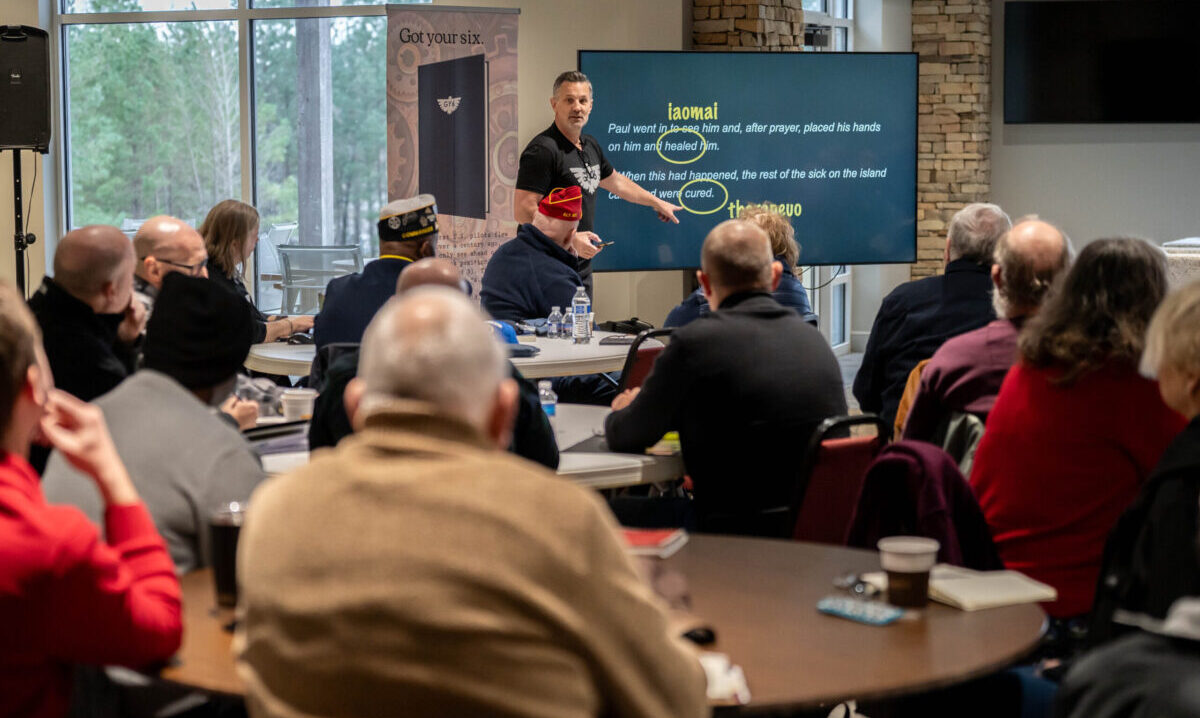
A recent Birmingham-area workshop showed how any veteran and first responder who deals with post-traumatic stress disorder and moral injury can find help from others to obtain the health that God has planned for them.
Subscribe to The Alabama Baptist today!
SIGN UP for our weekly Highlights emails.
This unique training event was held Jan. 31 at The Church at Liberty Park in Vestavia Hills and was led by Andy Jenkins of LifeLift Ministries. This was a “GY6” conference, which stands for “Got Your 6.” The earliest U.S. pilots were only able to see the front and either side of their planes — the 3, 9 and 12 o’clock positions. The only way they were sure their “6” was covered was through the communication of other pilots behind them.
According to the website for the event, “They would effectively tell the man ahead of them, ‘I’ve got your back. I’m looking out for you. Nothing will harm you as long as I’m here. I’ve got your 6.’ This mantra has carried forth to other military personnel, law enforcement officers and heroes of all kinds. The inference is the same: You’re covered.”
3 basic questions
Jenkins spent the day answering three basic questions about healing from the wounds no one sees — those internal issues that arise when a person’s been on the front lines:
What is God’s desire?
What is God’s design?
What is God’s direction?
He began by teaching about the different kinds of healing in the Bible. “Iaomai” is instant healing, and “therapeuo” is healing that takes place over time by walking it out deliberately. He emphasized that both are complementary and both are important. The job of those who serve those who served is to “therapeuo the sick” by teaching them “to be well and live whole.”
Jenkins also discussed how the body, soul and spirit are connected. Injuries to the body could be broken bones or wounds. Injuries to the soul may show up as PTSD. Injuries to the spirit are moral injuries.
“Any part of us can be injured, and any part can be made more whole. Each part impacts all the others,” Jenkins said.
Closer look at PTSD
Jenkins then talked about PTSD in depth. Currently, the criteria to be diagnosed is very specific. He said that the goal shouldn’t be to receive or avoid a diagnosis but to pursue health.
“Many of our emotional disruptions are normal responses to abnormal events. Though most of us aren’t diagnosable for a mental or emotional health disorder, we will all benefit from ‘leveling up’ our health in these areas,” Jenkins said.
One point that Jenkins addressed is that the responses that show up as PTSD are natural, God-given reactions. God made the storage in our brains to automatically react to certain stimuli. This is a protective design that can result in “fight, flight, freeze or fawn.”
However, a person doesn’t have to be stuck there. There are ways to heal.
“Let me give you an easy 1-2-3 process that you can use in real time. Here’s what you do. (First) you’ve got to learn to recognize the things you experience, and you’ve got to realize there aren’t good emotions, bad emotions — only healthy and unhealthy expressions of those,” Jenkins said.
Jenkins continued discussing how those on the front lines — either in the military or first responders — see things that impact them negatively.
“Some of the things that some of you have told me in the room — even today — I don’t think it would be healthy if you went through that and you did not have a response. It’s more normal that it affected you and impacted you than not normal that it impacted you.
“People who aren’t impacted by death and trauma and seeing some of the things that you walk through and some of the things that you go in and step in to fix voluntarily, giving of yourself — like getting affected by it — that is a normal response. It would not be normal to see that and not be impacted by it to some degree,” Jenkins said.
However, it’s not best to stay there. After recognizing an emotional response in someone, the second and third steps are to read what they are saying without reacting and then respond in a healthy way.
Jenkins also taught about moral injury that hurts one’s spirit.
Examples he shared of ways moral injury can occur include:
— Not doing something that should be done.
— Doing something that has a bad outcome.
— Surviving an event when others were injured or killed.
— Feeling guilt and shame when something that couldn’t be controlled happens.
— Being betrayed by a trusted person.
Where PTSD has a visceral, physical reaction, moral injury manifests as guilt and shame — both barriers to healing. Healing moral injuries comes through close engagement.
Moral injury leads to suicide more often than PTSD does, but both issues increase the risk. Jenkins encourages anyone at risk to reach out.
Resources
Some of the resources shared at the workshop included:
— Birmingham VA Health Care System
— Crisis Center Birmingham
— After Action Project
— BlueWatch Foundation
— Veterans Crisis Line
— S.A.F.E.R. Together
— American Legion Post 911
Healing, helping and honoring
Jenkins urged those who have been healed to help others, noting that there is power in “connection, community and cleansing.” He said three reasons to look back include healing, helping and honoring.



Share with others: