
The cataclysmic event of Easter that ushered in the apocalyptic age has challenged scholars, theologians and lawyers to debate the validity of the Bible’s account of Jesus’ resurrection. As we observe Easter there remain doubters, but strong rebuffs come from Alabama Baptist theologians, as well as history and religion scholars.
“Liberal biblical scholars have said that the Bible contradicts itself, so their take is that the Bible record is not trustworthy. They’ve completely misunderstood the nature of the biblical text,” said Timothy George, dean of Samford University’s Beeson Divinity School.
George said the mechanics of exactly how God raised Jesus from the dead are unknown, pointing out that there were no direct witnesses to the moment when God’s Holy Spirit performed the miraculous work of making Mary the mother of Jesus or raising Jesus from the dead. Yet evidence of both events is there.
“They took place in the mystery of God’s own being and reality,” George said.
Thomas Arnold, author of the famous “History of Rome” and appointed to the chair of modern history at Oxford University, England, said, “I have been used for many years to study the histories of other times, and to examine and weigh the evidence of those who have written about them, and I know of no one fact in the history of mankind which is proved by better and fuller evidence of every sort, to the understanding of a fair inquirer, than the great sign which God hath given us that Christ died and rose again from the dead.”
The women seeing the resurrected Jesus at what was perhaps a short time after He was resurrected, and hundreds seeing Him, walking and talking with Him for the 40 days after and before His ascension, is undeniable evidence, many scholars say.
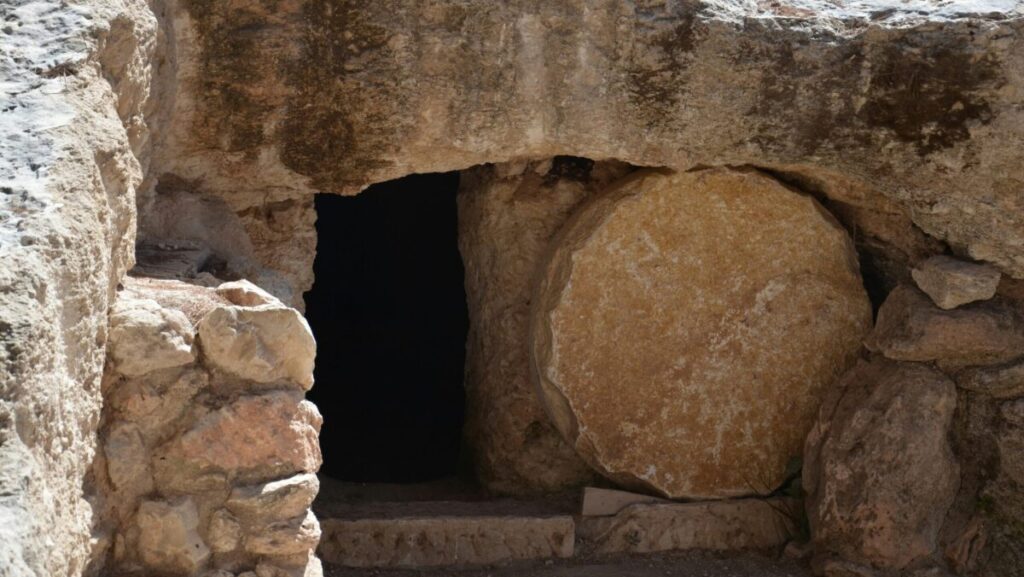
According to Josh McDowell, who has spent more than 700 hours studying the resurrection and evidence of it, said the sheer weight of the stone — they typically weighed up to two tons and were movable only by levers — would have rendered women and most men of that day powerless to move it. This dispels many naysayers who claim the disciples or the women stole the body to give the appearance of a resurrection.
“From the Roman perspective the bodily resurrection was an attempted coverup by Jesus’ followers. Rumors circulated that the disciples had stolen the body,” said W. Mark Tew, Judson College senior vice president and professor of religion.
If the disciples had removed the body, hidden it, then perpetrated in Jerusalem the idea that Christ had risen, then why would they attempt this deceit right there where the body could have been found and their hoax discovered? It would make more sense for them to attempt this guise farther away, Tew noted.
How did the disciples respond?
Also, getting past powerful Roman Empire guards, breaking the Roman seal on the tomb and risking punishment by the Roman law enforcement, which was relentless in its punishment of such a crime, is highly unlikely, given their state of mind and spirit. The disciples had given up hope and hidden themselves away in a room, according to McDowell.
“Their hopes were dashed and they were focusing on survival. They had no hope and were completely afraid,” said Terry Ellis, senior pastor of Spring Hill Baptist Church, Mobile.
In that day it would not be unusual for men to proclaim themselves as the Messiah, so to many, Jesus of Nazareth was simply another Jewish prophet. When these so-called Messiahs were killed, the whereabouts of their bodies was known. But the vast resources of the authorities of the Roman Empire failed to produce the dead body of Jesus after His resurrection, while more than 500 people could have been summoned into a court of law to testify of His existence after the resurrection. In a normal life and death case, this would have been record-setting evidence to establish the existence of an individual, lawyers say.
Edwin M. Yamauchi, associate professor of history at Miami University in Oxford, Ohio, said, “What gives a special authority to the list (of witnesses) as historical evidence is the reference to most of the 500 brethren being still alive. St. Paul says in effect, ‘If you do not believe me, you can ask them.’ Such a statement in an admittedly genuine letter written within 30 years of the event is almost as strong evidence as one could hope to get for something that happened 2,000 years ago.”
He said if the 500 witnesses who saw Jesus alive after His death and burial were testifying for only six minutes each, including cross-examination, this would be 50 hours of firsthand testimony. Adding the many other eyewitnesses would result in the largest and most lopsided trial in history, Yamauchi said.
Another theory was that Jesus was so wounded and exhausted from the crucifixion that He just fainted or lapsed into a coma, but managed to regain consciousness.
McDowell writes that David Friedrich Strauss, a skeptic who is no believer in the resurrection solidly gave the deathblow to this swoon theory. Strauss said, “It is impossible that a being who had stolen half-dead out of the sepulchre, who crept about weak and ill, wanting medical treatment, who required bandaging, strengthening and indulgence, and who still at last yielded to His sufferings, could have given to the disciples the impression that He was a Conqueror over death and the grave, the Prince of Life, an impression which lay at the bottom of their future ministry. Such a resuscitation could only have weakened the impression which He had made upon them in life and in death, at the most could only have given it an elegiac voice, but could by no possibility have changed their sorrow into enthusiasm, have elevated their reverence into worship.”
Dead meant dead to the Jewish society, the Roman Empire and to Jesus’ followers closest to Him, according to Dale Younce, associate professor of religion at the University of Mobile.
“The human body is bereft of personality, soul, spirit,” he said. This is why the women who trekked to Jesus’ tomb had no concept of the resurrection. They followed Jesus of Nazareth, a historical person. They believed He was the Messiah, but in their minds, Messiahs didn’t die.
Ellis said, “When Mary Magdalene and the other women went to the tomb, they were expecting nothing more than to anoint a dead body. It wasn’t as if they had a hint of hope. There is no indication of that hope in the narratives. Their mindset was that He is dead, and we have come to honor Him.”
Sigurd F. Bryan, retired Samford University religion professor, said, “The Jewish people looked for the Messiah to be strong, powerful, militant, victorious in war, so when Jesus came along and had no political ambitions and simply did not fit their ideas, many looked on His death as final.”
Bryan said that even those closest to Jesus, such as Mary Magdalene, didn’t recognize Him at first because she was looking for a corpse, not a risen Savior. “The women were surprised, the disciples were surprised — somehow they had just not gotten it, even with as much as Jesus said about what was going to happen,” Bryan said.
“[This] was not the resuscitation of a dead man,” George added.
Younce said Jesus’ risen body had a different molecular structure in its glorified form, but His person was recognizable.
George noted that Jesus’ resurrected body could move through solid objects, such as doors and two-ton rocks, making the point that the stone was removed from His grave not to let Jesus out, but to let the women and His disciples in.
“Jesus’ body had continuity and discontinuity. Space was not a problem any longer. Marks of where the nails were in His body were visible. He actually ate fish with His disciples and spoke of His body as flesh and bone,” Bryan said.
“Theologians say the best indication of what Christians’ resurrected bodies will be like is to read those passages where Jesus appeared after the resurrection,” Bryan said.
Jesus’ bodily resurrection from the dead became so significant to first-century Christians that they adopted a special way of referring to it, according to George.
“Jesus’ resurrection meant a whole new order of reality had dawned. This was so significant that in the early church they called it ‘the eighth day of creation,’” he said.
This “eighth day of creation” (the resurrection) became the rallying cry as the church moved more away from Jewish society and spread into the Gentile world.
Though Jesus’ resurrection is vital across time, for the early Christians who knew Him during His 33 years on earth, the idea of a bodily resurrection was even more monumental.
“For those people to say He had risen … was for them to say something astounding,” Younce noted.
Share with others: