
A piece of toast. Kermit. A purple anime ninja.
Avatar skins flashed across the screen like a late-night meme scroll, each one more absurd than the last. Choosing a character to represent you in the virtual world is hard enough — choosing one that helps start a gospel conversation on a virtual reality mission trip? That’s a whole new level.
RELATED: Check out more stories on how virtual reality and missions collides.
Giggles rippled through the short-term mission team when someone clicked on a giant fish perched atop a man in a three-piece suit. Ridiculous? Yes. But also a ready-made segue into Jesus feeding the 5,000 or why a fish is a universal symbol of Christianity.
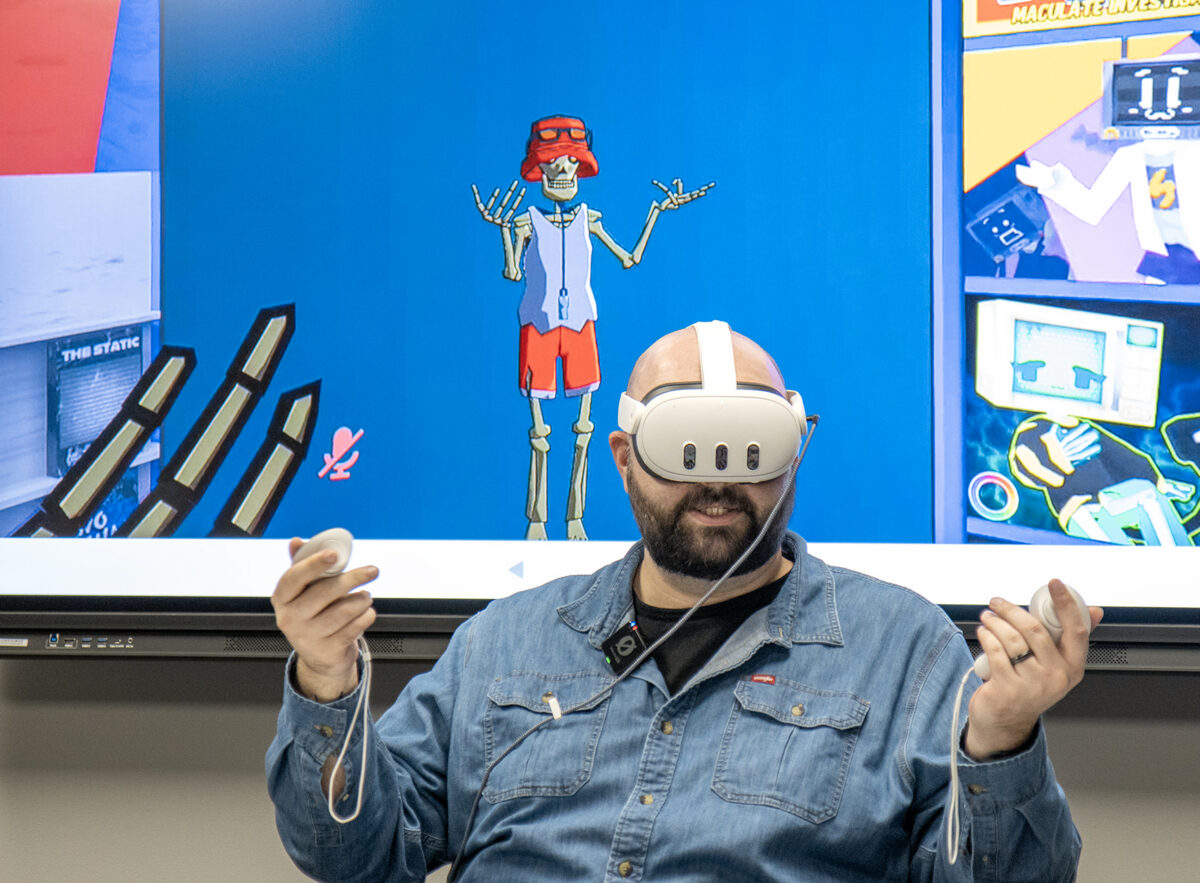
Matthew Banther lifted his VR headset and blinked at the room around him inside Calvary Church in Clearwater, Florida. This didn’t look like an average mission trip training. It looked like a group of friends hanging out, lost in their own digital universes.
Hope Café
Young adults sat staring into the middle distance while reaching out to tap at things no one else could see. At the front, a projector lit up the International Mission Board’s futuristic Hope Café floating on an asteroid. The team’s avatars milled around like regulars, ready to talk to people from other countries about the gospel without physically leaving Florida.
Virtual reality mission trips might look a little different, but the purpose is the same: take the gospel to those who haven’t heard, no matter where they are.
“This isn’t a video game. Behind every avatar is a real person that we interact with in real time,” Banther explained, sliding the headset back down to continue the training. “Get ready for a pioneering new way to reach the lost with the gospel.”
Virtual reality and missions
For the last 18 months, Calvary Church has partnered with the IMB’s Japan digital engagement team to build a strategy for sharing the gospel in virtual spaces that don’t physically exist yet attract 171 million visitors every day. With 60% of Japan’s population predicted to use some form of virtual reality daily by 2030, Daniel Rice knew his IMB team needed to reach communities that exist behind passwords and rendered 4K.
The IMB missionary living in Japan donned a VR headset and saw doors open to people they rarely met in person like the Hikikomori. In Japan, they are known as individuals who withdraw from society and spend countless hours in virtual worlds. As Rice’s team explored, they also encountered busy professionals whose only free time was spent online.
“Most Japanese adults are consumed with work,” Rice said, noting the difficulty missionaries often have in establishing relationships.
“Yet, when they get home,” he noted, “many will put on VR headsets to watch television, play games or socialize with friends. Now, through VR, we are interacting with them.”
See full story.
EDITOR’S NOTE — This story was written by Sue Sprenkle and originally published by the International Mission Board.
Share with others: