
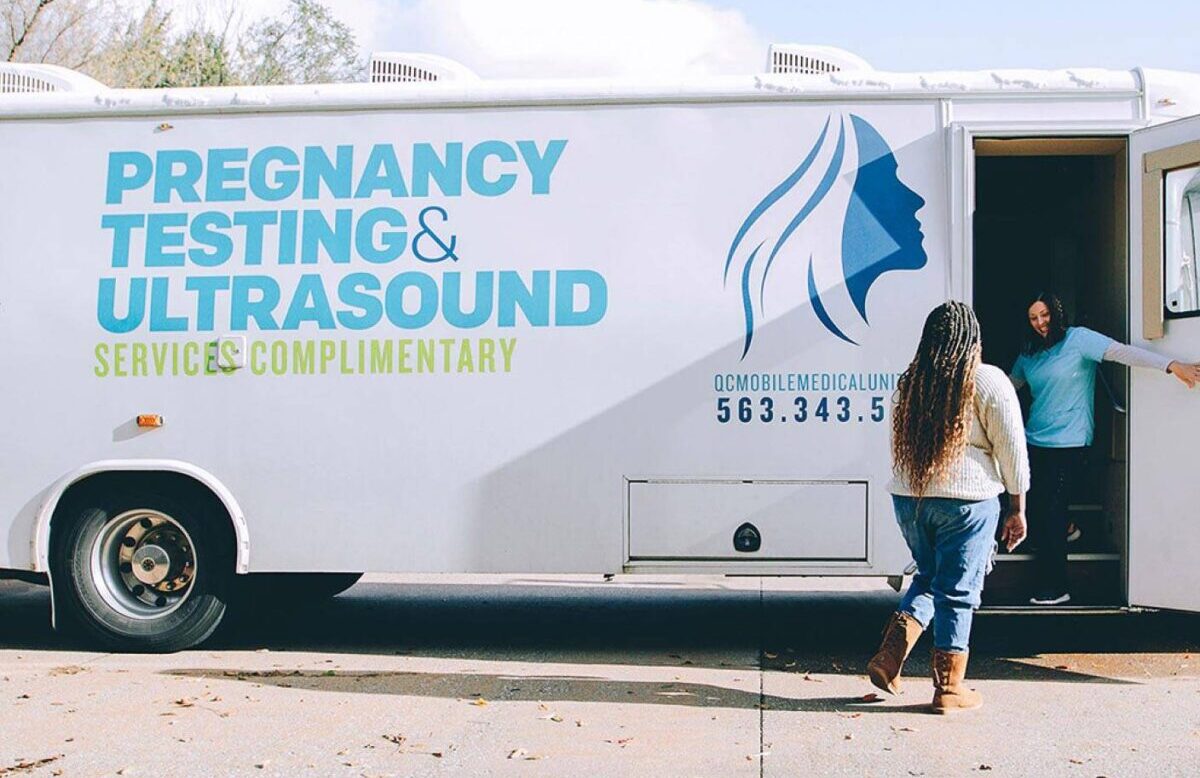
Save the Storks mobile medical clinics, or stork buses, continue providing women across the country with access to free maternity and life-affirming health care, including pregnancy testing, sexually transmitted infections testing, ultrasounds, counseling and medical referrals.
Check out more stories on medical clinics.
The 109 fully equipped vans go directly to patients, including those in maternity care deserts, where obstetrics services and maternity providers are limited, according to information provided by the organization.
Save the Storks was founded in 2012 in Colorado with its first stork bus in Pennsylvania but is now headquartered in Plano, Texas, and has mobile medical clinics available in 35 states. Alabama has two Save the Storks clinics — Demopolis and Hanceville — and a variety of other pregnancy resource centers such as Sav-A-Life scattered across the state.
‘Vessels of divine deliverance’
Save the Storks CEO Diane Ferraro said, “Sadly, 3,000 abortions are taking place each day in our country,” but four out of five women who board a stork bus will choose life.
Ferraro calls these stork buses “vessels of divine deliverance.” She said women are met with love and compassion when they step onto a bus. Patients can see their baby on an ultrasound and hear their baby’s heartbeat. As a result, the organization has saved nearly 16,000 babies.
According to Ferraro, the typical woman facing an unplanned pregnancy is no longer a teenager but a woman in her 20s who already has two or three children and does not know how to afford another child.
“We’ve been able to either come alongside them as a source of support or introduce them to one of our 15,000 resources around the United States,” she said.
Save the Storks also offers a program for expecting fathers called Dare to be a Dad. Ferraro said when a man stands with the woman and supports her, the woman will choose life 79% of the time.
Resources
The organization offers free online resources to help educate the public on abortion alternatives, as well as how to support women considering abortion. The Start Course equips Christians to better serve women experiencing unplanned pregnancies.
Ferraro also recommends sharing the organization’s social media posts to help keep the message and offers of hope in front of as many people as possible.
The stork buses intentionally park near what they describe as abortion vulnerable communities, including college campuses, Planned Parenthood facilities and strip clubs.
“We are providing services with true medical professionals to women who are worried about an unplanned pregnancy,” Ferraro said. “When it is determined that a woman is pregnant, they are invited back into the pregnancy resource center that’s local to them to get all of the support and services they need. It can be anything from free diapers and training so they are equipped to be a parent.
“[A woman experiencing an unplanned pregnancy] needs to know she’s loved and that she’s brave enough and strong enough,” Ferraro said. “She has a community that’s there behind her so she can choose life and choose it abundantly.”
Ferraro said Save the Storks also works with other pregnancy centers and churches to provide housing, child care, counseling, job training and other resources. Women also can participate in Save the Storks’ programs to earn points to receive items such as strollers, car seats and maternity clothing.
“That local mobile medical clinic is really the conduit and the first point of introduction to a woman so she can get everything she needs and all the support she needs in her community,” Ferraro said.
Even though Roe vs. Wade was overturned in 2022, Ferraro said women still see abortion as health care. She said the buses venture into urban and rural communities to meet women where they are to show them different life-affirming options, including adoption.
Ferraro encourages Christians to educate themselves and get involved with the pro-life movement, including adoption and foster care opportunities.
The Alabama Baptist Children’s Homes & Family Ministries at alabamachild.org provides foster care resources and information. Lifeline Children’s Services at lifelinechild.org assists with adoption programs.
“I was adopted as a baby. I’ve been a foster and adoptive mom,” Ferraro said. “I understand how critical the timing is before a woman chooses abortion that she understands the beauty of adoption.”
Even though abortion is technically illegal in Alabama, Ferraro said the chemical abortion or abortion pill is readily available online.
But the stork buses — as well as other pregnancy resource centers in Alabama — now offer the abortion reversal pill and some women do regret their initial decision regarding moving forward with abortion.
The love of Christ
Meredith Little, executive director of First Source for Women in Hanceville, said her organization has had a stork bus for nearly a decade. She said the mobile medical clinics allow medical staff to reach women in rural areas of Cullman County. Even if women are scared to board the bus, the center’s contact information is on the side of the vehicle so women can call or text First Source nurses 24/7 for help.
“It’s just a great outreach to be able to reach women before the abortion pill providers reach them,” Little said. “We just want to reach them first and encourage them to make a decision for life.”
As with all faith-based pregnancy resource centers, many Save the Storks staff members have experienced an unplanned pregnancy or had an abortion. Ferraro said these women often share their personal testimonies with patients when they board a stork bus.
“They are introducing them to the love of Christ,” Ferraro said. “They are providing meaningful care and support to these women.”
Similar conversations happen in Sav-a-Life centers, said Nicole Shewmake, executive director of New Day Women’s Center in Northport, which is a ministry of Sav-a-Life Tuscaloosa (SALT) and has served Tuscaloosa and surrounding counties in West Alabama for 41 years.
“Statistically, one in three women will have an abortion,” Shewmake said. “When you look within the Church, that number only moves to one in four women.”
Shewmake said many clients come to the center after they have taken the abortion pill. They want to have an ultrasound done to make sure the pill worked.
‘Scary reality’
With brick-and-mortar clinics closed in Alabama and abortion pills being shipped directly to women, there’s no way to know the exact number of abortions that are happening. Many women have abortions at home but end up in the hospital after complications arise; however, they tell doctors they experienced a miscarriage.
“The statistics on abortions at this point are going off of the sales from the manufacturers of these pills in California,” Shewmake said. “They are encouraging you to have these pills on hand in case you are to get pregnant.”
Both Little and Shewmake said they have gone on abortion pill websites, like Plan B, and said they were 12-year-old girls who think they could be pregnant. The abortion websites tell them they can ship pills directly to them or a friend’s house if they need to keep the abortion secret from their parents.
“It’s just so easy now online and it’s scary,” Little said. “It’s just a new evil that we’re fighting.”
Shewmake said it’s important to show women, who have been abandoned by their father or are planning to raise a child without a father, who their Heavenly Father is.
“We have a Heavenly Father who never leaves us and never abandons us,” Shewmake said. “Jeremiah 29:11 says He has a plan for our lives, has a plan for the babies’ lives.”
Since Tuscaloosa has a large international population because of the University of Alabama and Mercedes-Benz of Tuscaloosa, Shewmake said many international clients come to the resource center. Many families, who are introduced to the gospel through their interactions at the center, then share the gospel with others when they return to their home countries.
“The impact has the possibility to be bigger than what we could ever imagine,” Shewmake said. “The value of a child doesn’t change because of circumstances.”
Little said many of the women who reach out to First Source are Christians or attend church.
“It would be easier to ask God for forgiveness for their abortion than to ask their church for forgiveness for having sex outside of marriage,” Little said. “While that might not be their plan, this baby was God’s plan, and I just feel like if churches would say that more, maybe that would help.”
Share with others: