
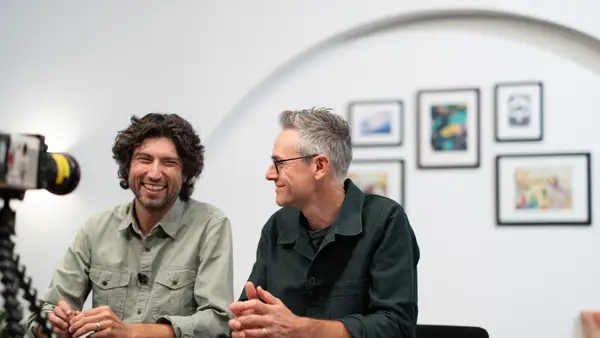
Even for those raised in church, studying the Bible can be overwhelming. Tackling this issue led Jon Collins and Tim Mackie to co-found BibleProject, an organization through which they are continually seeking to “present complex biblical themes in a way that [is] real and unapologetic but still approachable.”
Stay updated on stories like this — Get news delivered to your inbox
Steve Atkinson, CEO of BibleProject, explained it this way:
“The BibleProject’s mission is to ‘help people experience the Bible as a unified story that leads to Jesus.’
“One of our founders (Collins) grew up in a family of faith, a follower of Jesus. Yet when he looked at the Bible, he said oftentimes when he tried to read it, he would leave more confused than when he started and have more questions. So we felt like he probably wasn’t alone, that many of us that grew up in the Church wrestled with the same thing,” Atkinson said.
Although Mackie was also raised in a Christian home, he didn’t become a believer until he was older. He didn’t have “negative baggage” concerning the Bible but also had no idea what was going on beyond “the Jesus parts.”
Mackie eventually obtained a doctorate in Hebrew Bible and Jewish studies.
Collins had a very different experience.
“While Tim went on to just continue to study the Bible, I kind of hit a dead end there,” Collins said. “I kind of got to a point where I felt like I wasn’t cut out to really understand the Bible. It just became too bewildering to me.
“It’s funny; we took the same classes essentially. But I was given a pretty strict theological grid by which to understand the Bible and in a very specific kind of way that I’m supposed to engage with the Bible that I was trying to make work. I just got too frustrated. I saw other people could do it really well — and I couldn’t. I kind of was like, I’ll let the people who know what they’re doing and get it and love it figure it out, and I’ll go do something else,” Collins said.
Main goal
But Collins didn’t. Instead, with Mackie he founded a nonprofit with a main goal being to “create resources to help people understand the Bible.”
And it has. In the decade-plus time that BibleProject has been in existence, it has produced more than 180 animated videos — with total views over 620 million and 5.4 million YouTube subscribers — as well as podcast episodes, in-depth courses, study plans and a dedicated app.
Best of all, the vast majority of those resources are free.
One of BibleProject’s most unique resources is the “Read Scripture Poster Collection” book. Though the 19-by-12-inch oversized book’s material can be downloaded at no charge, it’s offered in a printed version because it’s not easy to print something that size. The diagrams are perforated so they can be easily torn out and hung on a wall.
The Protestant, theologically conservative backgrounds that Collins and Mackie have influence their approach. However, making it accessible for anyone is a top priority.
“We really are trying to create content and use language and an educational approach that tries to make very few assumptions on the viewer, and so we try to filter out religious lingo and just use normal English,” Mackie said.
This tenet not only makes BibleProject’s material more relatable to someone who didn’t grow up in church, but it also helps children understand the Bible better along with the visual, animated aspect of the videos.
One of the most important themes that the founders developed is about the image of God. Mackie’s favorite video is “Gospel of the Kingdom,” and Collins’ is “Tree of Life.”
‘Good news’
“Gospel of the Kingdom” is essentially a word study of the word “gospel.”
“But what I love about that video is it’s all about the good news announcement of a new King reigning over the world, but then the way that Jesus reigns is this inversion of all of our concepts of power and influence,” Mackie said.
Collins describes their “Tree of Life” video as “really beautiful. It’s actually technically one shot. You kind of are drawing through the world, pulling back.”
The founders recognize that it would be easy for BibleProject to replace the Bible.
“One of our convictions lately is that we don’t want it to be a substitute, and we actually want people to learn to read the Bible. Even after working on this project for nearly a decade now, it’s still hard for me to open the Bible and not feel lost or overwhelmed,” Collins said during a 2022 interview.
‘One unified story’
“Basically, our goal was, what is the Bible on its own terms? It’s a cross-cultural document. It’s ancient Israelite literature. It comes from a different time and place and language. But when you understand it on its own terms, it’s actually beautiful,” Mackie said.
“It’s aesthetically sophisticated, and it really is telling one unified story in ways that many Christian traditions haven’t fully explored or at least have forgotten,” he continued. “And so that’s kind of our core idea is we want to help people learn how to read this literature, how to understand the bigger story and how it all leads to Jesus and what it means to follow Jesus in light of that.
“I think it’s the most beautiful collection of texts that one could ever give your life to try and understand because we think they point to a Person who is singular and unique, the risen Jesus.”
To learn more about BibleProject and to access its resources, go to www.bibleproject.com.



Share with others: