
A hush gripped the sanctuary. A moment of contemplation kept Alabama Baptists silent and still until they erupted into a standing ovation.
It was the Tuesday afternoon session of the Alabama Baptist State Evangelism Conference, and Steve Gaines, pastor of Bellevue Baptist Church, Cordova, Tenn., returned to the state to participate in the conference.
Gaines, former pastor of Gardendale’s First Baptist Church, concluded his sermon about achieving a successful journey in the ministry by singing a cappella, which left the crowd spellbound.
A little more than an hour later, the same group of Baptists were whooping and hollering in support of Bob Pitman’s passionate presentation of salvation through grace in Jesus Christ as he defined evangelism.
Gaines and Pitman, pastor of Kirby Woods Baptist Church, Memphis, Tenn., were two of nine pastors and Baptist leaders preaching during the morning and afternoon sessions of the Evangelism Conference. The conference, which took place Jan. 23–24, was held at Dauphin Way Baptist Church, Mobile.
Preaching from Genesis 24, Gaines encouraged pastors to stay the course in ministry and pointed to keys for a successful journey:
• First, be a person of submission, he said.
“We live in a day where the cry is to question authority,” Gaines said, noting the importance to submit to the authority of God. “You will never be over what God wants you to be over until you are willing to be under what God wants you to be under.”
Gaines also said to submit to governmental authority, pastoral authority, a wife to her husband’s leadership and children to parental authority.
• Second, be a person of prayer, he said.
“You cannot have a successful journey and not spend time in prayer,” Gaines said. “A day without prayer is a wasted day.”
In fact, the disciples only asked Jesus to teach them one thing — to pray — Gaines pointed out.
“If you are a preacher, make prayer the priority of your life and make preaching the priority of your ministry,” he said.
• Third, be a person of worship, Gaines said. “Offer your heart up to God.
“When you’ve been in a worship service and have experienced the presence of Jesus, you will never be the same,” Gaines said.
• Fourth, be a person of focus, he said.
“My job is to let Jesus fill me and then He can fill the church,” Gaines said. “Focus on Him.”
• Fifth, be a person of completion, he said. “Run to the very end.
“Unless God has given you a release from the ministry you have, don’t quit,” Gaines said. “You and I need to complete the journey and do it well.”
Part of the journey includes evangelism, which was the focus of Pitman’s sermon.
“There seems to be a confusion today of what evangelism means,” he said. But it is basically “about getting lost people to become saved people.”
Preaching from Romans 3:21, Pitman explained what salvation means.
First, salvation means righteousness, he said.
“Righteousness carries us into the very throne room of heaven, into the heaven of heavens,” Pitman said. “Salvation has nothing to do with self-righteousness.”
Second, salvation means justified.
“The fact is we are guilty before God … but (if you are saved) you have been declared innocent, cleared of all guilt,” he said.
Third, salvation means redemption, Pitman said.
“Jesus, by the shedding of His blood, paid the price for my sin,” he said. “I am bought with a price.”
Fourth, salvation means propitiation, Pitman said. “Jesus Christ is our propitiation.”
Fifth, salvation means remission, he noted. “It means a passing over.
“All of the deeds I have ever committed are on … record,” Pitman said. “Lost people will be judged out of those things on record. Every sin I committed before I was saved is still written in that book, but when God comes to my name, He just passes over. He does not execute judgment on me.
“Jesus Christ took my place on the cross,” he said. “God poured out all His wrath against me on His son. That’s what it means to be saved.”
Along with the meaning of salvation, Pitman described the method and motive of salvation.
“My salvation is not determined by my keeping rules,” he said. “It is by faith of or in Jesus Christ.
“It is free but that doesn’t mean it is cheap,” Pitman noted.
“All man has ever done is break God’s heart and challenged His heart but He still loves us,” he said. “We are saved by grace … sustained by grace … encouraged by grace. That’s why God saved us, not because we are warm, cute, lovable and fuzzy.”
Dusty McLemore, pastor of Lindsay Lane Baptist Church, Athens, knows firsthand that evangelism works.
He explained that in his mid-20s, he found himself buried in gambling debts and contemplating suicide, but an intentional evangelistic visit by a local pastor a few years earlier changed his life.
“I never got over that visit,” McLemore said as he encouraged Alabama Baptists to meet people where they are.
“God had a plan for my life,” he said. “It was not at a church house, not at a revival; it was one-on-one evangelism.”
Preaching from Acts 8, McLemore gave three examples of what a soul winner looks like.
First, a soul winner is connected to the Spirit, he said.
“God uses us as His instruments to win others to Christ,” McLemore said, noting Philip was sensitive to the leading of the Holy Spirit.
“If we are not careful, we can be more connected to ourselves than we are to Jesus,” he noted. “We can be more connected to our programs, our projects, our plans and our personal responsibilities than God’s presence and power.
“When God shows up and the Holy Spirit gets a hold of us, things won’t make sense to us,” McLemore said.
Second, a soul winner is confident in the Scriptures, he said.
“Always be ready to give an answer to anyone who asks about the hope that is in us,” McLemore noted. “Thus saith the Lord — that’s all I have to stand on.”
Third, a soul winner is convinced of the Savior, he said.
“Philip took this ol’ boy (the Ethiopian eunuch) where he was and led him to where he needed to be,” McLemore said. “If we are going to impact the kingdom of God, we’ve got to do it one soul at a time.”
Mike Satterfield, pastor of The Church at Shelby Crossings, Pelham, challenged Alabama Baptists to stay true to their evangelistic calling.
Preaching from Matthew 16:13–18, he pointed out that the call is personal, powerful, purposeful and positional.
“The world is not evangelized because … they see us becoming so corporate that we look very little like Christ,” Satterfield explained.
“We look too much like the world,” he said. “The challenge is not ours; it is His through us.
“Faith comes by hearing and hearing by the Word,” Satterfield said. “How can they believe unless they have heard from you, and how can they hear unless the preacher shows up?”
He encouraged those attending the Monday afternoon session of the conference to share Jesus all the time. “We wait till we get to the sanctuary and assemble before we get busy,” Satterfield said. “God says, ‘Everywhere is my sanctuary.’
“Why do we spend so much time painting the barn if the fields are ripe for the harvest?”
Doug Chappelle, pastor of Valley Grande Baptist Church, Valley Grande, preached a related message as he reminded Alabama Baptists that “we’ve got to love people, and we’ve got to keep preaching the Word and preaching the truth.”
“As followers of Jesus Christ, we are set apart for a mission,” Chappelle said.
Preaching from Amos 7, he pointed to Amos’ experiences as examples of how to live a life of Intentional Evangelism.
First, God is looking for a man who is well suited for the task, he said. “When God calls you, you better walk away from it and walk into the place God has called you.”
Amos knew who called him, where he was sent and what he was supposed to do, Chappelle said. “God gave him clear direction.”
Second, God is looking for a people well fed, he said.
“The greatest danger is getting to a place where we can no longer hear the voice of God,” Chappelle said. “If we are not careful, no matter how hard we listen, we won’t hear.”
Noting that churches have more resources, programs and staff than ever before, he said churches are still in danger of “spiritual anorexia.”
“We need to be nourished, built up and fortified in the spirit,” Chappelle said.
Third, God’s redemptive plan lies ahead of us.
Although God announced judgment on Israel, He also says in Amos 9:14 that he will “restore the captivity of my people Israel and they will rebuild.”
“God has made a promise,” Chappelle said. “God will bring His purpose of perfect redemption to mankind. God’s got a plan.
“Let’s be faithful and carry the Word.”
David Joyner, pastor First Baptist Church, Scottsboro, focused his sermon on pastors, reminding them that they must spend time in prayer and preparing before preaching.
“Take your preaching seriously,” he said. “Don’t mount the pulpit on a whim. Spend time with God preparing yourself.
“I fear that in many pulpits today ‘Thus saith the Lord’ has been replaced with ‘Thus printed the Internet,’” Joyner said.
Preaching from Romans 10 and using Paul as the model soul winner, he said Paul loved lost souls like he did because:
1. It was a call from above. “God calls men personally,” Joyner said. “What are you all about? Can you say that your all-consuming desire is that they might be saved?”
2. God calls ministries collectively. “Worship precedes work,” he explained. “Before being successful in talking to men about God, we have to talk to God.”
3. Paul was keenly aware of what awaits those who die without Jesus. “People need to know that there is a hell,” Joyner said.
Robert White, executive director of the Georgia Baptist Convention, developed the qualities of a healthy church by focusing on Acts 2.
“More than ever before, we need a healthy church,” he said. “Our world will not be won with an anemic church, but one that is on fire for Jesus Christ.”
White, who grew up at First Baptist Church, Montgomery, and is a graduate of Birmingham’s Samford University, said, “We have to go back 2,000 years and find what it was about that early church that made it such a successful church.”
Noting that the church started with 120 members and moved quickly to a church with thousands of members, he said the first quality of the church was its unity. “It had a singleness of heart,” White said. “There is not a more beautiful quality for the church than unity.”
The second quality of a healthy church is the spirit of the living God, he said. “You cannot dissect the Lord Jesus Christ. All of Him comes in at once, and He comes in to stay,” White said. “Sometimes a believer in the experience of growth feels like he is getting more of the Holy Spirit when in reality the Holy Spirit is getting more of him.”
The third quality of a healthy church is a steadfast commitment, he said.
“The crux of the matter is the cross,” White said. “It must be the center of everything that we are and everything that we preach.”
The fourth quality of a healthy church is being steadfast in evangelism, he said. “Jesus Christ has sent us to declare His Word.”
Don Wilton, pastor of First Baptist Church, Spartanburg, S.C., also focused on the health of the church.
“All is not well in the local church,” he said. “It is time to face that reality. Thousands in our denomination feel disenfranchised or disillusioned.
“There are many of our churches that year by year don’t even baptize one person,” Wilton noted. “The time has come for us to re-evaluate and realign ourselves and come to a fresh understanding for all that God has called us to do.”
Preaching from Romans 3, he pointed out “the dangers of an unconverted church member.”
An unconverted man is:
• Totally unrighteous.
• Spiritually ignorant.
• Willfully rebellious.
• Naturally wayward.
• Scripturally worthless.
• Morally corrupt.
“My responsibility as a pastor is to lead my people to the Lord Jesus Christ,” Wilton said.
Perry Sanders, senior pastor of First Baptist Church, Lafayette, La., ended up being the comedian among the preachers. He managed to garner a roar of laughter every few minutes from those attending the Tuesday morning session.
But even with his humorous delivery, Sanders’ message was nothing but serious.
Preaching from Acts 17:1–6, he explored what it would be like for a person or church to be accused of “turning the world upside down.” And Sanders suggested that this type of thinking could turn around the stagnant growth rate among Southern Baptist churches.
He said the kind of people that turn the world upside down:
1. Must have been turned upside down themselves by Christ
Himself.
2. Are willing to sacrifice.
3. Are set on fire with a passion for lost souls.
“Sometimes we just don’t have that concern,” Sanders said. “We do other things we think are more important.”
4. Are filled with the Holy Spirit.
He also described the kind of message required to “turn the world upside down.”
The message is biblical, bloody and victorious, Sanders said.
“People not only need to hear but they want to hear the word of God,” he said.
“I would love to be known as the one who is trying to turn the world upside down.”

Lakeview Baptist in Auburn hosting women’s conference Aug. 1–2
Author Rosaria Butterfield will be the featured speaker, sharing her conversion experience to Christ and teaching from her book “Five Lies of our Anti-Christian Age.”
Henagar Baptist hosting women’s conference Aug. 9
The theme, Rooted in His Love, is based on Ephesians 3:14–21. Guest speakers include Jo Carwile, Missy Lundy, Pam Atcheson, Candace McIntosh and Julie Boyd.
Southern Baptist Convention VP to speak at North Shelby Baptist Church
North Shelby Baptist Church in Birmingham will host Lee Brand, first vice president of the Southern Baptist Convention, on Aug.
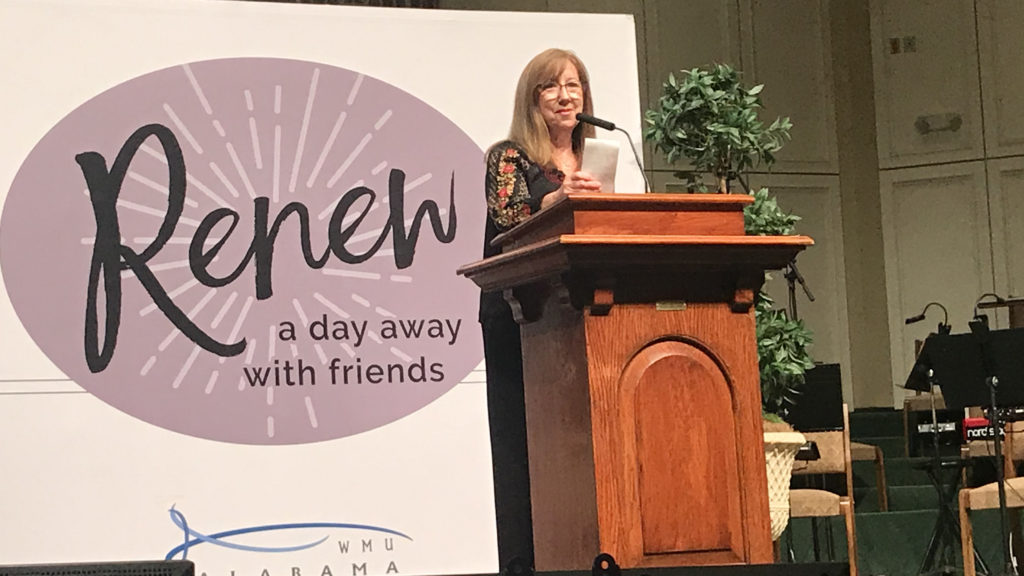
Renew 2021 encourages joy in the journey
After a year of virtual conferences and a few canceled events, women from across Alabama gathered in person on April
Share with others: