
After more than three decades of using Roe v. Wade as a platform, abortion advocates may have nothing left but a wobbly leg to stand on, according to pro-choice and pro-life activists alike.
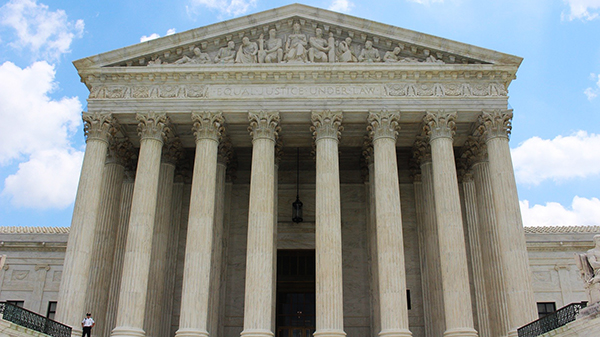
A sharply divided Supreme Court did April 18 exactly what many pro-lifers hoped — and what many abortion advocates feared. The majority upheld a federal ban on a procedure known as partial-birth abortion — the first time the court has done so on a specific abortion procedure.
The court’s previous abortion jurisprudence — including the landmark 1973 Roe v. Wade decision that first legalized abortion nationwide by declaring it constitutionally protected under a woman’s right to privacy— had required any restrictions on abortion to include exceptions for the mother’s life and health.
But this ban — Partial-birth Abortion Ban Act — though it includes a provision for the mother’s life includes no allowances for health issues that are not life-threatening. Past rulings have left gaping loopholes for “health-related” abortions.
Associate Justice Anthony Kennedy, who affirmed the court’s Roe v. Wade opinion in a crucial 1992 ruling, wrote in the majority opinion that the ban does not infringe on the right to abortion declared previously by the high court.
But Associate Justice Ruth Bader Ginsburg sharply disagreed, acknowledging in her dissent that the decision “does not go so far as to discard Roe or Casey (in 1992)” but it is “hardly faithful” to principles spelled out by the high court in the past.
“Congress imposed a ban despite our clear prior holdings that the State cannot proscribe an abortion procedure when its use is necessary to protect a woman’s health,” she said.
For pro-lifers, it was seen as a major victory over a deeply entrenched past precedent.
“With today’s Supreme Court decision, it is just a matter of time before the infamous Roe v. Wade decision in 1973 will also be struck down by the court,” said a press statement from Roberta Combs, president of the Christian Coalition of America.
James Tonkowich, president of the Institute on Religion and Democracy, agreed that the newest ruling begins chipping away at Roe.
“Roe is no longer the dictator over the Supreme Court,” he said in a press statement. “This is a landmark ruling that slams the breaks on infanticide and the devaluing of human life.”
Nancy Keenan, president of NARAL Pro-Choice America, agreed that the ruling could diminish Roe’s potency in protecting abortion rights.
“Today’s decision shows Bush’s appointees have moved the court in a direction that could further undermine Roe v. Wade and protections for women’s health,” Keenan said. “We need to elect more pro-choice members of Congress and a president who will stand up for — not attack — our fundamental values of freedom and privacy.”
President Bush’s election and influence on the ban may end up proving pivotal in the struggle over legalized abortion, Keenan added.
Congress approved the ban in 2003 with a 64–34 vote in the Senate and a 281–142 vote in the House of Representatives. Congress had twice adopted partial-birth abortion bans in the 1990s only to have President Clinton veto them.
In both 1996 and 1998, the House achieved the two-thirds majorities necessary to override vetoes but the Senate fell short.
After Bush signed the bill into law in November 2003, abortion rights organizations quickly challenged it in three courts and blocked its enforcement.
Federal judges in New York City, San Francisco and Lincoln, Neb., struck down the law.
Three-judge panels in the 9th Circuit based in San Francisco, 8th Circuit based in St. Louis and 2nd Circuit based in New York upheld the lower court decisions.
Then, when the issue reached the Supreme Court, once again — because of Bush’s appointees — things were different.
Bush’s re-election in 2004 enabled him to nominate John Roberts to replace the late Chief Justice William Rehnquist and Samuel Alito to take the seat of Associate Justice Sandra Day O’Connor upon her retirement, both in 2005.
Alito’s presence on the court made the difference in the ruling — he, along with Roberts, voted in the majority — since O’Connor had voted to strike down a similar state law in a 5–4 decision in 2000.
Bush said he was pleased with the ruling, calling it an “affirmation of the progress we have made over the past six years in protecting human dignity and upholding the sanctity of life.”
“We will continue to work for the day when every child is welcomed in life and protected in law,” he said.
Richard Land, head of the Southern Baptist Convention’s Ethics & Religious Liberty Commission, said, “This is a great day for justice. This is a great day for the unborn. And this is a great day for America.”
The Partial-birth Abortion Ban Act bars a procedure in which, as typically used, an intact baby is delivered feet first until only the head is left in the birth canal.
The doctor pierces the base of the infant’s skull with surgical scissors before inserting a catheter into the opening and suctioning out the brain, killing the baby. The technique provides for easier removal of the baby’s head. (ABP, BP)


Share with others: