
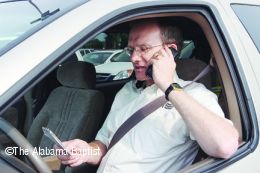
It’s another early morning for Bill Barker in the Appalachian Mountains of West Virginia.
He leaves home earlier than usual in his brown Toyota minivan, which suddenly tops a mountain crest.
He pulls off the road to talk to God.
"I look out across the mountains as the morning mist and fog begin to lift," he said. "You can still see the green valleys below filled with fog.
"It’s such a beautiful sight. I stand there and pray, ‘Lord, please send revival and fill these mountains again with Your glory even as You fill these valleys with the morning mist.’"
Born in Charleston, W. Va., Barker, a North American Mission Board (NAMB) missionary, grew up in the state’s rugged coal–mining country but left in 1969 with plans to never return.
But it was a higher calling — from God Himself — that told Barker seven years ago that he should "go home" to West Virginia after a 32-year absence.
As a native Appalachian, Barker believes he is uniquely qualified for his current post, director of Appalachian Regional Ministry (ARM). ARM is a partnership ministry of the NAMB, the Woman’s Missionary Union and 11 state conventions.
"I’m uniquely qualified for this work because not only am I a native of Appalachia, but over these past 32 years, God has been preparing me to come back and minister in West Virginia — first as a bivocational pastor working out in the secular market as a marketing rep for the Coca-Cola Bottling Co., in management for a grocery firm and later in the insurance business," he said.
"Through all this, God was preparing me for what I’m doing today."
As head of ARM — based in Hurricane, W. Va. — he directs a Southern Baptist organization that responds to the physical and spiritual needs of the people of Appalachia.
ARM’s main role is to share Christ with Barker’s people — the people of Appalachia.
Appalachia is a very diverse region of the United States, Barker said.
The north Georgia mountains include people who are transplants from Florida, south Georgia and Alabama.
But as you move into the coal-field areas of central and northern Appalachia, you come across people whose families have lived there for generations.
They’re isolated by the geography, mountainous terrain and profound poverty of the area. Only 26 percent of central Appalachians have local access to the Internet, according to Barker.
"Our people here are very good people," Barker said. "They’re quiet, loving and kind people. Religion is still a big part of their lives. It’s mountain religion. They love to sing and they love to make music. They are a very artistic people. They love to draw, carve and create with their hands."
At the same time, Barker believes Appalachian churches — the ones still open — can be overly legalistic and emphasize a "saved-by-works" religion instead of salvation by God’s grace.
He said locals tend to believe that people are saved by what they do or don’t do, by dressing a certain way or by using a certain Bible translation.
"As Southern Baptists, we have a wonderful opportunity to take the gospel of Jesus Christ into the mountains of Appalachia and tell them God loves them, Christ died for them and they’re saved by grace through faith, not by works, lest any many should boast," Barker said, paraphrasing the apostle Paul.
Working to share Jesus in Appalachia means ministering to millions of people without Christ and to the poorest of America’s poor.
"Within Appalachia, we have 37 of the 100 poorest counties in America," Barker said.
"Twenty-nine of those counties exist in eastern Kentucky, where 38 percent of adults lack either a high school diploma or a GED equivalent."
Calling the lostness of Appalachia "overwhelming," he said, "Within the 10-state region I cover, there are 13 million-plus unchurched men, women, boys and girls."
And although Appalachia has churches around every bend in every little mountain hamlet, overall church attendance is down, he said. Many churches have closed.
"Seventy percent of the Appalachian Mountain people are unchurched. In West Virginia, there’s one Southern Baptist church for every 7,200 unchurched persons," Barker said. "If I go over into Portsmouth, Ohio, I’m in an area that has only one Southern Baptist church for every 16,000 unchurched persons.
"If I drive up to the Pittsburgh area, I’m in an area with more unchurched persons than in the entire state of South Carolina or Kentucky, or twice the number in West Virginia.
"In the Pittsburgh area, there’s only one Southern Baptist church for every 61,000 unchurched persons."
Barker said he recruits volunteers to minister on several different levels.
"On one hand, we do ministry that involves cultivation evangelism," he explained. "Volunteers come in and hold backyard Bible clubs, run Vacation Bible Schools, distribute the ‘Jesus’ video, conduct block parties and a host of other things.
"Sometimes we work with our resort missionaries who are involved in resort ministries. Or maybe we work with a church planter to help plant new churches," Barker said. "We also work with church construction or renovation.
"But our ultimate goal is to reach people with the gospel of Jesus Christ." (NAMB)
Share with others: